$10K/Month VA" Instagram Myth vs. What Hiring Actually Delivers

Choosing between the promise of a “$10K/month VA” and the reality of hiring support is one of the most common decisions small businesses face. Social media loves a big number. Operations leaders care about something more useful: a clearer workflow, fewer dropped tasks and more owner time for growth.
This guide breaks down the “$10K/month VA” myth, explains what a Virtual Assistant actually delivers, and shows you how to measure value without relying on vanity claims. It includes a simple VALUE pilot framework you can use to test a VA role in 30 days.
The “$10K/Month VA” Instagram Myth vs. What Hiring Actually Delivers
The promise is a number. The value is a better-run business.
Scroll through enough business content and you will eventually meet the “$10K-a-month VA.”
Sometimes the claim is aimed at people who want to become a Virtual Assistant: buy the course, package a premium service and reach five figures quickly. Sometimes it is aimed at business owners: hire support, recover your time and unlock another $10,000 in monthly revenue.
Those are different propositions, but social media often compresses them into the same attractive story. A simple hire appears to produce a simple number.
Real operations do not work that way.
A skilled Virtual Assistant can remove recurring work from an owner’s day, keep important processes moving, shorten administrative delays and make follow-up more consistent. Those improvements may support revenue, retention and capacity. But a VA cannot guarantee demand, product–market fit, pricing, margin, sales skill or the decisions the owner makes with the time they get back.
The short answer: hiring a VA is an investment in execution capacity and operational reliability — not a guaranteed revenue event. Measure the workflow the VA owns first. Then trace how that improvement contributes to business results.
That distinction is not less exciting. It is more useful, because it tells you what to buy, what to manage and how to know whether the relationship is working.
For a broader view of staffing models, see Virtual Assistant vs Freelancer vs Agency and Virtual Assistant vs Employee.
First, What Exactly Is the “$10K/Month VA” Myth?
There is nothing inherently impossible about a VA business generating $10,000 in monthly revenue. A specialist may serve several clients, lead a team, sell retainers or provide high-value technical and operational services. Revenue, however, is not take-home pay. It says nothing about expenses, subcontractor costs, taxes, workload, client concentration or how long the business took to build.
Likewise, a company might eventually connect delegated work to more than $10,000 in monthly value. A VA may protect a high-value sales pipeline, improve customer continuity or release an owner to close more business. But that outcome depends on the starting business, the delegated workflow, the volume moving through it, the quality of the offer and what happens next.
The myth is not that a five-figure result can never happen. The myth is that the number is:
- typical without context;
- fast without a learning curve;
- attributable to one hire alone;
- equivalent to profit;
- guaranteed by a job title;
- evidence that every buyer should expect the same outcome.
That is why a screenshot is not a business case. It usually omits the baseline, time period, costs, attribution method and the many other factors behind the result.
If you’re exploring what to delegate first, see What Every Entrepreneur Should Outsource First.
Why the Claim Spreads So Well on Instagram

A dramatic outcome fits a short video. The operating conditions behind it usually do not.
An earnings number is concrete, emotional and easy to remember. Operational value is distributed across smaller improvements: a lead contacted on time, an inbox cleared, a customer updated before they complain, a meeting prepared properly and an owner who finishes the day without two hours of catch-up.
The platform rewards the first story. The business benefits from the second.
Current advertising guidance reflects the risk of presenting exceptional outcomes as ordinary ones. In March 2026, the U.S. Federal Trade Commission announced a proposed settlement in a case involving claims about business growth and earnings potential; the proposed order included restrictions on making earnings claims without adequate substantiation or disclosure. The case was not about Virtual Assistants, but it is a useful reminder that dramatic business-growth claims require evidence and context. (Federal Trade Commission)
UK guidance is similarly direct. In May 2026, the Committee of Advertising Practice advised that business-opportunity earnings claims should reflect what an average respondent is likely to attain, not a small group of unrepresentative high performers. (ASA/CAP)
This article is not legal advice, and not every social post is a regulated business-opportunity advertisement. The practical buyer lesson is simpler: the more precise the promise, the more specific the proof should be.
Ask: Whose result was it? Over what period? Revenue or profit? What was the baseline? What else changed? Can a normal buyer reproduce the conditions?
If those answers are missing, treat the number as marketing — not a forecast.
What a Virtual Assistant Actually Delivers
The U.S. Bureau of Labor Statistics describes administrative-assistant work as including scheduling, preparing documents and reports, maintaining databases and filing systems, supporting communications and performing basic bookkeeping. It also notes that some administrative assistants work from home as Virtual Assistants. (U.S. Bureau of Labor Statistics)
Modern VA scopes often go further. Depending on experience, access and training, a VA may own defined workflows in customer support, sales administration, e-commerce operations, marketing coordination, executive support, bookkeeping preparation or website administration.
The output is not “more money” in the abstract. It is completed work with a service standard.
For a long list of concrete examples, see 50 Tasks to Delegate to a Virtual Assistant.
| Workflow | What the VA can deliver | Honest measures |
|---|---|---|
| Inbox and calendar | Triage, approved replies, scheduling, meeting preparation | Backlog, response time, conflicts prevented, requests resolved |
| Sales administration | Lead capture, CRM hygiene, follow-up tasks, proposal coordination | Leads logged, next actions present, follow-up completed, ageing |
| Customer support | First response, routine resolution, routing and escalation | First-response time, open cases, resolution rate, escalations |
| E-commerce operations | Order checks, status updates, returns administration, catalogue maintenance | Queue size, processing time, error rate, overdue cases |
| Marketing coordination | Content calendar, asset collection, publishing, reporting preparation | On-time publication, approval delays, missing assets, cadence |
| Bookkeeping support | Receipt collection, invoice preparation, categorisation support, follow-up | Missing documents, overdue invoices, close-readiness, corrections |
| Executive support | Agenda preparation, travel research, reminders, decision follow-through | Preparation completed, actions captured, scheduling lead time |
These measures are less glamorous than a five-figure promise. They are also closer to the work and easier to verify.
To understand typical pricing in the U.S., see How Much Does a Virtual Assistant Cost in the USA in 2026?.
Control, Influence and Outcome: The Attribution Test
Before setting a target, put it into one of three layers.
1. The VA controls
These are actions the VA can complete when the process, access and authority are clear:
- entering every qualified lead into the CRM;
- sending the approved follow-up sequence on schedule;
- responding to routine customer requests within the service window;
- preparing a weekly pipeline or operations report;
- publishing approved content at the planned time;
- escalating defined exceptions with the required context.
Performance can reasonably be attributed to the VA here.
For a deep dive on one high-impact workflow, see Virtual Assistant Lead Follow-Up.
2. The VA influences
These results depend partly on the quality and consistency of the support:
- faster lead response;
- fewer missed follow-ups;
- better customer continuity;
- more complete sales records;
- a shorter order or approval cycle;
- more owner time available for selling, strategy or delivery.
The VA may contribute meaningfully, but other people and systems also affect the result.
3. The business controls
These are outcomes a VA cannot responsibly guarantee:
- market demand;
- offer strength and pricing;
- close rate and sales judgment;
- gross margin and cash conversion;
- product quality;
- the owner’s use of released time;
- the economy, seasonality and competitive conditions.
If a company generates no qualified leads, immaculate CRM administration will not manufacture demand. If the owner uses ten recovered hours to return to low-value tasks, the hire cannot force strategic reinvestment. If the offer is uncompetitive, faster follow-up may reveal the problem without fixing it.
This is why “increase monthly revenue by $10,000” is usually a poor first VA KPI. It is too far downstream and too dependent on factors outside the role.
The Real Value Equation

The value appears when routine work moves reliably without repeatedly returning to the owner.
Do not reduce every benefit to a speculative hourly calculation. Use a broader value model:
VA value = time released + missed work prevented + cycle time reduced + service continuity + process visibility − (onboarding + management + rework cost)
This is a thinking tool, not an accounting formula. Some inputs can be valued in dollars; others should remain operational measures until the evidence is strong enough.
Time released
Count only time that genuinely leaves the owner’s workload. If a two-hour task becomes one hour of briefing and one hour of checking, capacity has not yet been released.
Then record how the owner uses the recovered time. Ten hours spent on qualified sales conversations has a different potential value from ten hours absorbed by new low-priority admin.
Missed work prevented
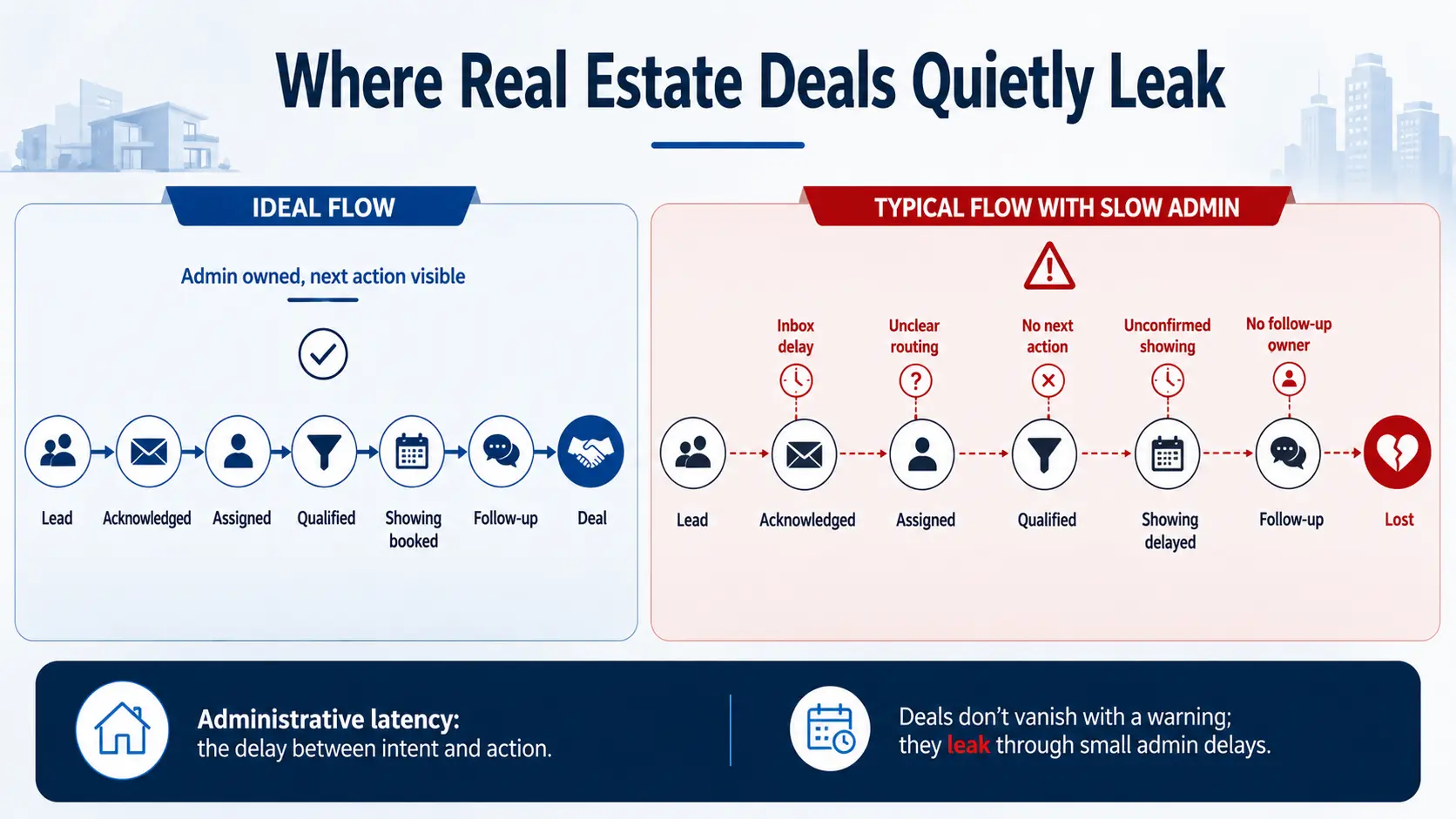
Unanswered leads, forgotten renewals, overdue invoices and unresolved customer requests create leakage. A reliable workflow can reduce that risk even when no single prevented loss can be proved.
Track the observable proxy: overdue items, leads without next actions, appointments not confirmed or cases sitting beyond the service standard.
Cycle time reduced
Faster is valuable when delay blocks the next business action. Measure the time from request to first response, lead receipt to first touch, approved content to publication or completed service to invoice preparation.
Service continuity
An owner-led process often stops when the owner is selling, travelling or delivering client work. A VA can keep the normal path moving and surface only the exceptions.
Process visibility
A maintained CRM, current task board or concise weekly report gives the business a clearer picture of what is happening. Visibility improves decisions before it improves a financial statement.
Onboarding, management and rework cost
A responsible calculation includes the other side. Add the time required to document the workflow, grant access safely, review early examples, answer new questions and correct avoidable errors. These costs should usually decline as the lane stabilises. If they do not, diagnose the scope, system or fit.
For a related decision framework, see Automate, Delegate, or Do It Yourself?.
A Worked Example Without Fantasy Arithmetic
Imagine a small B2B service firm receiving 60 enquiries each month.
Before hiring, some leads wait two business days for a reply. CRM notes are incomplete and follow-up depends on the founder’s memory. The founder estimates eight hours a week are spent sorting messages, updating records and deciding what to chase.
The business assigns a VA one defined workflow: log every qualified enquiry, send an approved acknowledgement, create the next action, prepare the relevant scheduling link and escalate high-value or unusual requests.
After 30 days, suppose the records show:
- all 60 enquiries were logged;
- 55 received the approved first response within the agreed window;
- 58 had a dated next action;
- the open follow-up queue fell from 21 to 6;
- founder administration fell from eight hours to three hours a week;
- the founder used the released time for sales calls and proposal reviews.
Those are defensible operational results.
Now suppose the business also closed two extra deals. It may be reasonable to say the improved workflow contributed to the result if those deals came through the managed process. It would still be careless to claim the VA alone “generated” the full revenue. The offer, salesperson, lead source, timing and client decision all mattered.
Attribution should become stronger as evidence accumulates. Compare several normal periods, account for seasonality and inspect the path of the affected opportunities. Do not turn one good month into a universal promise.
The VALUE Method for a 30-Day VA Pilot

A useful pilot starts with a baseline, a defined lane and measures close to the work.
Use the VALUE method to test support without relying on vanity claims.
V – Verify the baseline
Choose one recurring workflow and measure its current state for a normal week or month.
Record volume, backlog, turnaround time, owner time, errors and exceptions. If there is no baseline, an improvement claim becomes a feeling.
A – Assign an owned workflow
Delegate a complete lane, not scattered spare tasks.
“Help with sales” is vague. “Maintain every inbound lead from receipt through booked call or documented close reason” creates ownership. Define the normal path, system of record, permitted actions and escalation conditions.
L – Link the work to a business outcome
Write one sentence explaining why the workflow matters.
For example: “Consistent lead administration should reduce missed follow-up and give the founder more time for qualified conversations.” This is a contribution hypothesis, not a guarantee.
U – Use leading indicators
Select three to five measures the VA can control or strongly influence. Review them weekly.
Do not bury the relationship under 20 metrics. A sales-admin pilot might use lead capture completeness, time to first approved response, percentage with a dated next action, aged follow-ups and owner hours returned.
E – Evaluate after enough volume and time
At the end of the pilot, compare the baseline with the current state. Ask:
- Did the workflow become more reliable?
- Did owner involvement decrease after calibration?
- Were risk and quality standards maintained?
- Did the improvement create useful capacity or reduce leakage?
- Is the next 30-day scope clear?
A quiet, repeatable win is a better foundation than a dramatic but unrepeatable week.
If you’re deciding between staffing models, see How to Scale a Business Without Hiring Full-Time Staff.
Questions to Ask Anyone Promising a Revenue Result
When a provider, coach or creator connects a VA hire to a specific financial outcome, ask for the conditions behind the claim.
- Is the figure revenue, gross profit, net profit or owner income?
- Is it a typical result, an average, a median or a selected case?
- How many customers are represented?
- What period does the figure cover?
- What was the business baseline?
- What did the VA actually own?
- Which other changes happened at the same time?
- Does the calculation include hiring, software, management and rework costs?
- Can the provider explain the attribution method?
- Is the result guaranteed in the contract, or merely suggested in marketing?
Vague answers do not prove bad intent. They do mean the number should not drive your buying decision.
What a Good VA Provider Should Promise Instead
A credible provider can make commitments about its process, scope and standards. Depending on the service, those may include:
- how candidates are vetted and matched;
- which capabilities have been assessed;
- how the workflow and service level will be defined;
- how access, confidentiality and escalation will be handled;
- when the VA will be available;
- how quality and communication will be reviewed;
- what happens if the match is not right.
What it should not do is guarantee a business result it cannot control.
At Ellite Assistant, the productive starting question is not “How quickly can this person make me $10K?” It is “Which recurring workflow should stop depending on me, and what will better performance look like?”
That question leads to a scope you can test. For step-by-step guidance, see How to Hire a Virtual Assistant and Hire a Virtual Assistant for Small Business.
When a VA Is — and Is Not — the Right Investment
Hiring support is a strong option when work is recurring, transferable and important enough to need consistent ownership. It is especially useful when the owner is repeatedly performing administrative execution that another capable person could handle with a clear process.
A VA may be premature when:
- the business does not yet know which problem it needs solved;
- work appears only occasionally and requires a rare specialist;
- there is no stable offer or demand to support;
- every task requires the founder’s non-transferable judgment;
- the company is unwilling to provide secure access, examples or feedback;
- the economic case depends entirely on an unproven revenue leap.
In those situations, the next move may be clarifying the process, hiring a specialist for a project or fixing the underlying sales and product problem first.
To compare staffing options, see Virtual Assistant vs Freelancer vs Agency and Virtual Assistant vs Employee.
The Honest Case for Hiring a Virtual Assistant
Microsoft’s 2025 Work Trend Index found that 80% of the global workforce in its research said they lacked the time or energy to do their work, and its productivity-signal analysis found heavy interruption among the most-notified users. This is Microsoft research rather than VA-specific evidence, but it captures the environment many owners recognise: valuable work competes with a constant stream of coordination. (Microsoft 2025 Work Trend Index)
A VA does not automatically solve that problem. A well-scoped VA relationship can remove a meaningful portion of the stream from the owner’s direct attention.
The strongest case is therefore not:
“Pay for a VA and receive $10,000.”
It is:
“Give a capable person clear ownership of a valuable recurring workflow, measure the operational change and reinvest the capacity where your business benefits most.”
That is slower to say on Instagram. It is much closer to how durable value is created.
For a forward-looking view, see AI-Augmented Virtual Assistant in 2026 and AI Assistant vs Virtual Assistant.
If you’re evaluating discovery and visibility strategies, see GEO vs SEO for Small Business in 2026.
Frequently Asked Questions
Can a Virtual Assistant make my business $10,000 per month?
A VA may contribute to growth by improving follow-up, service continuity and owner capacity, but no responsible provider can guarantee a fixed revenue result from the hire alone. Demand, offer quality, pricing, sales execution and the owner’s decisions also affect revenue.
How do I calculate Virtual Assistant ROI?
Start with one workflow. Compare the baseline and current state for volume, backlog, turnaround time, errors, owner time and missed work. Include the VA fee plus onboarding, software, management and rework costs. Treat downstream revenue as contributed value unless you can establish a credible attribution method.
How long should I test a VA before judging results?
Thirty days is often enough to assess a narrow, repeatable workflow if the VA receives timely access, examples and feedback. Complex or low-volume work may need longer. Judge early quality and communication immediately, but allow a sensible calibration period before expecting mature efficiency.
Which metrics should I use for a VA?
Use measures close to the work: completion rate, response time, backlog, accuracy, follow-up coverage, exceptions, owner touches and hours genuinely released. Add business outcomes later, once the relationship between the workflow and those outcomes is visible.
Is a high-priced VA automatically more valuable?
No. Price may reflect experience, specialisation, time-zone coverage or service structure, but value depends on fit, scope, reliability, business volume and the quality of the operating system around the role.
What should I delegate first?
Choose a recurring workflow with clear inputs, a visible finish line and manageable risk — for example inbox triage, lead administration, calendar coordination, customer follow-up or weekly reporting. Avoid starting with a vague instruction to “handle everything.”
For more ideas, see 50 Tasks to Delegate to a Virtual Assistant and What Every Entrepreneur Should Outsource First.