Can a Virtual Assistant Help You Actually Run a 4-Day Workweek?
A Virtual Assistant can help a founder or small business run a genuine four-day workweek when recurring work is redesigned rather than compressed. The VA can provide inbox, scheduling, CRM, first-line customer service, reporting and follow-up coverage while documented authority limits and escalation rules reserve only high-impact decisions for the owner. A safe approach is to audit the workload, create minimum viable SOPs, run a shadow day and measure hours, interruptions, service levels, backlog and errors during a pilot.

Yes—a Virtual Assistant can help you run a genuine four-day workweek, but only if you redesign the work. The assistant can maintain routine coverage, protect response times and keep administration moving while the owner is unavailable.
A VA cannot turn five days of unmanaged tasks into four days by magic. What the right assistant can do is remove recurring administrative work, maintain customer and operational coverage on your day off, prepare decisions in advance and escalate only the exceptions that genuinely need you.
That is the difference between a four-day week and a hidden five-day week:
- In the hidden version, you call Friday “off” but keep checking messages, approving routine work and clearing a Sunday-night backlog.
- In the genuine version, the business has documented ownership, service coverage, decision limits and an emergency route that does not depend on your constant availability.
What does “four-day workweek” actually mean?
Businesses use the phrase for several different arrangements.
| Model | Hours | Business coverage | What changes? |
|---|---|---|---|
| Compressed week | Four 10-hour days | May close or use staggered coverage | The same hours are squeezed into fewer days |
| Reduced-hours week | Often about 32 hours | Maintained through redesigned work or staggered teams | Hours fall while pay and expected output may remain stable |
| Staggered four-day week | Employees take different days off | Business remains open five or more days | Coverage is distributed across the team |
| Founder four-day week | Owner works four days | Team, VA or systems cover the fifth day | The owner reduces availability without necessarily changing every employee’s schedule |
| Seasonal or alternating model | Schedule changes by week or season | Adjusted to customer demand | The business tests flexibility before a permanent change |
This article focuses mainly on the founder or small-business four-day week, although the operating principles can support a wider team policy.
If recurring administration already consumes a large part of your week, review these 50 tasks to delegate to a Virtual Assistant before deciding how much fifth-day coverage you need.
A reduced-hours model is not the same as four 10-hour days. The Portuguese four-day-week trial, for example, defined the model as reduced weekly hours without a pay cut, not the compression of the same hours into four days.
What the research says—and what it does not
Interest in shorter working weeks is supported by substantial trial evidence, but the findings should not be converted into universal guarantees.
The UK’s large 2022 pilot included 61 organisations and roughly 2,900 workers. A follow-up by Autonomy reported that one year later, at least 54 of the 61 organisations—89%—were still using the policy, and at least 31 had made it permanent.
A 2025 peer-reviewed study in Nature Human Behaviour examined 2,896 employees across 141 organisations in the United States, United Kingdom, Australia, Canada, Ireland and New Zealand. Researchers reported improvements in burnout, job satisfaction, mental health and physical health after organisations reduced working time and redesigned work. The same pattern was not observed in 12 control organisations.
The practical mechanism matters. Boston College notes that participating organisations reduced or removed activities of questionable value, with unnecessary meetings a frequent target. In Portugal’s trial of 41 companies, 75% introduced at least one organisational change, shorter meetings were the most common change and 87% reported active worker participation in redesigning processes.
The studies also have limitations. Participating organisations volunteered, industries differed, some outcomes were self-reported and not every business used the same schedule. A successful trial elsewhere does not prove that your own revenue, productivity or wellbeing will improve.
Where a Virtual Assistant creates the missing capacity
Many owners do not need to eliminate a full day of strategic work. They need to stop spending fragments of every day on recurring administration.
Consider an illustrative 42-hour week:
| Work category | Owner time before delegation |
|---|---|
| Inbox triage and routine replies | 6 hr |
| Scheduling and reminders | 3 hr |
| CRM updates and follow-up administration | 4 hr |
| First-line customer requests | 5 hr |
| Reporting, invoices and document preparation | 4 hr |
| Sales conversations, decisions and specialist work | 20 hr |
| Total | 42 hr |
If a VA takes ownership of 18 hours of suitable recurring work and the owner adds three hours of briefing, review and exceptions, the owner’s week falls to approximately 27 hours. Real workflows are never this clean, but the arithmetic shows why delegation can create a genuine day off.
The gain does not come simply from hiring someone. It comes from moving clear categories of work—with authority and context—away from the owner.
Businesses that need ongoing reserved capacity can compare Ellite Assistant's current Virtual Assistant pricing packages after completing the workload audit.
The COVER operating model
Use the COVER framework to design a four-day workweek supported by a Virtual Assistant.
C — Coverage promise
Define what customers, leads, suppliers and team members can expect on the owner’s day off.
Examples:
- New enquiries acknowledged within two business hours.
- Urgent support tickets assessed within 30 minutes.
- Routine requests answered from the approved knowledge base.
- Appointments booked into available slots.
- Financial or contractual exceptions held for the owner’s next working day.
Coverage does not mean that every issue is solved immediately. It means every issue enters a reliable process.
O — Ownership
Every recurring task needs one named owner. “Someone checks the inbox” is not enough. Specify who reviews it, what they may do and where they record the next action.
The VA may own routine execution. The founder may own strategy and high-impact approvals. A team leader may own quality and absence coverage.
V — Visibility
The owner should not need to check messages all day to know whether the business is safe.
Use a simple dashboard or end-of-day briefing showing:
- Completed work
- Open items
- Waiting items
- Exceptions
- Deadlines
- Decisions required on the next owner day
Visibility replaces anxiety-driven checking.
E — Escalation
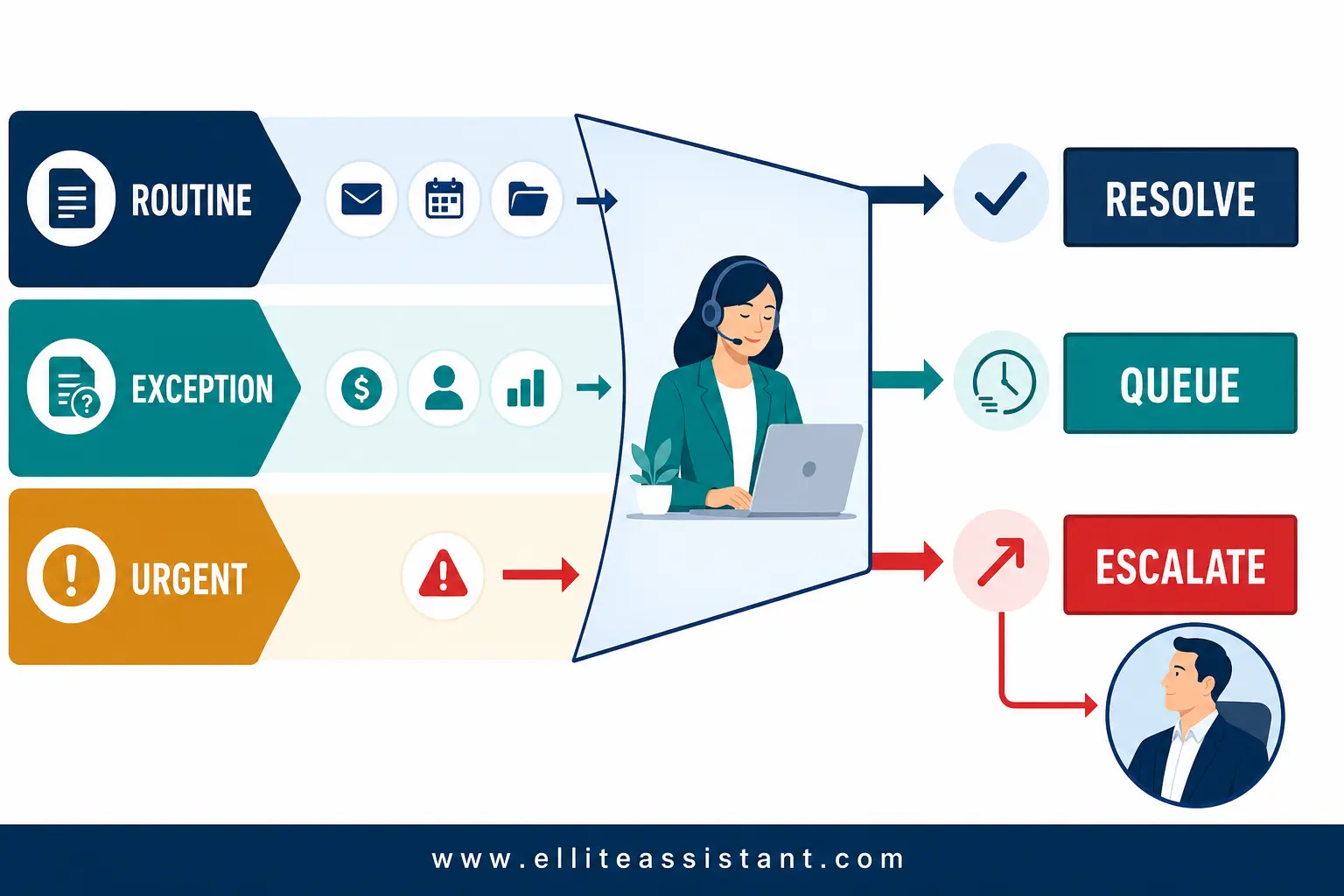
Define the small number of situations that may interrupt the day off. Use severity levels.
| Level | Example | VA response |
|---|---|---|
| Routine | Rescheduling, standard order update or basic information request | Resolve using the SOP and log it |
| Exception | Unusual refund request, supplier delay or complaint outside policy | Prepare context and hold for next working day unless a deadline applies |
| Urgent | Service outage, payment fraud signal or same-day operational risk | Contact the designated decision-maker through the emergency channel |
| Emergency | Safety, legal, clinical or security incident | Follow the organisation’s emergency plan immediately |
The word “urgent” must have a business definition. Otherwise, every uncomfortable request becomes an interruption.
R — Review and redesign
Review the system weekly during the pilot. Repeated exceptions often reveal missing rules, weak source data or an approval limit that is too narrow. Improve the workflow instead of accepting permanent founder interruption.
What a VA can handle on your day off
Inbox and communication coverage
A VA can categorise incoming messages, answer approved routine questions, request missing information, convert messages into tasks and prepare a concise briefing. The owner returns to decisions, not an undifferentiated inbox.
Calendar and appointment coordination
The VA can offer approved availability, confirm attendees, collect agendas, issue reminders and protect focus blocks. Booking rules should prevent the owner’s fifth day from quietly becoming a meeting day.
Lead capture and follow-up administration
New leads can be entered into the CRM, acknowledged and routed. The VA can run the approved follow-up sequence and schedule qualified conversations without promising price, scope or outcomes beyond authority.
First-line customer support
The assistant can handle order status, standard account questions, basic troubleshooting, return instructions and knowledge-base responses. Complex complaints, contractual issues and high-value exceptions remain with the owner or appropriate specialist.
CRM and project-system hygiene
Records can be updated, duplicates removed, overdue actions flagged and next steps assigned. This reduces the Monday-morning reconstruction of what happened while the owner was away.
Reporting and financial administration
A VA may prepare dashboards, reconcile basic records, issue approved invoices, follow up overdue paperwork and organise receipts or bookkeeping documents. Payments, bank changes and financial commitments should retain appropriate approvals.
Content and marketing operations
The VA can schedule approved content, repurpose verified source material, monitor standard responses and prepare campaign reports. Sensitive public statements and major changes remain subject to review.
What should remain with the owner or specialist
A VA should not become an informal substitute for leadership, legal judgment or specialist responsibility.
Retain human approval for:
- Pricing and contract exceptions
- Material refunds, credits or write-offs
- Banking and payment changes
- Hiring, termination and disciplinary decisions
- Legal, tax, medical or regulated advice
- Significant customer complaints or reputational threats
- Strategic partnerships
- Public crisis communication
- Irreversible deletion or high-impact system changes
The aim is not to remove the owner from the business. It is to remove the owner from work that does not require ownership-level judgment.
A realistic weekly coverage design
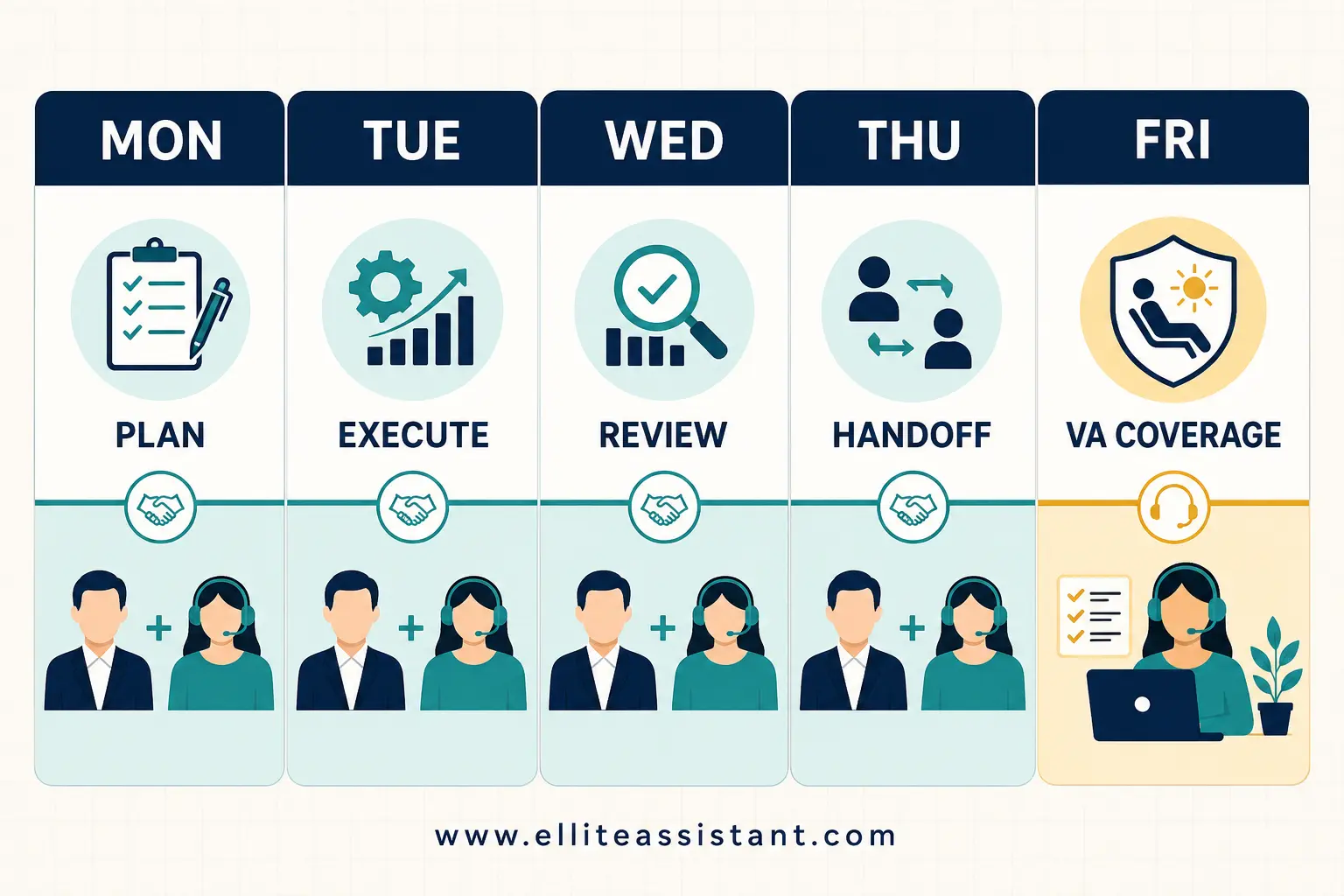
Here is a simple founder-focused schedule.
| Day | Owner | Virtual Assistant | Operating focus |
|---|---|---|---|
| Monday | Working | Working | Planning, priorities and customer decisions |
| Tuesday | Working | Working | Execution, sales and project coordination |
| Wednesday | Working | Working | Deep work plus midpoint review |
| Thursday | Working | Working | Approvals, handoff and Friday preparation |
| Friday | Off | Coverage shift | Routine operations, follow-up, triage and exception logging |
Thursday’s handoff should take 20–30 minutes, not two hours. A practical handoff contains:
- Expected Friday events
- Unresolved priorities
- Approval limits
- Known risks
- Emergency contact rules
- The time and format of the Friday summary
If Friday repeatedly requires a long preparation meeting, the SOPs or systems are not mature enough.
The exception queue protects the day off
Without an exception queue, a VA either interrupts the owner too often or makes decisions beyond their authority.
The queue should contain:
- The request
- Relevant customer or project context
- Deadline
- Risk if delayed
- Approved options
- The VA’s recommended next step
- The person authorised to decide
A decision-ready brief might say:
Customer requested a refund outside the 30-day policy. Order value: $180. Product is unopened. The standard VA refund limit is $100. No response is legally or operationally required today. Recommended action: approve a one-time return on Monday or decline using the attached template.
That is more useful than “Please advise urgently.”
How to implement the model in six weeks
Week 1: Choose the version of four-day work you are testing
Decide whether the pilot applies to the founder, one team, or the entire company. Choose the proposed day off and whether the business remains open.
Record the baseline:
- Owner and team working hours
- After-hours work
- Customer response time
- Backlog
- Revenue or completed work
- Errors and rework
- Reported stress or workability
Week 2: Audit and classify the work
For every recurring task, choose one action:
- Stop low-value work
- Simplify unnecessary steps
- Automate reliable rule-based movement
- Delegate suitable execution to the VA
- Retain work requiring owner or specialist judgment
Do not delegate a broken process before understanding it. You will simply make the confusion someone else’s full-time job.
Week 3: Create the minimum viable SOPs
Each SOP needs:
- Trigger
- Source of truth
- Steps
- Expected completion time
- Templates
- Permission limit
- Quality check
- Escalation condition
Use actual examples. “Respond professionally” is subjective; an approved response library and examples are teachable.
Week 4: Run a shadow Friday
The owner remains available but does not intervene unless the escalation rule requires it. The VA handles routine work and produces the end-of-day briefing.
Record every interruption and why it occurred. Some will be genuine. Others will reveal avoidable habits, missing data or unclear permissions.
Week 5: Run the first protected day
The owner is unavailable through ordinary channels. One emergency method remains active. The VA follows the coverage promise and logs exceptions.
Do not judge the entire model by one awkward Friday. Early friction is information.
Week 6: Compare, repair and decide
Compare the pilot with the baseline. Decide whether to continue, expand, adjust the day, add coverage or pause.
A successful pilot may still reveal that the business needs staggered coverage rather than a universal Friday closure.
Metrics that show whether it is genuinely working
Track both operational results and the quality of the day off.
| Metric | Why it matters |
|---|---|
| Owner weekly hours | Confirms whether time actually fell |
| Day-off interruptions | Measures dependence on the owner |
| After-hours and weekend work | Detects hidden compression |
| Response SLA | Shows whether customers still receive coverage |
| Backlog entering Monday | Identifies delayed work |
| Error and rework rate | Protects quality |
| Exception rate | Tests the usefulness of authority limits |
| Revenue or completed units | Monitors commercial performance |
| VA utilisation and capacity | Prevents overload |
| Team wellbeing | Tests sustainability rather than short-term output |
Set a clear success threshold. For example:
- Owner works no more than 32 hours
- No more than one genuine interruption during the day off
- Customer response time stays within the existing SLA
- Monday backlog does not increase
- Error rate does not deteriorate
- The VA remains within agreed paid capacity
These are illustrative pilot measures, not universal benchmarks.
Common ways businesses create a fake four-day week
Compressing without removing work
Longer days, skipped breaks and evening catch-up may produce a four-day calendar but not a healthier operating model.
Making the VA absorb unlimited work
The founder’s day off should not be financed by the VA’s unpaid overtime or constant availability. Scope, paid hours, breaks and backup capacity still matter.
Keeping every approval with the founder
If the VA must ask permission for every routine reply, reschedule or small exception, the owner remains the bottleneck.
Treating all customers as emergencies
Urgency should depend on impact and deadline, not the emotional intensity of a message.
Failing to tell customers and partners
Publish realistic response expectations, use an appropriate out-of-office message and provide a route for defined urgent issues. Silence creates more escalation.
Skipping the weekly review
Without review, workarounds accumulate. The VA should be able to recommend process changes based on repeated questions and exceptions.
How to protect the VA and the rest of the team
A sustainable four-day week cannot simply transfer pressure down the organisation.
- Match the workload to contracted VA hours.
- Use staggered or backup coverage for continuous operations.
- Give the assistant authority appropriate to the responsibility.
- Pay for onboarding, documentation and handoff time.
- Do not expect one VA to cover every speciality.
- Measure rework and work intensity, not just completed volume.
- Make days off and emergency rules mutual where possible.
- Ask the VA what should be simplified or stopped.
If changing employee schedules, pay or working hours, obtain current employment and wage-and-hour advice for the relevant jurisdiction. A founder choosing to work four days is different from changing contractual terms for employees.
Can every business use this model?
Not in the same way.
A consultancy may close on Friday and route urgent enquiries. An online store may require seven-day customer coverage. A healthcare practice may need staggered teams. A real estate business may choose Monday off because weekend enquiries matter. A global company may already have time-zone coverage.
The Portuguese trial found that businesses used Fridays off, rotating days and mirror teams. The correct model depends on customer demand, operating rhythm, rest and the cost of coverage.
The question is not “Can our business disappear for one day?” It is “Can the business provide the right level of service without every person working every day?”

What to ask a Virtual Assistant provider
- Can you support a defined fifth-day coverage window?
- Is the VA dedicated, shared or backed by a team?
- Who covers absence or leave?
- How will SOPs and client knowledge be documented?
- What is included in the VA’s decision authority?
- How are urgent matters escalated?
- Who monitors quality and capacity?
- How will the provider report completed work and exceptions?
- Can we pilot one workflow before expanding?
- How are confidential information and system access protected?
The strongest provider will help define what the VA should not do as clearly as what they should do.
Ready to test a genuine four-day week?
Ellite Assistant can help you identify recurring work, define a coverage window and match a Virtual Assistant to the administrative and operational tasks that keep pulling you back into the business.
Ready to test a genuine four-day week?
Book a consultation to map a four-day-workweek pilot around your real workload. Start with one protected day, one coverage promise and a small number of measurable workflows.
Book a consultation Start the 7-day trial for $49Five total support hours during the seven-day trial. Confirm final eligibility and terms on the trial page before purchase.
The aim is not a dramatic overnight transformation. It is a business that can operate responsibly when you are not watching it.
Frequently asked questions
Can a Virtual Assistant make it possible to work four days a week?
Yes, if enough of your fifth-day workload consists of delegable administration, customer coverage, scheduling, follow-up and reporting. You still need SOPs, authority limits, backup and measured capacity.
How many VA hours are needed for a four-day workweek?
It depends on the workload and coverage promise. Audit the tasks currently completed on the proposed day off, add weekly recurring administration, then include time for reporting, handoff and exceptions. Pilot before buying a large block of hours.
Should the business close on the fifth day?
Not necessarily. A VA or staggered team can maintain routine coverage while the owner is off. Some businesses may close; others need continuous customer or operational support.
Is a four-day week the same as four 10-hour days?
No. Four 10-hour days compress the same 40 hours. Many reduced-hours four-day-week programmes aim to reduce total working time while maintaining pay and useful output through redesign.
What should the VA do on the owner’s day off?
Typical work includes inbox triage, scheduling, CRM updates, lead follow-up, first-line customer support, document preparation, reporting and exception logging.
What happens if there is an emergency?
Use a written escalation policy with severity levels, examples, a named decision-maker and one emergency contact channel. Routine issues should wait or be resolved within the VA’s authority.
Will customers notice the owner is unavailable?
They may notice the schedule, but they should not experience silence or confusion. Communicate response expectations and ensure routine requests receive reliable coverage.
Does a Virtual Assistant guarantee four-day-week productivity?
No. Outcomes depend on task fit, process quality, authority, systems, team capacity and customer demand. Measure the pilot against your own baseline.
A four-day week is a test of the operating system
The real measure of a well-run business is not how many hours the owner stays available. It is whether customers are served, work is visible and decisions reach the right person.
A Virtual Assistant can provide the missing capacity, but the deeper change is operational:
- Low-value work is removed
- Recurring work has an owner
- Routine decisions have rules
- Genuine exceptions have a route
- Results are visible without constant checking
- Time off is protected rather than borrowed from the weekend
When those conditions exist, a four-day workweek stops being an aspiration and becomes a repeatable way of running the business.
Sources and editorial notes
- Boston College, “A Four-Day Work Week?”.
- University of Cambridge, “New Results from the World’s Largest Trial of a Four-Day Working Week”, 23 February 2023.
- Autonomy, “The Results Are In: The UK’s Four-Day Week Pilot”.
- Autonomy, “Making It Stick: The UK Four-Day Week Pilot One Year On”, 21 February 2024.
- Fan et al., “Work time reduction via a 4-day workweek finds improvements in workers’ well-being”, Nature Human Behaviour, 2025.
- 4 Day Week Global, “Four-Day Week: Results from the Portuguese Trial”, final report dated July 2024.
The examples, targets and time calculations in this article are illustrative and do not guarantee productivity, revenue, wellbeing or cost savings. Employment, working-time, overtime and contractual rules vary by jurisdiction. Obtain appropriate professional advice before changing employee schedules or pay.
Can a Virtual Assistant help you run a four-day workweek?
- Can a Virtual Assistant make it possible to work four days a week?
- How many VA hours are needed for a four-day workweek?
- What should a VA do on the owner's day off?
- Should a business close on the fifth day?
- Is a four-day week the same as four 10-hour days?
- What happens if there is an emergency on the owner's day off?
- Will customers notice that the owner is unavailable?
- Does a Virtual Assistant guarantee four-day-week productivity?