How Much Does a Virtual Assistant Cost in the USA in 2026?
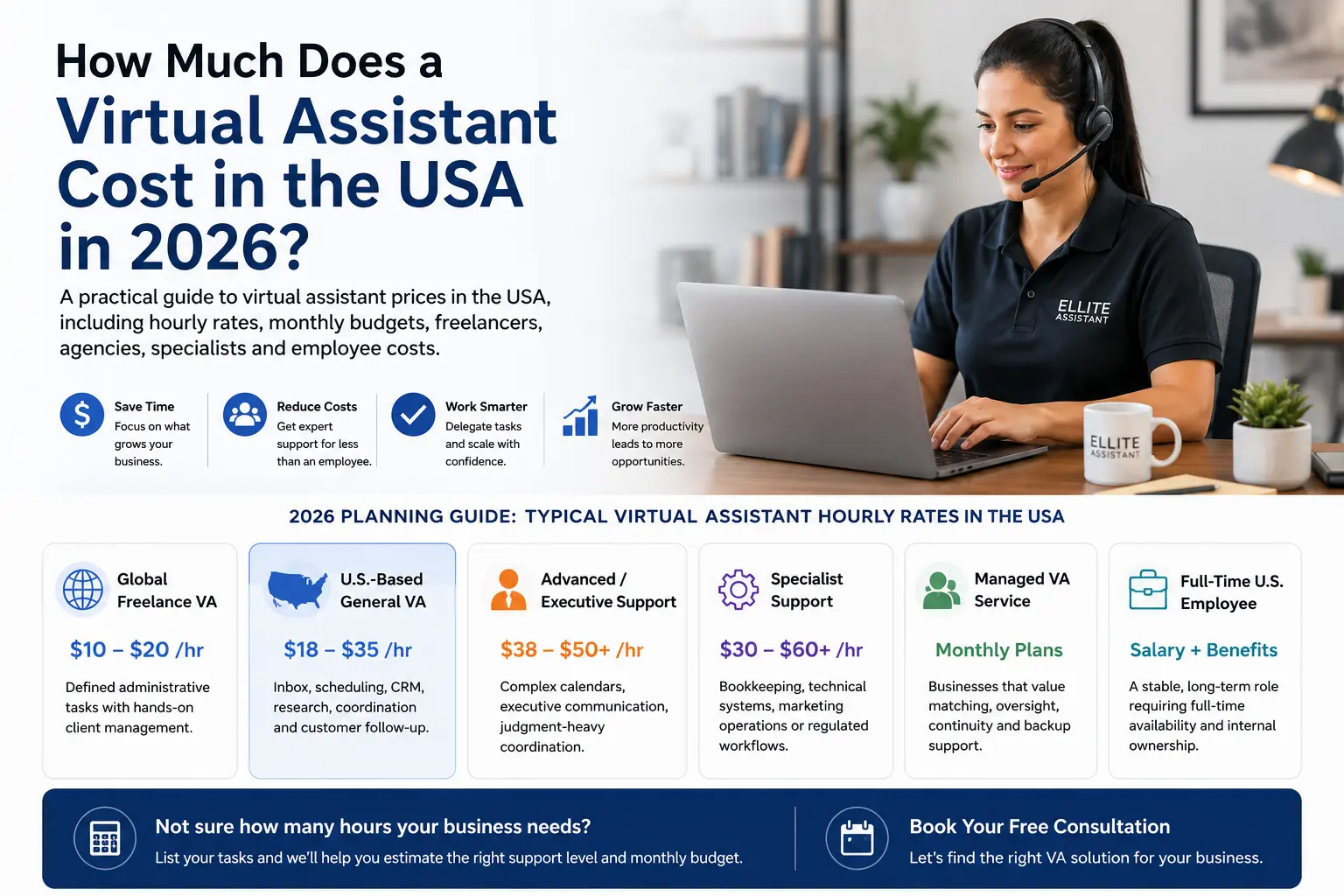
In 2026, virtual assistant costs in the USA typically range from $18–$35 per hour for general U.S.-based freelance support, while advanced executive and specialized support can cost $38–$60+ per hour. Global freelance VA rates can start around $10–$20 per hour. Monthly costs depend on workload, hourly rate, service fees, tools, and onboarding. Businesses should also consider experience, specialization, availability, and whether they hire a freelancer, agency, or managed VA service when comparing the total cost of virtual assistant support.
There is a familiar moment in a growing business when the owner realizes that the problem is no longer a lack of ideas. It is a lack of uninterrupted time.
The inbox is full before breakfast. Customer questions arrive while the team is serving customers. Quotes need chasing, appointments need confirming, the CRM needs updating, and last week's receipts are still waiting to be organized. None of these tasks looks large on its own. Together, they begin to control the working week.
That is usually when someone asks: How much does a Virtual Assistant cost in the USA?
The short answer is that, in 2026, a business should usually budget about $18–$35 per hour for a U.S.-based freelance Virtual Assistant handling general business support. Advanced executive, consulting, or highly specialized North American support commonly reaches $38–$50+ per hour. Global marketplace talent can start around $10–$20 per hour, while managed services are often sold as monthly packages rather than a simple hourly rate.
Those ranges are a starting point, not a price list. The right cost depends on what the assistant is trusted to do, how independently they must work, and what support sits behind them.
If you are still deciding whether a VA is the right model for your business, see Virtual Assistant vs Freelancer vs Agency and AI Assistant vs Virtual Assistant .
Virtual Assistant Cost in the USA: The Quick Answer
Here is a practical 2026 planning guide:
| Type of support | Typical planning range | Best suited to |
|---|---|---|
| Global freelance VA | $10–$20 per hour | Defined administrative tasks with hands-on client management |
| U.S.-based general freelance VA | $18–$35 per hour | Inbox, scheduling, CRM, research, coordination and customer follow-up |
| Advanced or executive support | $38–$50+ per hour | Complex calendars, executive communication and judgment-heavy coordination |
| Specialist support | $30–$60+ per hour | Bookkeeping, technical systems, marketing operations or regulated workflows |
| Managed VA service | Usually a monthly plan | Businesses that value matching, oversight, continuity and backup support |
| Full-time U.S. employee | Salary plus employer costs | A stable, long-term role requiring full-time availability and internal ownership |
The first three bands are grounded in current marketplace data. Upwork's general VA cost guide shows a global marketplace range of about $10–$20 per hour. Its U.S. Virtual Assistant guide says many U.S. freelancers charge about $18–$35 per hour, while advanced North American support can reach $38–$50+.
Indeed provides another useful reference point: its 2026 career data lists an average U.S. Virtual Assistant wage of $26.20 per hour. These figures are not directly interchangeable—one may describe freelancer charges and another worker pay—but together they show why a single universal “VA rate” is misleading.
Virtual assistant pricing in the USA typically ranges from $18–$35 per hour for general admin support, $38–$50+ for executive-level assistance and $30–$60+ for specialist roles like bookkeeping or marketing ops. For detailed pricing bands, packages and trial options, view our VA pricing plans.
What Does a Virtual Assistant Cost per Month?
Most businesses do not experience support as an hourly rate. They experience it as a monthly commitment.
The table below converts three common hourly rates into simple monthly budgets.
| Support level | At $20/hour | At $30/hour | At $45/hour |
|---|---|---|---|
| 20 hours/month | $400 | $600 | $900 |
| 40 hours/month | $800 | $1,200 | $1,800 |
| 80 hours/month | $1,600 | $2,400 | $3,600 |
| 160 hours/month | $3,200 | $4,800 | $7,200 |
This table is useful for budgeting, but it still does not tell you which option is better value. A $20-per-hour assistant who needs detailed daily supervision may cost the owner more time than a $35-per-hour assistant who can run an agreed process, identify exceptions and report the result clearly.
Experience level, specialization, service model and support hours all impact the final cost. If you want to compare service tiers and see what’s included in each virtual assistant package, explore our pricing page for transparent breakdowns and package options.
Why Virtual Assistant Prices Vary So Widely
Two assistants can both say they provide “administrative support” while doing very different work.
One may copy information from a form into a spreadsheet. Another may review the same information, spot missing details, contact the customer, update the CRM, schedule the next action and alert a manager when the situation falls outside an agreed rule.
The second person is not just completing a task. They are protecting a process. That difference affects price.
1. Location and working-hour overlap
A U.S.-based assistant generally charges more than an assistant working in a lower-cost market. Businesses may pay that premium for native-market familiarity, local working-hour overlap or experience with U.S. customers and systems.
An overseas assistant can still provide excellent support. The key question is whether the role requires real-time availability or whether the work can move asynchronously.
2. Experience and judgment
Experience changes the amount of direction an assistant needs. Entry-level support works well when the process is stable and every step can be defined. Experienced support becomes more valuable when priorities compete, information is incomplete or the assistant must communicate on the owner's behalf.
3. The type of work
Routine data entry and calendar updates normally sit at the lower end of the range. Work involving bookkeeping, CRM administration, lead qualification, executive communication, technical platforms or sensitive customer information usually costs more.
4. Speed and availability
Guaranteed coverage, same-day turnaround, weekend availability or support across several U.S. time zones can increase the price because the assistant or provider must reserve capacity.
5. Freelancer, agency or managed service
With a freelancer, the client usually handles recruitment, screening, onboarding, training, quality control and backup planning. An agency or managed service may include skills matching, process support, performance oversight, replacement support and continuity.
For a detailed comparison of models and when each makes sense, see Virtual Assistant vs Freelancer vs Agency .
6. U.S. market and cost-of-living differences
Within the United States, virtual assistant rates vary by region and cost of living. Assistants based in major metropolitan areas such as New York, San Francisco or Boston often charge more than those in lower-cost regions, even when providing similar services.
Businesses sometimes combine a U.S.-based VA for client-facing work and time-zone overlap with an overseas VA for back-office tasks. This hybrid approach can balance cost, coverage and quality when managed with clear processes and communication rules.

Typical Virtual Assistant Rates by Type of Work
There is no government tariff for Virtual Assistant services, so the ranges below should be used as planning bands.
General administrative support: $18–$35 per hour
Typical work includes inbox organization, calendar management, data entry, file organization, meeting preparation, research and basic reporting.
Customer service and CRM support: $20–$40 per hour
This can include answering routine customer questions, updating records, confirming appointments, recording outcomes and escalating exceptions.
Lead follow-up and sales administration: $25–$45+ per hour
Support may include responding to enquiries, qualifying leads, updating the pipeline, scheduling sales calls and sending approved follow-ups.
Executive Virtual Assistant: $38–$50+ per hour
Executive support may involve complex calendars, travel, confidential communication, meeting preparation, project coordination and senior-stakeholder communication.
Bookkeeping and finance administration: $30–$60+ per hour
Common delegated work includes collecting documents, categorizing transactions, preparing reconciliations for review and following up on missing information.
Marketing and technical support: $35–$75+ per hour
Marketing operations, website updates, automations, analytics, email platforms and advanced CRM work can command higher rates because they combine administrative discipline with specialist knowledge.
If you are unsure which tasks to delegate first at these rates, see 50 Tasks to Delegate to a Virtual Assistant .
Virtual Assistant Versus Full-Time Employee Cost
A Virtual Assistant is not always cheaper, and an employee is not always better. They solve different staffing problems.
The U.S. Bureau of Labor Statistics reports that in May 2024, the median annual wage was $46,290 for general secretaries and administrative assistants and $74,260 for executive secretaries and executive administrative assistants. Those figures are wages, not the employer's complete cost.
In March 2026, BLS reported that benefits accounted for 30.1% of total private-industry employer compensation. Employers may also carry recruiting, payroll, equipment, software, paid leave, training and workspace costs.
| Factor | Virtual Assistant | Full-Time Employee |
|---|---|---|
| Capacity | Often flexible depending on the model | Generally more fixed |
| Best for | Defined remote workflows | Deeply integrated ongoing roles |
| Scaling | Often easier to adjust | Usually requires staffing changes |
| Management | Requires deliberate remote processes | Can support closer day-to-day integration |
Classification must be based on the real working relationship, not the label in a contract. The IRS advises businesses to consider behavioral control, financial control and the relationship between the parties.
For more on scaling without adding full-time headcount, see How to Scale a Business Without Hiring Full-Time Staff .
How to Calculate Your Real Virtual Assistant Budget
Use this simple formula:
Monthly VA budget = task hours × hourly rate + service fees + required tools + onboarding allowance
Consider a small ecommerce company that identifies 45 hours of recurring work each month:
- 12 hours of customer and returns follow-up.
- 10 hours of CRM and order-record updates.
- 8 hours of supplier coordination.
- 7 hours of weekly reporting.
- 8 hours of inbox and scheduling support.
At $30 per hour, the working budget is $1,350 per month. That number only becomes meaningful when the company decides what it will do with the released time.
How to Calculate Your Real Virtual Assistant Budget
Estimate your monthly and first-month Virtual Assistant budget based on your expected workload and costs.
Budget Breakdown
Monthly VA Budget = (Task Hours × Hourly Rate) + Service Fees + Required Tools
First-Month Budget = Monthly VA Budget + Onboarding Allowance
Ready to calculate your VA investment?
Ellite Assistant provides transparent pricing with flexible virtual assistant packages for admin, executive, customer support, sales and bookkeeping support. Start with a 7-day trial for $49 and test 5 hours of focused support.
View Pricing Plans Hire a Virtual AssistantWhat Should a Business Delegate First?
The best first task has four characteristics:
- It happens regularly.
- It takes meaningful time.
- It can be explained and checked.
- It does not initially require unrestricted access or unlimited authority.
Strong starting points include inbox triage, appointment confirmation, CRM cleanup, lead research, report preparation, customer follow-up using approved responses and collecting bookkeeping documents.

Frequently Asked Questions About Virtual Assistant Costs
How much is a Virtual Assistant per hour in the USA in 2026?
A practical benchmark is $18–$35 per hour for U.S.-based general freelance support and $38–$50+ for advanced executive or consulting-level North American support. Specialist work can exceed these bands.
How much does a Virtual Assistant cost for 10 hours per week?
Using a simple 40-hour month, the cost would be about $800 at $20 per hour, $1,200 at $30 per hour or $1,800 at $45 per hour.
Is a Virtual Assistant cheaper than an employee?
A part-time VA can be less expensive when a business needs a limited number of hours. An employee may provide better value when the work is stable, full-time and deeply integrated.
Should I pay hourly or choose a monthly VA plan?
Hourly support works well for an uncertain workload. A monthly plan often works better for recurring tasks that need reserved capacity and continuity.
What should be included in a Virtual Assistant trial?
Use one or two real, low-risk tasks with clear instructions and a defined result. Evaluate accuracy, communication, reliability, questions asked and exception handling—not just speed.
What is the typical virtual assistant cost in the USA?
In 2026, U.S.-based general freelance virtual assistants typically charge about $18–$35 per hour. Advanced executive or specialist support often ranges from $38–$60+ per hour. Global marketplace talent can start around $10–$20 per hour, while managed services are usually sold as monthly plans.
Is it better to pay hourly or use a monthly virtual assistant plan?
Hourly support works well for an uncertain or changing workload. A monthly plan often works better for recurring tasks that need reserved capacity and continuity. Compare what happens to unused hours, overages and priority coverage when choosing between them.
Can I hire a virtual assistant for 10 hours a week?
Yes. Many businesses start with 10 hours per week (around 40 hours per month) to cover inbox management, scheduling, CRM updates and routine follow-up. You can increase or decrease hours as your workload and delegation confidence grow.
What should I look for in a virtual assistant pricing package?
Look for clear details on hours per month, skill level, management and backup coverage, onboarding, and what happens with unused hours or overages. Good virtual assistant pricing packages make these terms explicit so you can compare offers fairly.
Pricing data and public pages were checked on August 20, 2026. Rates can change and individual quotes vary. This article provides general business information, not legal, tax, employment or financial advice.
How much does a virtual assistant cost in the USA in 2026?
- What is the average cost of a virtual assistant in the USA?
- How much should I pay a virtual assistant per hour?
- How much does a virtual assistant cost per month?
- Is hiring a virtual assistant worth it?
- Are virtual assistants cheaper than employees?
- What is the cheapest way to hire a virtual assistant?
- How much does a virtual assistant agency charge?
- What does a virtual assistant do?
- How many hours should I hire a virtual assistant?
- What is the difference between a freelance VA and an agency VA?