Virtual Assistant for Lead Follow-Up: How to Stop Enquiries Falling Through the Cracks

The owner is standing in a customer’s driveway, trying to understand a problem that needs fixing today. His phone lights up on the clipboard behind him. A website enquiry. Then a missed call. Then a message asking for a quote.
None of those prospects knows he is doing good work for someone else. They only know they have not heard back.
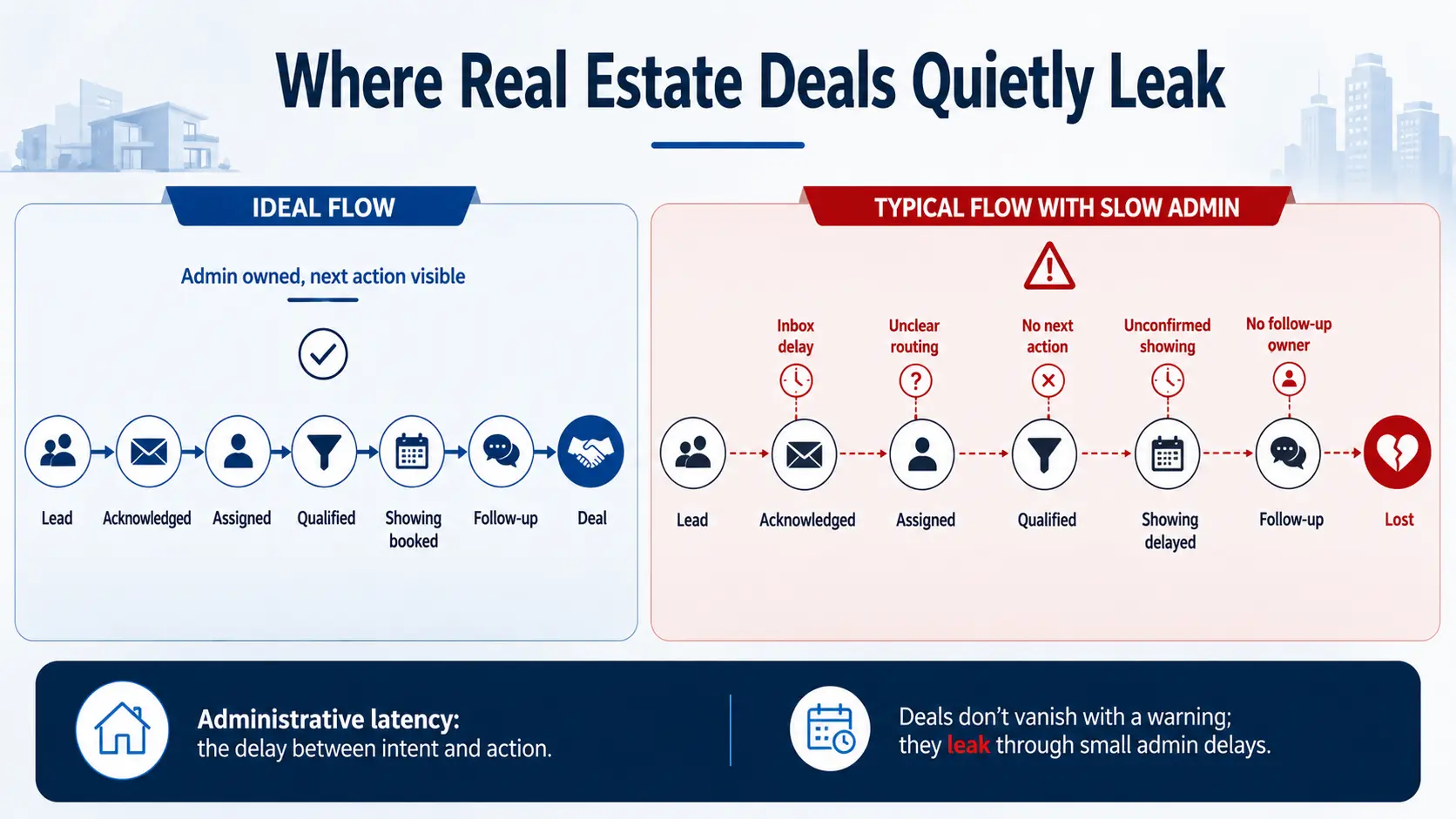
This is the follow-up gap: the space between a person showing interest and a business giving that interest a clear next step. It appears in a one-person service company, but it also appears inside established sales teams. The tools become more sophisticated; the underlying failure is often the same. An enquiry arrives, but ownership is unclear. A first reply goes out, but no next action is recorded. A promising conversation becomes an old row in the CRM.
A Virtual Assistant can help close that gap. Not by sending endless generic reminders and not by pretending to be the salesperson. The useful role is operational: capturing enquiries, acknowledging them appropriately, keeping records clean, preparing context, scheduling approved follow-ups and making sure the right person steps in when judgment is required.
This guide explains how to build that system without making your communication feel robotic.
The short answer: how can a Virtual Assistant improve lead follow-up?
A Virtual Assistant can support lead follow-up by making sure every legitimate enquiry is:
- Captured in one reliable system
- Acknowledged within the business’s agreed service window
- Checked for the information needed to move forward
- Assigned to a named owner
- Given a dated next action
- Closed with a clear outcome instead of being forgotten
The VA does not need authority to negotiate, promise a result or answer every complex question. They need a defined lane, approved messages, sensible escalation rules and enough context to recognise when a human decision is needed.
That distinction matters. Automation can send an alert. A capable assistant can notice that the customer replied from a different address, that the account manager is away, that a requested date is impossible, or that a worried prospect needs reassurance rather than another sequence email.
Follow-up is not about chasing people
The phrase “lead follow-up” can sound like pressure: more emails, more calls, more persistence. That is the wrong foundation.
Good follow-up is the practice of making the next step easier.
Sometimes that means sending a relevant answer. Sometimes it means confirming that a request was received and explaining when a fuller response will come. Sometimes it means asking one useful question so the sales team does not enter a meeting without context. And sometimes it means recording “not interested” or “do not contact” and stopping immediately.
The goal is not maximum message volume. It is reliable, respectful continuity.
Research published by Harvard Business Review examined how quickly organisations responded to online leads and found a sharp decline in qualification likelihood as response was delayed. The study is older and should not be treated as a universal 2026 benchmark, but its operational lesson remains useful: interest has a window, and businesses need an owner and a process while that window is open. See The Short Life of Online Sales Leads.
Speed alone is not enough. A fast reply that ignores the question, invents an answer or sends the prospect into another queue simply produces disappointment faster.
Why good leads disappear even when the business has a CRM
A CRM can store a lead. It cannot create responsibility by itself.
Here are the failure patterns that usually sit underneath inconsistent follow-up.
Enquiries arrive through too many doors
The website form goes to one inbox. Instagram messages belong to the marketing manager. Calls reach whoever happens to be free. Event leads live in a spreadsheet. Referrals arrive by WhatsApp. Nobody has a complete view, so nobody can confidently say every enquiry was handled.
The first reply is mistaken for completion
An automatic “we received your message” email is useful, but it is not follow-up. The lead still needs an owner, a meaningful response and a next action. Acknowledgment keeps the door open; it does not move the opportunity through it.
Ownership is shared, which means ownership is absent
“Sales will handle it” is not an owner. Neither is “the team.” A lead needs one named person responsible for the next action, even if several people contribute later.
Notes describe the past but not the future
Many records say what happened: “spoke Tuesday” or “sent brochure.” The more important field is often missing: what happens next, who will do it and by when?
Staff protect urgent work and sacrifice important work
When a day becomes crowded, the meeting happening now will beat the follow-up due this afternoon. That is understandable. The problem begins when there is no second person or system making sure the deferred action returns to view.
Templates replace listening
A sequence can maintain cadence, but it cannot assume every recipient has the same question, urgency or history. If messages continue after a prospect has asked to pause—or ignore something they have already explained—the system begins to damage the trust it was meant to build.

The six-step Follow-Up Loop
An effective process does not need to be complicated. It needs to be complete.
The Ellite Follow-Up Loop has six stages:
1. Capture
Bring every legitimate enquiry into one source of truth. This might be a CRM, help desk or well-designed tracker for a very small business.
At minimum, capture:
- Name and preferred contact method
- Company, where relevant
- Source of the enquiry
- Date and time received
- What the person is asking for
- Product, service or location involved
- Permission or communication preference where required
- Current owner
- Next-action date
The system should not depend on someone remembering to check five separate inboxes at the end of the day.
2. Acknowledge
Let the person know the enquiry reached the right place. A useful acknowledgment does three things:
- Confirms receipt
- Sets an honest expectation
- Makes the next step clear
Thanks for getting in touch about [specific request]. I have passed this to [name/team], who will review the details and respond by [realistic time]. If [one missing detail] is available, please send it here so we can prepare the right answer.
Do not promise “within an hour” because it sounds impressive if the business cannot consistently deliver it.
3. Qualify
Qualification is not interrogation. It is gathering enough context for the right person to have a useful conversation.
The VA may confirm approved information such as service needed, location, timing, budget range where appropriate, decision stage or availability for a call. The assistant should not push for information the business does not genuinely need.
4. Assign
Every active lead receives a named owner. The record should show:
- Who owns the next action
- What that action is
- When it is due
- What happens if it becomes overdue
If the normal owner is unavailable, the backup rule should be known before an urgent lead arrives.
5. Continue
Follow-up continues only while it is useful and appropriate. Each touch should be based on what happened previously, not simply on “day three of sequence.”
A thoughtful follow-up might:
- Answer the outstanding question
- Share the requested document
- Offer two specific appointment times
- Confirm whether priorities changed
- Remind the prospect of an agreed deadline
- Ask whether they would prefer the conversation to close
6. Close the loop
Every record needs an outcome. Examples include:
- Booked consultation
- Qualified opportunity
- Not ready — follow up on an agreed future date
- Referred elsewhere
- No response after the approved cadence
- Not suitable
- Declined
- Do not contact
Closing a lead is not failure. Leaving a lead indefinitely in “follow-up” is a reporting failure and a consent risk.

What should a lead follow-up Virtual Assistant own?
The safest and most effective scope separates routine ownership from commercial authority.
| A Virtual Assistant can usually own | Owner or sales lead should usually own | Automations can support |
|---|---|---|
| Monitoring approved enquiry channels | Pricing exceptions and negotiation | Form-to-CRM record creation |
| Creating and cleaning lead records | Strategic discovery calls | Receipt confirmations |
| Sending approved acknowledgment messages | Complex objections | Round-robin alerts |
| Gathering agreed qualification details | Commitments affecting scope, cost or delivery | Reminders before a due time |
| Scheduling calls and reminders | Sensitive complaints or reputational risk | Duplicate detection suggestions |
| Preparing context before meetings | Legal, regulated or specialist advice | Routine calendar confirmations |
| Recording outcomes and next actions | Final disqualification where judgment is required | Dashboard calculations |
| Flagging overdue records | Decisions about changing the sales approach | Standard task creation |
| Maintaining do-not-contact and preference fields | Relationship repair after a serious failure | Template insertion for human review |
These boundaries should reflect the actual business. A trained assistant supporting a mature process may responsibly handle more than a brand-new VA working from incomplete instructions.
If you are still deciding which responsibilities to delegate, read 50 Tasks to Delegate to a Virtual Assistant—and What to Keep. If you are deciding where software ends and human judgment begins, use our guide to AI Assistant vs. Virtual Assistant.
What lead follow-up looks like at different business sizes
The same loop can serve a solo business and a larger team, but the operating design changes.
Solo founder or independent professional
The problem is usually interruption. The owner is selling, delivering, invoicing and answering enquiries between everything else.
A VA can centralise new enquiries, confirm receipt, collect missing details and schedule the conversations that genuinely need the owner. The simplest workable system may be one shared pipeline with a daily summary.
The test of success is not whether the owner receives fewer messages. It is whether the owner receives fewer unclear messages and enters important conversations with better context.
Small business with two to ten people
The problem often becomes ambiguity. Several people can respond, so each assumes someone else already did.
The VA can become the process owner: checking channel coverage, assigning leads, maintaining next actions and running a short overdue review. Sales or service staff still own the substantive conversation.
Growing team or multi-location business
Volume, routing and handoffs matter more. Enquiries may need assignment by location, product, language, service line or account type.
The VA can apply documented routing rules, prepare handoff notes and surface exceptions. A team lead should review capacity and patterns rather than inspecting every message.
Larger organisation
The value shifts toward coordination and data quality. A VA or VA team may support CRM hygiene, meeting preparation, backlog triage, campaign follow-up, event-lead processing and reporting across several internal owners.
At this scale, access controls, audit trails, quality sampling and escalation design matter as much as speed. The assistant should operate inside established governance—not around it.

A copy-ready lead follow-up SOP
Use this as a starting point and adapt it to your channels, sales cycle, working hours and legal requirements.
Purpose
Make sure every legitimate inbound enquiry receives a relevant response, a named owner and a documented next action.Channels covered
[Website forms] [Shared inbox] [Phone/voicemail] [Approved social channels] [Events/referrals]Coverage hours
[Days, hours and time zone]Step 1: Capture
Create or update the record. Check for duplicates before adding a new contact. Record the source, request, receipt time and communication preference.Step 2: Acknowledge
Send the approved response appropriate to the channel. State a realistic response expectation. Never claim the request has been reviewed if it has not.Step 3: Check
Gather only the approved information needed for routing or preparation. Do not request sensitive data through an unapproved channel.Step 4: Assign
Select the owner using the routing rules. Record the next action and due date. Notify the owner in the agreed system.Step 5: Follow through
Review due actions at [time/frequency]. Send only approved and context-appropriate follow-ups. Stop or escalate when the response falls outside the approved scope.Step 6: Close
Record the outcome and reason. Update contact preferences. If the person opts out or asks not to be contacted, apply the suppression process immediately.Escalate immediately when
[List safety, legal, payment, reputational, high-value or sensitive situations]Quality check
Review [sample or percentage] of records each week for correct owner, next action, tone, accuracy and contact preference.
CRM fields that make follow-up visible
Do not build a form with 40 required fields. Required information should earn its place.
Start with:
| Field | Why it matters |
|---|---|
| Enquiry received date/time | Shows age and coverage performance |
| Lead source | Helps identify where demand originates |
| Request summary | Gives the next person usable context |
| Status | Shows where the enquiry sits now |
| Named owner | Creates accountability |
| Next action | Defines what must happen |
| Next-action due date | Makes overdue work visible |
| Last meaningful contact | Prevents duplicate or mistimed outreach |
| Preferred channel/time | Respects the person’s communication needs |
| Consent or lawful-contact note | Supports compliant communication where applicable |
| Outcome and reason | Improves reporting and future decisions |
One field deserves special attention: next action. A pipeline with accurate next actions is operational. A pipeline made only of historic notes is archival.
Respectful follow-up across the US, UK and Australia
An assistant can execute a process, but the business remains responsible for the rules and the instructions it gives.
Also distinguish between two situations:
- Responding to an inbound service or sales enquiry, where the person asked to hear from the business
- Sending additional marketing, which may be subject to different consent, identification and opt-out requirements
For US commercial email, the Federal Trade Commission’s CAN-SPAM compliance guide covers accurate sender information, non-deceptive subject lines, identification, address and opt-out requirements.
For UK marketing, the Information Commissioner’s Office explains that the correct basis depends on the context and that PECR may require consent for some electronic marketing. Read the ICO’s business-to-business marketing guidance.
For Australia, the Australian Communications and Media Authority says commercial messages must include a clear unsubscribe option and that businesses must honour unsubscribe requests within the required period. See ACMA guidance on avoiding spam.
Metrics that show whether the system is working
Measure the process before claiming that it improved revenue.
First meaningful response time
How long does it take to send a relevant human or human-reviewed reply? Separate this from an automatic receipt confirmation.
Percentage of active leads with a named owner
This should be close to universal. An unowned lead is a lead the organisation has quietly chosen to risk.
Percentage of active leads with a future next action
This reveals whether conversations are moving or simply accumulating notes.
Follow-up completion rate
Of the actions due this week, how many were completed, rescheduled with a reason or properly closed?
Overdue lead count and age
One lead overdue by an hour is different from 80 leads overdue by two weeks. Track both the number and the age.
Qualified consultations or opportunities
Measure how many enquiries become the next meaningful business step. Define “qualified” before reporting it.
Outcome reasons
“Lost” is not enough. Record useful, respectful categories such as timing, budget, service mismatch, no response, duplicate, competitor chosen or contact preference.
Quality and complaint signals
Sample messages for accuracy and tone. Track duplicate messages, incorrect routing, opt-out failures and complaints. A faster system that creates more errors is not an improvement.
A seven-day setup plan
| Day | Action | What to do |
|---|---|---|
| Day 1 | Map every enquiry channel | List website forms, inboxes, phone numbers, messaging platforms, referral routes and event imports. Note who currently checks each one. |
| Day 2 | Define stages and owners | Choose simple statuses. Write the routing rules, backup owners and red-flag escalations. |
| Day 3 | Clean the minimum fields | Add owner, next action, due date, last contact and outcome fields. Remove fields nobody trusts or uses. |
| Day 4 | Write three core responses | Prepare an acknowledgment, a request for missing information and a polite close-the-loop message. Give examples of when not to use each one. |
| Day 5 | Test with real scenarios | Run recent anonymised examples through the process: a routine enquiry, a poor-fit request, a pricing question, an urgent complaint and a person who asks not to be contacted. |
| Day 6 | Start with one channel | Do not launch every source at once. Begin with the most important shared inbox or website form and watch the handoffs. |
| Day 7 | Review the friction | Ask: Which field was unclear? Which action needed approval? Which message sounded unnatural? Which escalation was too slow? Improve the process before expanding coverage. |
If you need help choosing the person who will run this workflow, use our practical guide on how to hire a Virtual Assistant.
The human standard: never make the prospect feel processed
A reliable system should make communication more human, not less.
Before a follow-up goes out, it should pass five checks:
- Is it true? Do not imply someone reviewed information they have not seen.
- Is it relevant? Respond to the person’s actual request and history.
- Is it proportionate? The number and channel of messages should suit the context.
- Is the next step easy? Offer a clear action without manufactured pressure.
- Is stopping easy? Respect “no,” “not now” and opt-out requests promptly.
The best follow-up rarely feels like chasing. It feels like the business remembered what mattered.
Frequently asked questions
What is a lead follow-up Virtual Assistant?
A lead follow-up Virtual Assistant is a remote professional who helps a business capture enquiries, maintain CRM records, send approved responses, gather basic context, schedule conversations, track next actions and flag overdue or sensitive situations. Their authority should be clearly defined.
Can a Virtual Assistant respond to new leads?
Yes, when the business provides an approved scope, accurate information, response standards and escalation rules. Complex pricing, negotiation, specialist advice and sensitive complaints should remain with authorised people unless the assistant is specifically trained and empowered to handle them.
Can a VA manage our CRM?
A VA can often create and update records, remove duplicates, add notes, assign owners, schedule next actions, prepare reports and flag incomplete data. Access should be limited to what the role needs, and important changes should be auditable.
Should lead follow-up be automated?
Automate predictable mechanics such as creating records, sending receipt confirmations, assigning reminders and calculating overdue work. Keep human review or ownership where context, judgment, emotion, accuracy or commercial consequences matter.
How quickly should a business respond to an enquiry?
There is no single honest target for every industry and channel. Set a service window based on when your team is available, what the person reasonably expects and how urgent the request may be. Measure acknowledgment and meaningful response separately, then improve from your own baseline.
How many times should a business follow up?
There is no universal number. Use a documented cadence appropriate to the relationship, channel, request and applicable rules. Each message should have a reason. Stop when the person declines, opts out, asks you to pause or the approved process reaches its close point.
How do we prevent a VA from sending the wrong message?
Use approved examples, clear authority levels, scenario training, an escalation path and regular quality sampling. For higher-risk messages, require a draft-and-approve step until the assistant has demonstrated consistent judgment.
Is a Virtual Assistant useful for a larger sales team?
Yes. In a larger team, the value may be less about answering every enquiry and more about routing, CRM quality, backlog control, meeting preparation, event-lead processing, handoff documentation and reporting across multiple owners.
Your next lead does not need another tool. It needs a clear owner.
Most businesses do not lose follow-up because their people do not care. They lose it because caring is not a workflow. The urgent task wins. The inbox fragments. The next action remains in somebody’s memory.
A good Virtual Assistant creates continuity around that work. The owner can stay present with the customer in front of them while knowing the next enquiry has been captured, acknowledged and moved toward the right person.
That is not aggressive sales. It is operational respect—for the prospect’s time, for the team’s attention and for the opportunities the business has already worked to create.