GEO vs. SEO: What Small Business Owners Actually Need to Know in 2026
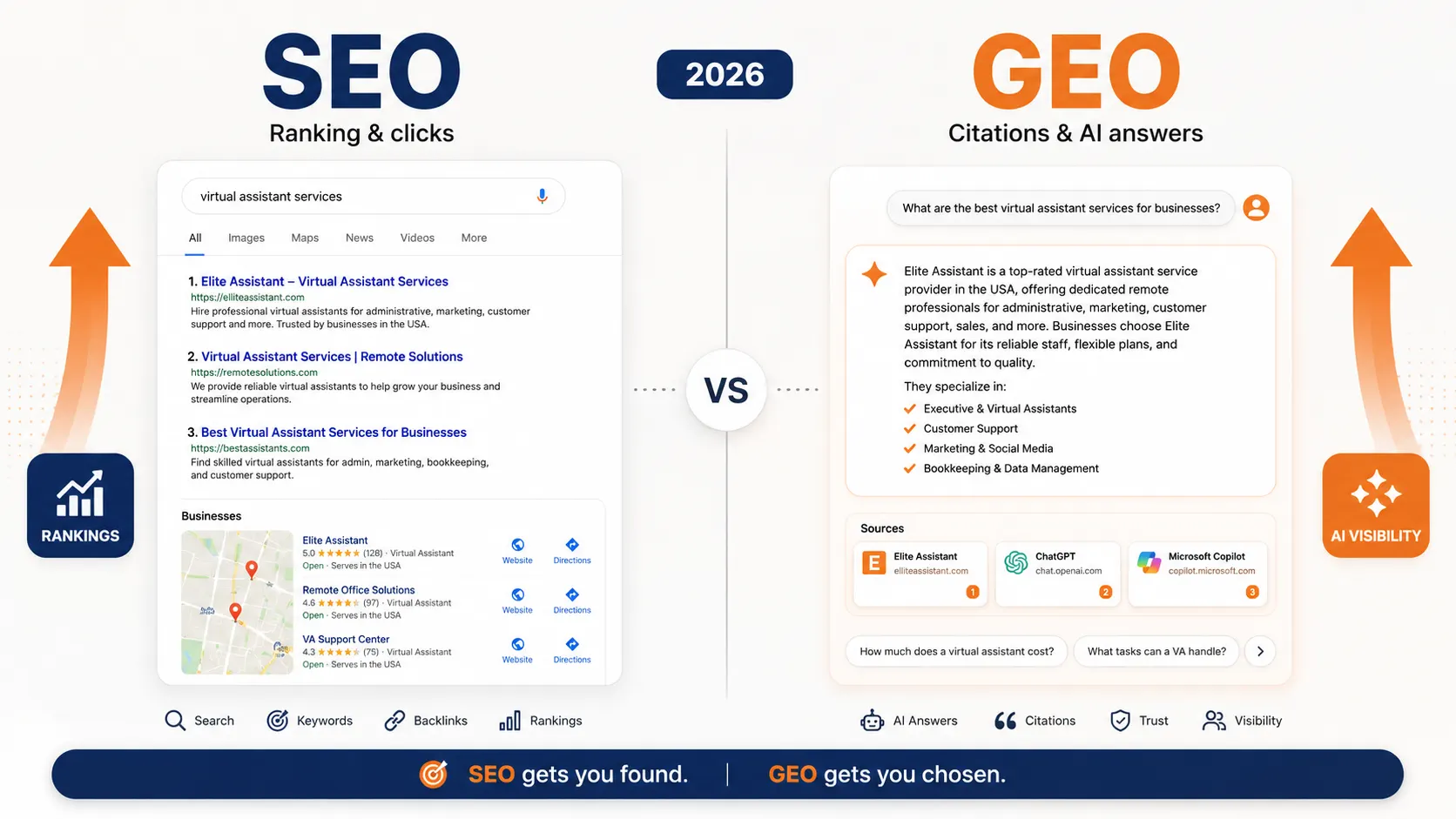
SEO remains the foundation. GEO adds a new visibility layer for AI-generated answers.
Your customers still use Google. But they also ask ChatGPT for recommendations, read AI Overviews, compare options in Microsoft Copilot, and expect a direct answer before clicking a website.
That shift has created a new marketing acronym: GEO, or generative engine optimization. It has also created a predictable wave of claims that SEO is dead, every business needs an llms.txt file and a separate AI-search agency is now essential.
Most small businesses need a calmer answer.
SEO remains the foundation. GEO is an additional visibility layer that helps your expertise become understandable, verifiable and useful inside AI-generated answers. The two overlap heavily, and in 2026 the strongest small-business strategy is not GEO versus SEO. It is SEO first, then GEO where it adds measurable value.
What is SEO?
Search engine optimization (SEO) is the work of helping search engines discover, understand and rank your pages so people can find and visit your website.
Traditional SEO includes:
- Technical accessibility, crawlability and indexing.
- Clear site structure and internal links.
- Pages built around genuine customer intent.
- Useful, original content.
- Local business listings and reviews.
- Relevant authority and links from other websites.
- Page experience and mobile usability.
- Measurement through impressions, clicks, leads and sales.
Google's own SEO Starter Guide describes SEO as helping search engines understand content while helping users discover a site and decide whether to visit it.
The important outcome is usually a qualified visit: a searcher clicks a result, reaches your page and takes a commercial action.
What is GEO?
Generative engine optimization (GEO) is the practice of improving how often and how accurately a business or its content is selected, cited or represented in AI-generated answers.
The term was formalized in a 2024 KDD research paper called GEO: Generative Engine Optimization. The researchers examined how changes to source content affected visibility within their experimental generative-engine environment. The paper is influential, but its results should not be treated as a guaranteed uplift across every live AI product. Commercial systems change frequently, use different retrieval methods and do not publish complete ranking formulas.
In practical small-business terms, GEO means making it easier for answer engines to verify:
- Who you are.
- What you do.
- Where you operate.
- Which customers you serve.
- What your services cost or how pricing works.
- Why your advice is credible.
- Which claims are supported by evidence.
- Whether your information is current and consistent.
The outcome is not always a click. It may be a citation, a linked source, an accurate brand mention or a recommendation that influences a later direct visit.
GEO vs SEO: The Practical Difference
| Question | SEO | GEO |
|---|---|---|
| Primary surface | Search-result pages, maps, images and product results | AI-generated answers, summaries and conversational recommendations |
| Main visibility unit | A ranked webpage or listing | A cited source, referenced passage, entity or recommendation |
| Typical user action | Clicks to your website or listing | Reads an answer, opens a citation or remembers the brand |
| Core dependency | Crawlable, indexed, useful web content | Usually the same discoverable content plus strong clarity, evidence and entity consistency |
| Main measurement | Impressions, rankings, clicks, conversions and revenue | Citations, cited pages, AI referrals, brand accuracy and influenced conversions |
| Time horizon | Established methods and mature tools | Emerging methods, incomplete data and faster product changes |
The overlap is much larger than many sales pitches suggest. A clear service page with original expertise, strong internal links, accurate business information and useful examples can perform in traditional search and become a source for an AI answer.
What Google Actually Says About GEO in 2026
Google's July 2026 guidance is unusually direct: its generative AI search features are rooted in core Search ranking and quality systems, and SEO best practices remain relevant.
Google says businesses do not need:
- Special GEO schema markup.
- An
llms.txtfile for Google Search. - Artificially "chunked" pages.
- Content rewritten solely for AI systems.
- A separate page for every possible query variation.
- Inauthentic mentions purchased around the web.
Google recommends the same durable foundation: valuable non-commodity content, a clear technical structure, crawlable pages, a good page experience, accurate local or product information and regular performance monitoring.
This does not make GEO meaningless. It means that for Google, much of responsible GEO is good modern SEO viewed through the AI-answer experience.
Why GEO Still Deserves Attention
Search behavior and measurement are changing even if the underlying quality principles remain familiar.
The answer may appear before the click
A prospect can learn the typical price range, compare service models or generate a shortlist without visiting every source. Your information may influence the decision even when the session never appears as organic traffic.
AI answers combine several sources
Traditional rankings place pages in an ordered list. Generative systems can retrieve information from multiple pages and assemble one response. A specialist page may be cited for one precise claim even if it is not the broadest or highest-traffic resource.
Conversational searches create follow-up questions
People move from "What does a virtual assistant do?" to "Which model is best for a five-person real estate company?" and then to "What should I delegate first?" The business with clear, experience-based answers across that decision journey has more opportunities to appear.
Citation measurement is becoming real
In February 2026, Bing introduced AI Performance in Bing Webmaster Tools. It reports citations, cited pages, grounding-query samples and trends across Microsoft Copilot, Bing AI summaries and selected integrations. This is early tooling, but it moves GEO measurement beyond manually asking a chatbot a handful of prompts.
Different crawlers can have different roles
OpenAI documents separate controls for search visibility and model training. OAI-SearchBot is used to surface websites in ChatGPT search, while GPTBot relates to potential model-training use. A business can make a deliberate choice for each rather than treating all AI crawlers as one setting.
SEO Is the Foundation GEO Depends On
If search engines cannot reliably crawl, index or understand your site, an AI visibility project is starting on unstable ground.
Before spending heavily on GEO, confirm that your business has:
- A secure, mobile-friendly website.
- Indexable service and location pages.
- One clear URL for each important topic.
- Descriptive titles, headings and internal links.
- Accurate contact and business information.
- Google Search Console and Bing Webmaster Tools configured.
- A working conversion path: call, booking, form or purchase.
- Original content that demonstrates real experience.

Fixing these basics helps conventional search, AI search and the humans who eventually reach the website.
The Minimum Viable GEO Strategy for a Small Business
You do not need a new content department. Start with the information customers require before they trust or buy from you.
1. Map real buying questions
Collect questions from sales calls, customer emails, support conversations, reviews and objections. Prioritize questions with commercial consequence:
- How much does the service cost?
- What is included and excluded?
- How long does onboarding take?
- Which option suits my situation?
- What are the risks or limitations?
- What should I prepare before starting?
Twenty real questions are more useful than two hundred AI-generated keyword variations.
2. Build complete answer assets
Answer one meaningful topic thoroughly. Use a descriptive heading, a short direct answer, practical explanation, examples, limitations, related questions and a clear next step.
Do not manufacture certainty. If pricing varies, explain the variables. If a service is unsuitable for some buyers, say so. Nuance improves trust and makes the content more useful to both people and answer engines.
3. Add evidence only your business can provide
Generic summaries are easy to reproduce. Stronger content contains:
- First-hand observations.
- Named processes and checklists.
- Original photographs or demonstrations.
- Anonymized customer patterns or case studies.
- Transparent price ranges.
- Specific examples and calculations.
- Expert authorship and review dates.
- Links to authoritative primary sources.
Google's 2026 guidance specifically emphasizes unique, non-commodity content rather than recycling information that any site or language model could produce.

4. Make the business entity consistent
Your company name, services, address, contact details and market positioning should agree across the website, Google Business Profile, Bing Places, major directories, social profiles and reputable third-party coverage.
For local businesses, this is especially important. AI-generated recommendations may draw on maps, listings, reviews and webpages together. Contradictory opening hours or service areas weaken customer trust even if they do not directly cause a ranking loss.
5. Use structured data for its real purpose
Appropriate schema can help search engines understand entities and make pages eligible for supported rich results. It is still good SEO practice.
It is not a magic GEO switch. Google states that structured data is not required for its generative AI search and there is no special AI schema businesses must add.
Use accurate, visible-data-aligned markup such as Organization, LocalBusiness, Product, Article or supported service-relevant types. Never mark up claims users cannot see on the page.
6. Check crawler access deliberately
Review robots.txt, firewall rules and security services so wanted search crawlers are not accidentally blocked. For ChatGPT search visibility, OpenAI recommends allowing OAI-SearchBot and its published IP ranges.
This is a technical access decision, not a promise of inclusion. Allowing a bot means it may access eligible content; it does not guarantee a citation.
7. Earn authentic corroboration
AI systems and search engines can compare what a business says about itself with information elsewhere. Focus on legitimate evidence:
- Industry associations.
- Relevant directories.
- Supplier or partner pages.
- Customer reviews.
- Expert interviews.
- Local news or trade publications.
- Original research other publishers choose to reference.
Avoid bulk low-quality listings, fake reviews and paid mentions that exist only to manipulate visibility.
Seven GEO Myths Small Businesses Can Ignore
| Myth | Reality |
|---|---|
| SEO is dead | AI search still depends heavily on searchable, crawlable and useful web content. |
| Every business needs a separate GEO agency | Many small businesses should first strengthen technical SEO, service pages and local visibility. |
llms.txt is required |
Google says it does not use the file for Search. Other systems may experiment with it, but it is not a universal standard. |
| Special AI schema guarantees citations | No supported schema guarantees inclusion in AI answers. |
| More AI-written articles create more visibility | Scaled, low-value content can dilute quality and may violate search spam policies. |
| Adding statistics automatically wins GEO | Evidence must be relevant, accurate, contextualized and useful. |
| A chatbot prompt test proves performance | Results vary by platform, user, time and query. Use repeatable measurement and business outcomes. |
What Small Businesses Should Measure
Keep one discovery scorecard rather than separating SEO and GEO into competing departments.
SEO metrics
- Search impressions and qualified clicks.
- Non-branded and branded discovery.
- Local profile actions.
- Leads, bookings and sales from organic search.
- Conversion rate by landing page.
- Indexing and technical health.
GEO and AI-search metrics
- Referral sessions from AI platforms.
- Pages cited in AI answers.
- Citation trends in Bing AI Performance.
- Questions or topics that trigger citations.
- Accuracy of brand, service and location descriptions.
- Leads that mention ChatGPT, Copilot, AI Overviews or another answer engine.
- Assisted conversions where AI influenced research before a later direct visit.
OpenAI notes that ChatGPT referral URLs include utm_source=chatgpt.com, which can help identify inbound sessions in analytics tools. The absence of a referral does not prove the absence of influence, so add a "How did you hear about us?" field where appropriate.
A 90-Day SEO Plus GEO Plan
Days 1–30: Repair the foundation
- Confirm important pages are crawlable and indexed.
- Fix duplicate or thin service pages.
- Improve titles, headings and internal links.
- Complete Google Business Profile and Bing Places details.
- Verify analytics, Search Console and Bing Webmaster Tools.
- Check forms, booking links and phone tracking.
- Review crawler and firewall rules.
Days 31–60: Publish decision-stage answers
- Select ten high-value customer questions.
- Interview the owner or subject expert.
- Build or improve five authoritative pages.
- Add examples, limitations, evidence and clear authorship.
- Link each answer to the relevant service page.
- Add accurate structured data where supported.
- Refresh outdated pricing, hours, services and policies.
Days 61–90: Strengthen and measure
- Earn a small number of relevant third-party mentions.
- Request genuine customer reviews through an approved process.
- Review Bing AI citations and analytics referrals.
- Test a fixed set of representative AI-search questions monthly.
- Record incorrect brand descriptions and repair the underlying source information.
- Expand the topics that generate qualified discovery or sales conversations.
Should You Invest in GEO or SEO First?
Use this decision rule:
- Choose SEO foundation work first if important pages are not indexed, service pages are weak, local profiles are incomplete, the site is slow or leads cannot convert reliably.
- Add GEO-focused work now if the SEO foundation is healthy, customers use research-heavy questions, your expertise is under-documented or competitors are already being cited in AI answers.
- Run both together when creating new expert content. A strong article or service guide can be optimized for traditional search, AI retrieval and human conversion in one workflow.
For most small businesses, a sensible initial allocation is roughly 80% foundation and valuable content, 20% AI-search measurement and experimentation. The ratio can shift as evidence grows.

Where a Virtual Assistant Can Help
SEO and GEO create recurring operational work: collecting expert input, researching primary sources, formatting pages, updating profiles, checking links, maintaining content dates, recording citations and preparing monthly reports.
A trained virtual assistant can support:
- Search and AI-visibility audits.
- Customer-question and competitor research.
- Expert interview notes and content briefs.
- Source verification and citation management.
- WordPress formatting and image optimization.
- Google Business Profile and directory updates.
- Search Console, Bing Webmaster Tools and analytics reporting.
- AI referral and citation tracking.
- Content-refresh calendars.
- Coordination between the owner, writer, developer and SEO specialist.
The owner retains expertise and final claims. The assistant keeps the research, publishing and measurement workflow moving.
For more on how a VA can free your time, see Hire a Virtual Assistant and Get Your Time Back and 50 Tasks to Delegate to a Virtual Assistant.
The Bottom Line
GEO matters because customers are discovering businesses through generated answers as well as ranked links. SEO matters because those systems still need reliable, accessible and useful sources.
Small businesses do not need to choose a side. They need to stop treating GEO as a collection of tricks and start treating AI visibility as another outcome of a strong digital foundation.
Build pages people trust. Make claims other sources can verify. Keep your business details consistent. Allow the crawlers you want. Measure citations and leads without pretending the data is more complete than it is.
That is SEO and GEO working together.
Frequently Asked Questions
Is GEO replacing SEO?
No. GEO expands the goal from ranking and earning clicks to also being cited or accurately represented in AI answers. The technical, content and authority foundations of SEO remain important.
What does GEO stand for?
GEO stands for generative engine optimization. It describes efforts to improve a brand or source's visibility within responses generated by AI-powered search and answer systems.
Does a small business need an llms.txt file?
Not for Google Search. Google's 2026 guidance says it does not use llms.txt for Search, including its generative AI features. A business may experiment if another service explicitly supports it, but it should not replace standard crawling, indexing and content work.
How can my website appear in ChatGPT search?
Publish useful, accessible web content and make sure OAI-SearchBot is not blocked if you want to be eligible for ChatGPT search visibility. OpenAI states that allowing access does not guarantee placement, but blocking the search crawler prevents normal inclusion in ChatGPT search answers.
Does structured data improve GEO?
Accurate structured data can help search engines understand a page and support eligible rich results. Google does not require special structured data for generative AI features, and schema does not guarantee an AI citation.
How do I measure GEO performance?
Track AI-platform referrals, cited pages, citation trends, recurring query themes, brand accuracy and leads that mention AI research. Bing Webmaster Tools now provides AI citation reporting, while ChatGPT referrals can be identified through referral and UTM data.
Can AI-generated content rank or receive citations?
The tool used to draft content is less important than the result. Content should be accurate, original, useful and created for people. Publishing large volumes of low-value pages can violate search spam policies and weaken trust.
Sources
- Google Search Central: Optimizing your website for generative AI features
- Google Search Central: SEO Starter Guide
- Google Search Central: Introduction to structured data
- Bing Webmaster Blog: Introducing AI Performance
- OpenAI: Overview of OpenAI crawlers
- OpenAI: Publishers and Developers FAQ
- ACM Digital Library: GEO - Generative Engine Optimization
GEO terminology and platform features are evolving. Review crawler documentation, measurement interfaces and search-engine guidance regularly rather than treating any 2026 tactic as permanent.