Virtual Assistant Pricing Packages: How to Choose the Right Plan in 2026
Ellite Assistant offers virtual assistant pricing packages ranging from a five-hour paid trial to monthly plans with 10, 20, 40, 80, 140 or 180 hours. The appropriate plan depends on workload, task complexity, required availability and whether the role needs non-technical or technical skills. Businesses should also compare annual billing, rollover hours, tracking, supervision, replacement and cancellation terms.

Hiring a Virtual Assistant often starts with a simple question: how much support do we actually need?
That question is more useful than asking for the cheapest hourly rate. A business with ten hours of clearly defined monthly admin work needs a very different arrangement from an e-commerce company handling daily customer messages, product updates and order administration.
Virtual Assistant pricing packages usually combine a set number of hours with a defined level of support. Some plans are designed for occasional overflow work. Others reserve enough capacity for the assistant to become a consistent part of the business.
This guide explains how VA packages work, what Ellite Assistant's current plans include and how to choose a package without paying for hours you do not need—or buying too little support to make a meaningful difference. If you are still deciding what kind of help your business needs, start with our guide to hiring a dedicated Virtual Assistant.
Virtual Assistant Pricing Packages: The Quick Answer
Ellite Assistant currently offers packages ranging from a paid seven-day trial with five hours of support to monthly plans designed for 10, 20, 40, 80, 140 or 180 hours.
| Support level | Included time | Current listed price | Best suited to |
|---|---|---|---|
| Paid trial | 5 hours over 7 days | $49 one-time | Testing one or two defined workflows |
| Light support | 10 hours per month | $99/month, billed yearly | Occasional tasks and overflow work |
| Basic support | 20 hours per month | $149/month, billed yearly | Small recurring workloads |
| Consistent support | 40 hours per month | $299/month, billed yearly | Weekly administrative or operational support |
| Part-time support | 80 hours per month | $599/month, billed yearly | Daily part-time assistance |
| Extended support | 140 hours per month | $799/month | Larger recurring workloads |
| Full-time support | 180 hours per month | $999/month | High-volume, ongoing operational support |
The number of hours is only the first part of the comparison. Check the skill category, management support, rollover rules, time-zone coverage, reporting, replacement policy and what happens when your workload exceeds the plan.
What Is Included in a Virtual Assistant Package?
A VA package is not simply a bundle of hours. It defines the working arrangement around those hours.
Depending on the plan, Ellite Assistant lists features such as:
- A dedicated Virtual Assistant.
- Candidate matching based on the required role.
- Free assistant replacement.
- Multi-channel support.
- Flexible time-zone coverage.
- Team-lead or partnership-manager support.
- Quality control and supervision.
- Task and time tracking through a client logbook.
- Rollover hours on selected higher-volume plans.
- Backup-assistant support on selected plans.
Before purchasing any virtual assistant service package, confirm which features apply to your selected tier. If a plan promises a “dedicated assistant,” ask about reserved hours, availability, response expectations and backup coverage. You can also review the broader range of Virtual Assistant and remote staffing services before selecting a role.
How Many Virtual Assistant Hours Do You Need?
Choosing a package by instinct often creates one of two problems. The business buys too few hours and never delegates enough work to create relief, or it buys too many before it has documented suitable tasks.
A better method is to audit one normal working week. Record every task that:
- Happens repeatedly.
- Can be completed remotely.
- Can be explained with a process or example.
- Does not require the owner's judgment every time.
- Has a clear definition of “done.”
If your delegation list is still unclear, use these 50 tasks to delegate to a Virtual Assistant as a practical starting point.

Choose 10 hours per month for occasional work
Ten hours can work for a controlled list of small tasks such as monthly spreadsheet cleanup, research, data entry, document formatting or scheduled updates. It is unlikely to support a daily inbox, ongoing customer service or several unrelated workflows.
Choose 20 hours per month for one small recurring workflow
Twenty hours gives a business roughly five hours of support per week. That may be enough for CRM maintenance plus a weekly pipeline report, or another small group of closely related tasks.
Choose 40 hours per month for consistent weekly support
At approximately ten hours per week, a VA can provide more continuity. This can suit founders who need regular inbox organization, calendar coordination, CRM updates, meeting preparation and routine follow-up. Leaders with complex scheduling or confidential coordination needs may require a more specialized Executive Assistant service.
Choose 80 hours per month for part-time operational support
Eighty hours is approximately half-time capacity. At this level, the assistant can become part of the daily operating rhythm rather than handling occasional requests.

Possible uses include daily customer-support administration, e-commerce product and order support, lead research and CRM maintenance, executive scheduling and routine marketing operations.
Choose 140 or 180 hours for a stable, high-volume role
These plans are intended for businesses with enough documented work to keep an assistant consistently productive. Before choosing near-full-time support, define responsibilities, schedule, daily deliverables, response expectations, system access, escalation rules and performance measures.
Hourly VA Pricing Versus Monthly Packages
Hourly arrangements can suit irregular or project-based work. Monthly virtual assistant packages are generally better when the business needs reserved capacity and continuity.
| Factor | Hourly arrangement | Monthly VA package |
|---|---|---|
| Workload | Irregular or uncertain | Recurring and predictable |
| Capacity | May depend on availability | Hours reserved by plan |
| Budgeting | Can fluctuate | Easier monthly planning |
| Continuity | Varies by provider | Designed for ongoing support |
| Best use | Short projects or occasional help | Stable business workflows |
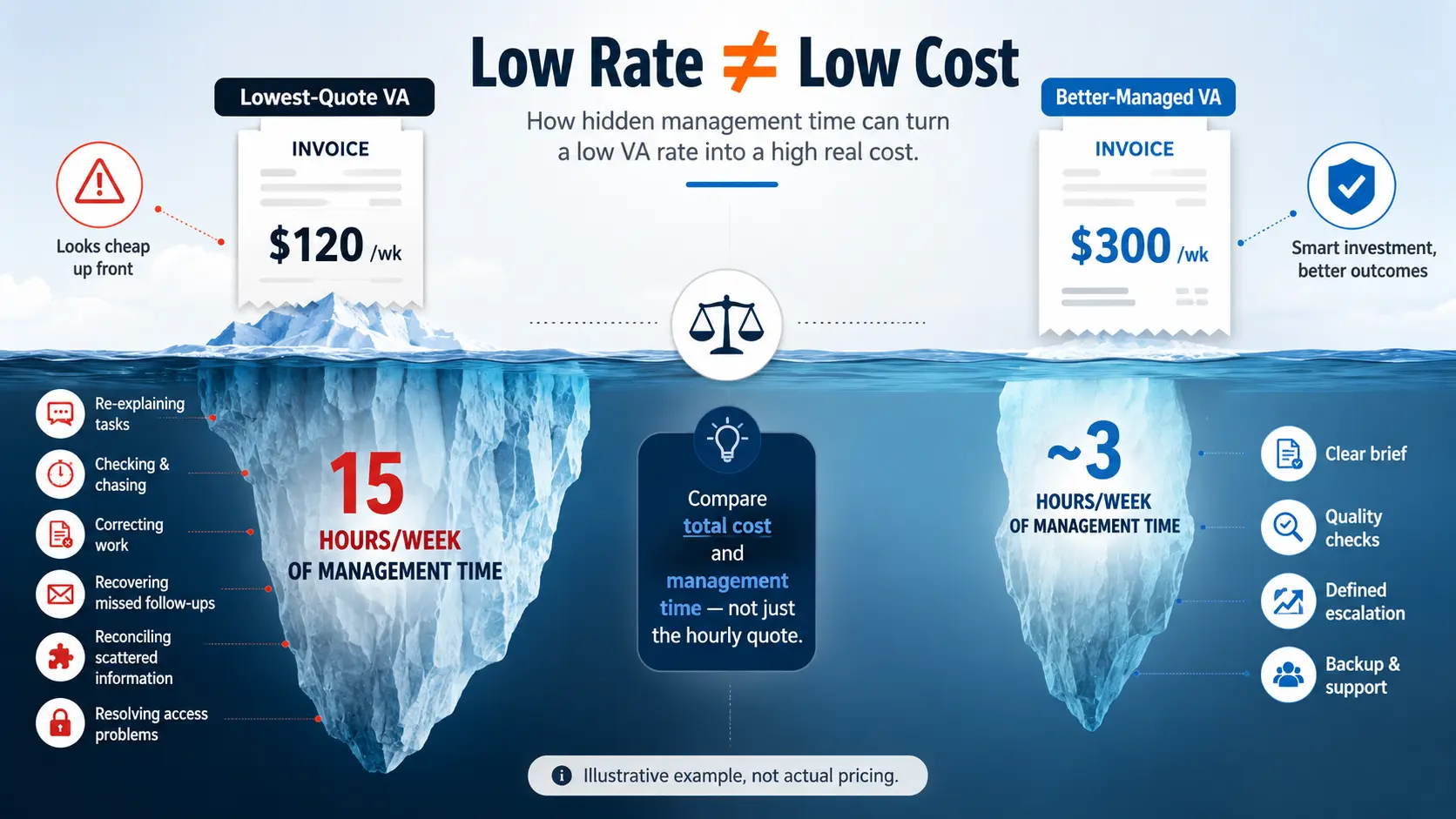
The cheaper option on paper is not always the lower-cost option in practice. If a low-priced arrangement requires the owner to recruit, train, supervise, review and replace the assistant without support, the owner's time becomes part of the real cost. The level of support also changes depending on whether you choose a Virtual Assistant, freelancer or managed agency model.
For broader market comparisons, read How Much Does a Virtual Assistant Cost in the USA in 2026?
Non-Technical Versus Technical Virtual Assistant Packages
Ellite Assistant separates non-technical and technical support because the required skills can differ substantially.
Non-technical support may include:
- Email and calendar administration.
- Data entry and research.
- Customer communication.
- CRM updates.
- Lead-list preparation.
- Appointment coordination.
- Routine bookkeeping support.
Technical support may include:
- WordPress or Shopify updates.
- Product uploads and store administration.
- Basic HTML or CSS updates.
- Website maintenance.
- Automation assistance.
- Technical customer support.
- Software-specific workflows.
Do not choose a technical package merely because a task happens inside software. Updating approved CRM fields is operational support; troubleshooting integrations or modifying a website requires a different capability.
What to Check Before Buying a VA Package
A clear package should answer more than “How many hours do I get?” Ask:
- Are the displayed prices monthly or dependent on annual billing?
- What happens to unused hours?
- What is the policy for additional hours?
- Are particular skills charged differently?
- Is candidate matching included?
- Can I interview and approve the assistant?
- Is onboarding included in the package hours?
- How are tasks and time recorded?
- What happens if the assistant is unavailable?
- Is replacement support included?
- Can I upgrade, downgrade or cancel?
- Which software costs extra?

How to Use the Seven-Day Trial Properly
Ellite Assistant currently lists a paid trial of five hours over seven days for $49. Treat it as a small operational test—not an attempt to delegate everything at once.
Choose one or two real, low-risk workflows and provide:
- A clear objective.
- Written steps.
- One example of a correct result.
- Required access.
- A deadline and priority.
- A quality standard.
- A rule for when the assistant should ask rather than guess.
Evaluate accuracy, communication, questions asked, reliability and how well the assistant handles exceptions. Speed matters, but a fast incorrect result does not demonstrate a good working fit.
Not sure which package fits your workload?
Bring us your task list, estimated hours, tools and required working schedule. We will help you identify an appropriate skill category and support level.
Compare Pricing Plans Hire a Virtual AssistantFrequently Asked Questions About Virtual Assistant Pricing Packages
What is a Virtual Assistant package?
A Virtual Assistant package combines a defined number of support hours with terms such as candidate matching, time tracking, management support, replacement options and availability. Inclusions vary by provider and plan.
How much does a Virtual Assistant package cost?
Costs vary by hours, location, experience, specialization and service model. Ellite Assistant's currently listed plans begin with a $49 paid trial and include monthly options from 10 to 180 hours.
Is 20 hours per month enough for a Virtual Assistant?
Twenty hours may be enough for one small recurring workflow or approximately five hours of weekly support. It is unlikely to cover several high-volume or daily responsibilities.
What can a VA do in 40 hours per month?
Forty hours can support a consistent set of weekly tasks such as inbox organization, scheduling, CRM updates, research, document preparation and routine follow-up. Output depends on complexity and process quality.
Do unused Virtual Assistant hours roll over?
Rollover policies vary. Ellite Assistant currently lists rollover hours on selected higher-volume plans. Confirm the allowance, expiration and eligibility before purchasing.
Should I choose a monthly package or pay hourly?
Choose hourly support for irregular or short-term work. A monthly package may be more suitable when you need recurring support, reserved capacity and continuity.
Can I change my VA plan later?
Ellite Assistant states that clients can scale their plan as workloads change. Confirm upgrade, downgrade, cancellation and billing rules before subscribing.
Are technical VA packages more expensive?
Technical work may cost more when it requires specialist software, development, automation or troubleshooting skills. The correct category depends on the responsibilities—not simply whether the assistant uses technology.
What are virtual assistant pricing packages, and how do I choose the right one?
- How much does a virtual assistant package cost?
- How many virtual assistant hours do I need?
- Is 20 hours per month enough for a virtual assistant?
- What can a virtual assistant do in 40 hours per month?
- Should I pay a virtual assistant hourly or monthly?
- Do unused virtual assistant hours roll over?
- Are technical virtual assistant packages more expensive?
- Can I change my virtual assistant plan later?