
Real Estate Virtual Assistant: Tasks, Cost and Hiring Guide
A real estate VA provides remote administrative and operational support for real estate businesses. Common responsibilities include lead management, CRM maintenance, appointment scheduling, listing support, transaction administration, marketing coordination, and reporting. Pricing depends on skills, location, capacity, specialization, and engagement model. Businesses should define outcomes, verify experience, respect licensing boundaries, protect data, and onboard the VA gradually.
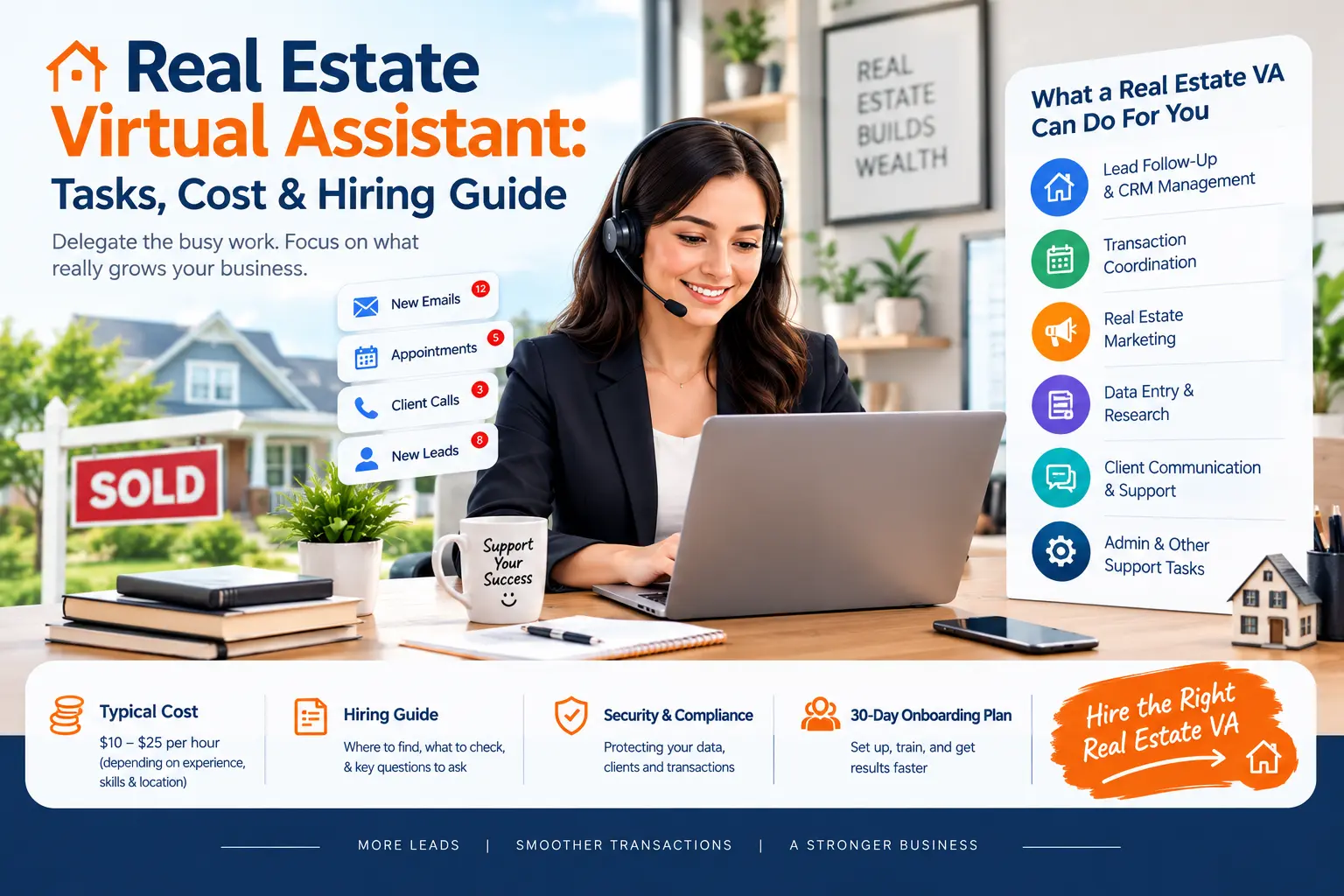
Answer summary: A real estate virtual assistant is a remote professional who supports agents, brokers, investors, or property teams with repeatable work such as lead follow-up, CRM updates, listing administration, appointment scheduling, transaction checklists, database management, and marketing coordination. Cost depends on experience, location, specialization, hours, and whether the VA is freelance, part-time, dedicated, or managed.
Real estate is a relationship business supported by a large amount of administrative work. Every new enquiry may require a fast response, several follow-ups, CRM updates, a scheduled call, property information, document coordination, and accurate next steps.
When agents handle all of that personally, revenue-producing activities compete with routine execution. Prospecting gets postponed, follow-ups slow down, listings become inconsistent, and clients wait longer for updates.
A real estate virtual assistant can create operational capacity without immediately adding another in-office employee. But the results depend on assigning the right work, selecting the right level of experience, setting appropriate access controls, and onboarding the VA around measurable workflows.
What Is a Real Estate Virtual Assistant?
A real estate virtual assistant, or real estate VA, is a remote professional who provides administrative, operational, sales-support, marketing, listing, or transaction-related assistance to a real estate business.
The VA can support an individual agent, brokerage, property investor, property manager, mortgage professional, or real estate team. The exact scope depends on the business model, local rules, the VA's experience, and which activities require a real estate license.
A VA should not automatically be treated as a licensed real estate professional. Activities involving representation, negotiation, advice, or other regulated conduct must remain with appropriately licensed people under applicable state and local rules.
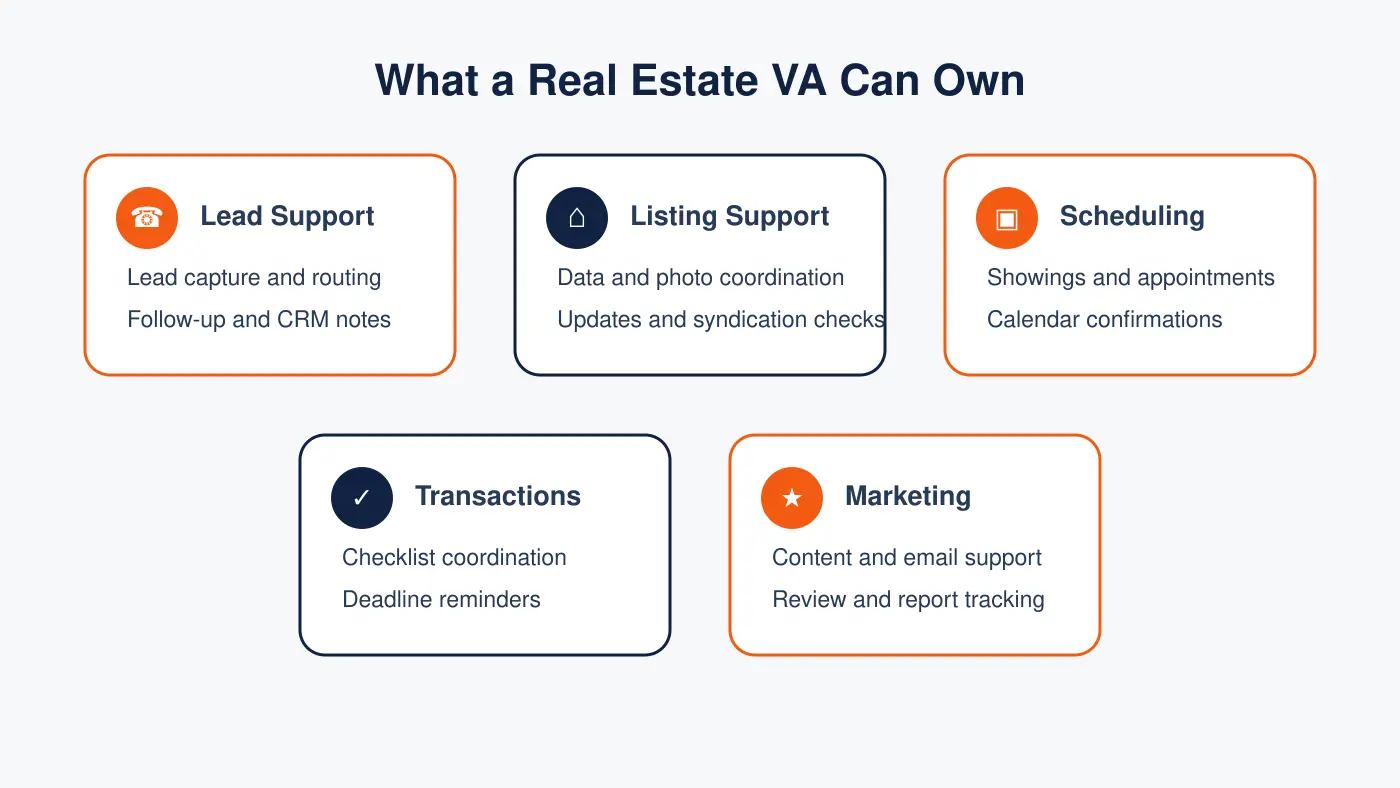
What Tasks Can a Real Estate Virtual Assistant Perform?
The best tasks are remote-friendly, repeatable, documentable, and measurable. Exact responsibilities must be adjusted to your jurisdiction and brokerage policies.
1. Lead Capture and Follow-Up Support
- Entering new enquiries into the CRM
- Assigning leads according to defined routing rules
- Sending approved initial responses
- Scheduling follow-up reminders
- Updating lead status and communication notes
- Re-engaging older leads using approved scripts
- Escalating high-intent prospects to an agent
If enquiries are being lost because the team responds too slowly, read Why Real Estate Teams Are Quietly Losing Deals to Slow Admin and Virtual Assistant for Lead Follow-Up.
2. CRM and Database Management
- Creating and updating contact records
- Removing duplicates and correcting incomplete fields
- Maintaining lead stages, tags, notes, and next-action dates
- Segmenting contacts for approved campaigns
- Preparing pipeline and activity reports
- Flagging neglected or overdue opportunities
3. Listing Administration
- Collecting approved property details and media
- Preparing listing drafts for licensed review
- Coordinating photography, floor plans, and vendor schedules
- Checking listing information for completeness
- Updating approved descriptions, statuses, and open-house details
- Maintaining listing files and marketing asset folders
4. Appointment and Showing Coordination
- Managing calendars and booking requests
- Confirming appointments and sending reminders
- Coordinating approved access instructions
- Organizing viewing schedules and route information
- Recording feedback and notifying the responsible agent
5. Transaction Administration
- Maintaining transaction checklists
- Organizing documents in approved systems
- Tracking administrative deadlines
- Coordinating status updates among authorized parties
- Sending reminders for missing information
- Preparing closing or handover files for review
A VA can support the administrative workflow, but responsibility for regulated transaction activity must remain with qualified and authorized professionals.
6. Real Estate Marketing Support
- Scheduling approved social media content
- Preparing email newsletters from approved templates
- Coordinating listing graphics and property brochures
- Updating agent profiles and business directories
- Tracking campaign enquiries and basic performance data
- Repurposing approved property content across channels
7. Client and Vendor Coordination
- Sending approved onboarding information
- Coordinating inspectors, photographers, cleaners, and contractors
- Maintaining vendor contact records
- Sending routine status updates
- Escalating questions that require agent judgment
What Should You Not Delegate to an Unlicensed Real Estate VA?
Rules vary by location, so obtain guidance from your broker, legal adviser, and relevant real estate regulator. In general, do not assign activities that require a license or independent professional judgment.
- Negotiating price, terms, commissions, or contracts
- Providing legal, tax, mortgage, or investment advice
- Representing themselves as a licensed agent when they are not
- Making final decisions on offers or contractual commitments
- Disclosing confidential client information without authorization
- Publishing unapproved claims or discriminatory advertising
- Handling funds unless properly authorized and controlled
When Should a Real Estate Agent or Team Hire a VA?
You may be ready when several of these signs occur together:
- New leads wait too long for a response.
- Your CRM does not accurately show the pipeline.
- You repeatedly complete administrative work at night or on weekends.
- Listing updates, marketing tasks, or client messages are inconsistent.
- Revenue-producing activities are being postponed.
- The team needs more capacity but not another in-office employee.
- At least 10 hours of weekly work could be documented and delegated.
Before hiring, track your work for two weeks. Sort it into licensed or strategic work, delegable execution, automation, and work to stop. The delegable category becomes the starting scope.
For a broader workload audit, see What Every Entrepreneur Should Outsource First and What Should a Business Owner Automate, Delegate, or Do Themselves?.
How Much Does a Real Estate Virtual Assistant Cost?
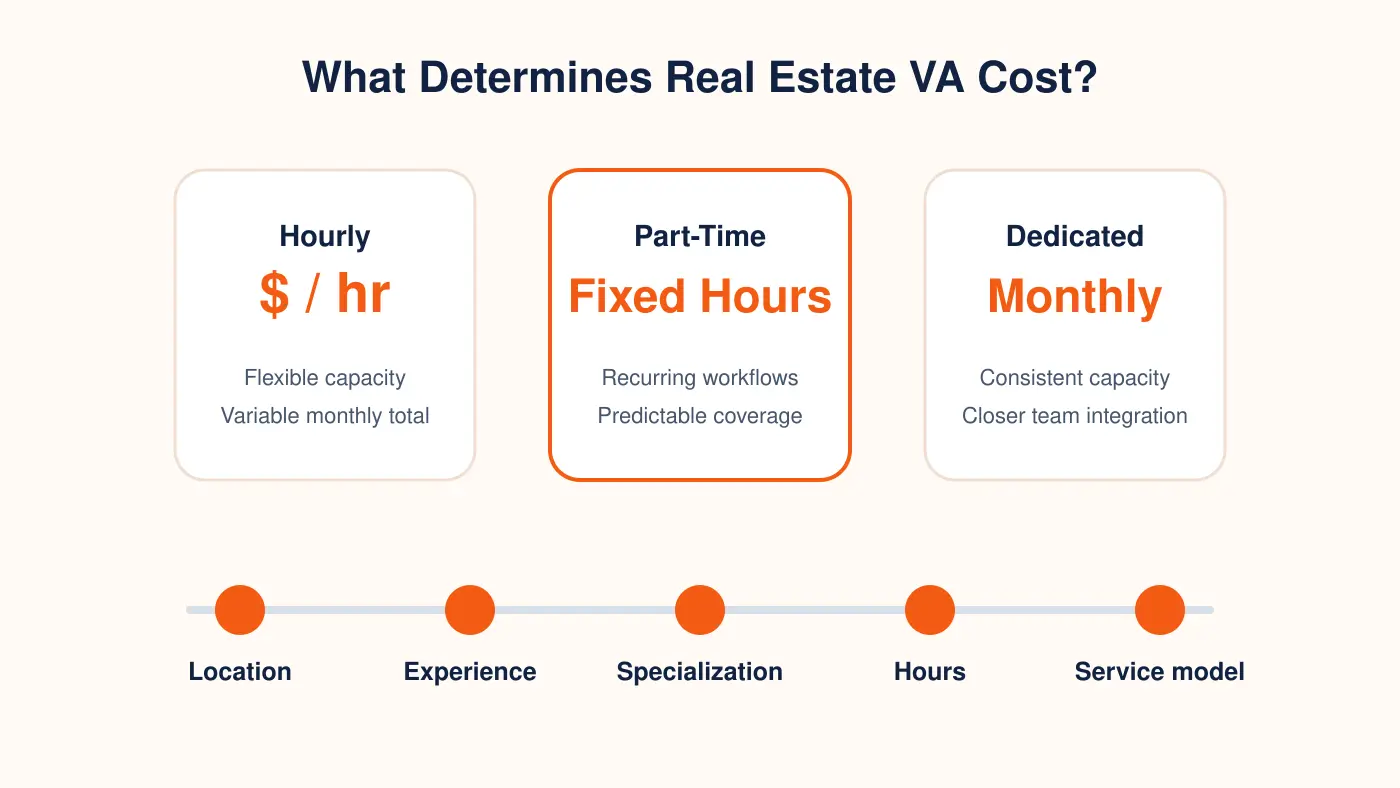
There is no single universal rate. Real estate VA cost depends on location, experience, specialization, hours, working-time overlap, software knowledge, service model, and the complexity or risk of the assigned workflows.
Common pricing arrangements include:
- Hourly: useful for limited or changing workloads
- Part-time monthly: useful for stable recurring workflows
- Dedicated monthly: useful when consistent availability and closer integration are required
- Project-based: useful for defined database cleanup, listing migration, or campaign projects
Compare total engagement value rather than hourly price alone. Ask whether recruiting, vetting, onboarding, management support, software, minimum hours, replacement coverage, and unused hours are included.
For current pricing considerations, read How Much Does a Virtual Assistant Cost in the USA? and Virtual Assistant Pricing Packages.
Freelance, Part-Time, Dedicated, or Managed Real Estate VA?
| Model | Best for | What you manage |
|---|---|---|
| Freelance VA | Clear scope and hands-on owners | Sourcing, vetting, onboarding, performance, continuity |
| Part-time VA | Stable but limited weekly workload | Priorities, workflow documentation, feedback |
| Dedicated VA | Consistent support across several workflows | Business context, access, outcomes, daily coordination |
| Managed VA service | Teams seeking additional provider support | Priorities, approvals, business-specific training, performance feedback |
For a broader comparison, read Virtual Assistant vs. Freelancer vs. Agency and Virtual Assistant vs. Employee.
How to Hire a Real Estate Virtual Assistant in 8 Steps
1. Audit Your Workload
Record recurring work, time spent, delays, tools, and consequences when tasks are missed.
2. Define Outcomes
Replace “manage my CRM” with a measurable scope: review new leads daily, complete required fields, assign approved stages, create next actions, flag exceptions, and submit a weekly data-quality report.
3. Confirm Legal and Brokerage Boundaries
Identify which tasks require licenses, supervision, approvals, or specific disclosures in your jurisdiction.
4. Choose the Service Model
Select freelance, part-time, dedicated, or managed support based on capacity and how much recruiting and management you want to own.
5. Write a Real Estate-Specific Brief
List property type, market, responsibilities, tools, hours, time-zone overlap, expected volume, communication standards, access rules, and success measures.
6. Vet Relevant Experience
Ask candidates to explain similar workflows, software familiarity, handling of sensitive data, quality checks, and when they would escalate rather than guess.
7. Use a Small Paid Test
Test a realistic, non-sensitive workflow such as cleaning sample CRM records, organizing mock listing information, or preparing a sample follow-up queue.
8. Start Narrow and Expand
Begin with one or two recurring workflows. Add responsibility only after accuracy, speed, communication, and documentation become reliable.
For a detailed selection process, see How to Hire a Virtual Assistant: A Step-by-Step Guide.
Questions to Ask a Real Estate VA Candidate
- Which real estate workflows have you handled?
- Which CRM, transaction, listing, and scheduling tools have you used?
- How would you prioritize a new lead, a client update, and an incomplete listing?
- What would make you escalate a request to an agent?
- How do you check CRM and listing data for errors?
- How do you protect confidential client and property information?
- What reports would you provide each week?
- How much working-hour overlap can you provide?
- Which tasks would you refuse because they require a license or authority?
- What information do you need to succeed during the first month?
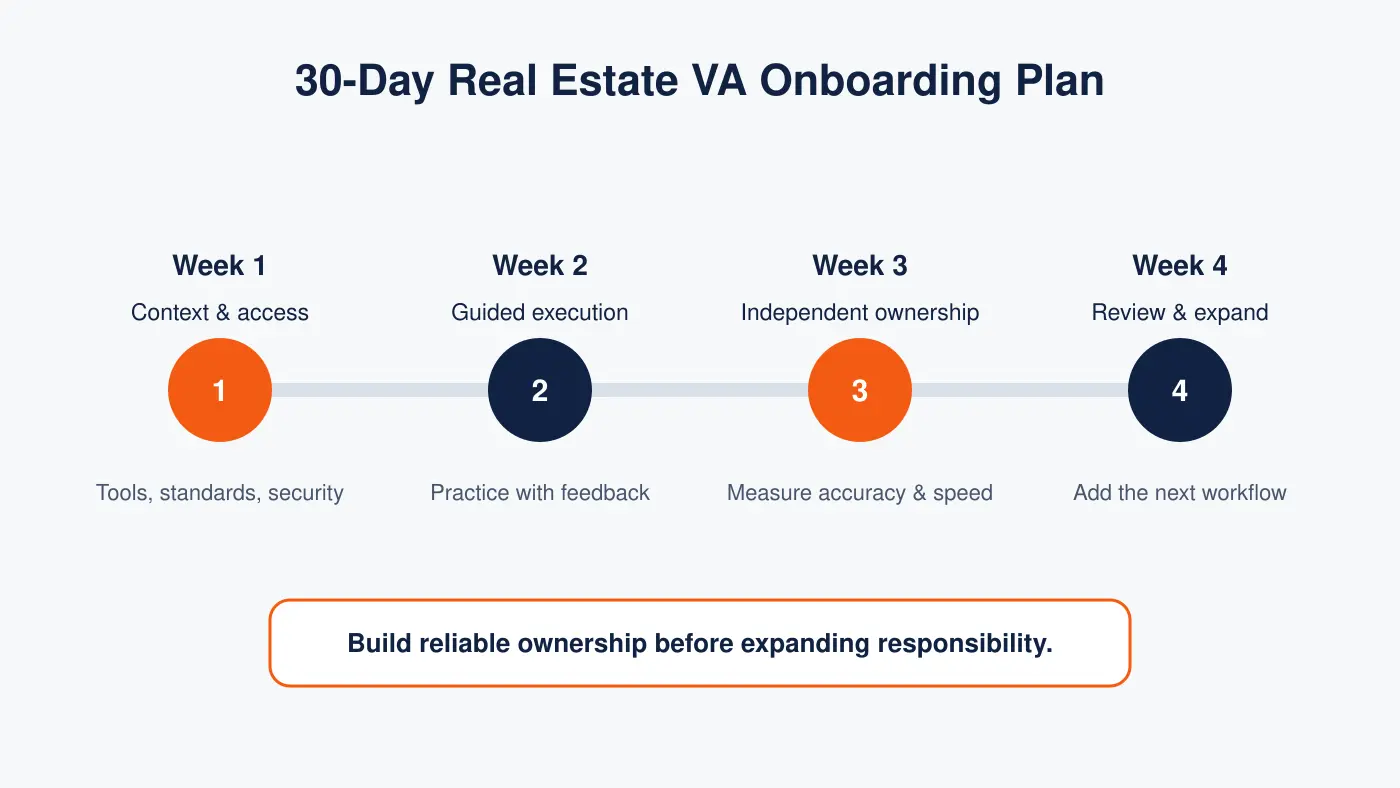
A 30-Day Real Estate VA Onboarding Plan
| Week | Focus | Actions |
|---|---|---|
| Week 1 | Context and access | Explain the market, clients, brokerage rules, tools, security, approval limits, and one core workflow. |
| Week 2 | Guided execution | Run the workflow with daily review; document questions, exceptions, and escalation rules. |
| Week 3 | Independent ownership | Reduce supervision and measure accuracy, turnaround, updates, and exception handling. |
| Week 4 | Review and expand | Refine the SOP and add the next workflow only when the first is reliable. |
How to Protect Real Estate and Client Data
- Create individual accounts instead of sharing logins.
- Enable multi-factor authentication.
- Use a password manager where appropriate.
- Apply role-based and least-privilege access.
- Keep sensitive documents in approved systems.
- Document confidentiality and data-handling obligations.
- Review access periodically and remove it promptly when no longer required.
For a complete security checklist, read Data Security and Compliance When Outsourcing to a Virtual Assistant.
How to Measure Real Estate VA Performance
- Lead response time: time from enquiry to approved first action
- Follow-up completion: percentage completed by the required date
- CRM accuracy: completeness and error rate of records
- Listing turnaround: time to prepare approved listing materials
- Deadline reliability: administrative milestones completed on time
- Agent hours recovered: time returned to client and revenue activities
- Escalation quality: issues correctly identified and routed
Sources and Compliance References
- U.S. Department of Housing and Urban Development: Fair Housing
- IRS: Independent Contractor or Employee?
- NIST: Multi-Factor Authentication Guidance
These references provide general information. Licensing, advertising, employment, privacy, and transaction rules may differ by state and business structure.
How Ellite Assistant Can Support Your Real Estate Business
Ellite Assistant helps real estate professionals build reliable remote support for lead administration, CRM maintenance, appointment coordination, listing support, transaction administration, marketing execution, reporting, and recurring back-office work.
The goal is not to delegate everything. It is to move clearly defined execution away from licensed professionals so they can focus on clients, negotiations, properties, and growth.
If slow admin is costing your team time and opportunities, hire a dedicated Virtual Assistant through Ellite Assistant.
Frequently Asked Questions
What does a real estate virtual assistant do?
A real estate VA remotely supports agents and teams with lead follow-up, CRM updates, listing administration, scheduling, transaction checklists, client coordination, database maintenance, and marketing support.
How much does a real estate virtual assistant cost?
Cost varies according to location, experience, specialization, hours, software knowledge, time-zone overlap, and service model. Compare total capability and included support instead of choosing only by hourly rate.
What should a real estate agent delegate first?
Begin with repeatable work such as CRM updates, lead routing, appointment confirmations, database cleanup, approved follow-ups, reporting, and file organization.
Can a real estate VA make cold calls?
A VA may support calling where permitted, using approved scripts and systems. Businesses must comply with applicable telemarketing, consent, do-not-call, brokerage, licensing, and privacy requirements.
Can an unlicensed VA manage property listings?
An unlicensed VA may provide permitted administrative support, such as organizing approved details or preparing drafts for review. Rules differ by jurisdiction, so confirm the scope with your broker and regulator.
Can a real estate VA handle transaction coordination?
A VA may support administrative checklists, documents, reminders, and status coordination. Licensed, legal, financial, or judgment-based activity should remain with authorized professionals.
Is a real estate VA better than an in-office assistant?
A VA can suit defined remote workflows and flexible capacity. An in-office employee may be better for physical tasks, constant local coordination, or duties requiring an on-site presence.
How many hours should I hire a real estate VA for?
Track delegable work for two weeks and total the average weekly hours. Start with enough capacity for one or two stable workflows, then expand based on results.
Which tools should a real estate VA know?
The right tools depend on your business. Relevant categories include CRM, calendar, email, transaction management, document storage, listing systems, project management, and marketing platforms.
How do I know if a real estate VA is performing well?
Track response time, follow-up completion, CRM accuracy, deadline reliability, turnaround time, escalation quality, and agent hours recovered.
What does a real estate virtual assistant do?
- What does a real estate virtual assistant do?
- How much does a real estate VA cost?
- What tasks should a real estate agent delegate?
- Can a VA make real estate cold calls?
- Can an unlicensed VA manage listings?
- Can a VA handle transaction coordination?
- Is a VA better than an in-office assistant?
- How many VA hours should a real estate agent hire?