Why “Cheap VA” Always Costs More: The Hidden 15 Hours a Week Nobody Talks About
The true cost of hiring a virtual assistant includes billed fees plus your management time, rework and error recovery. A low hourly rate can become expensive if you spend many hours each week explaining, checking and correcting work. This guide shows how to calculate real VA cost, where hidden management time disappears and how to compare pricing based on outcomes, not just the hourly quote
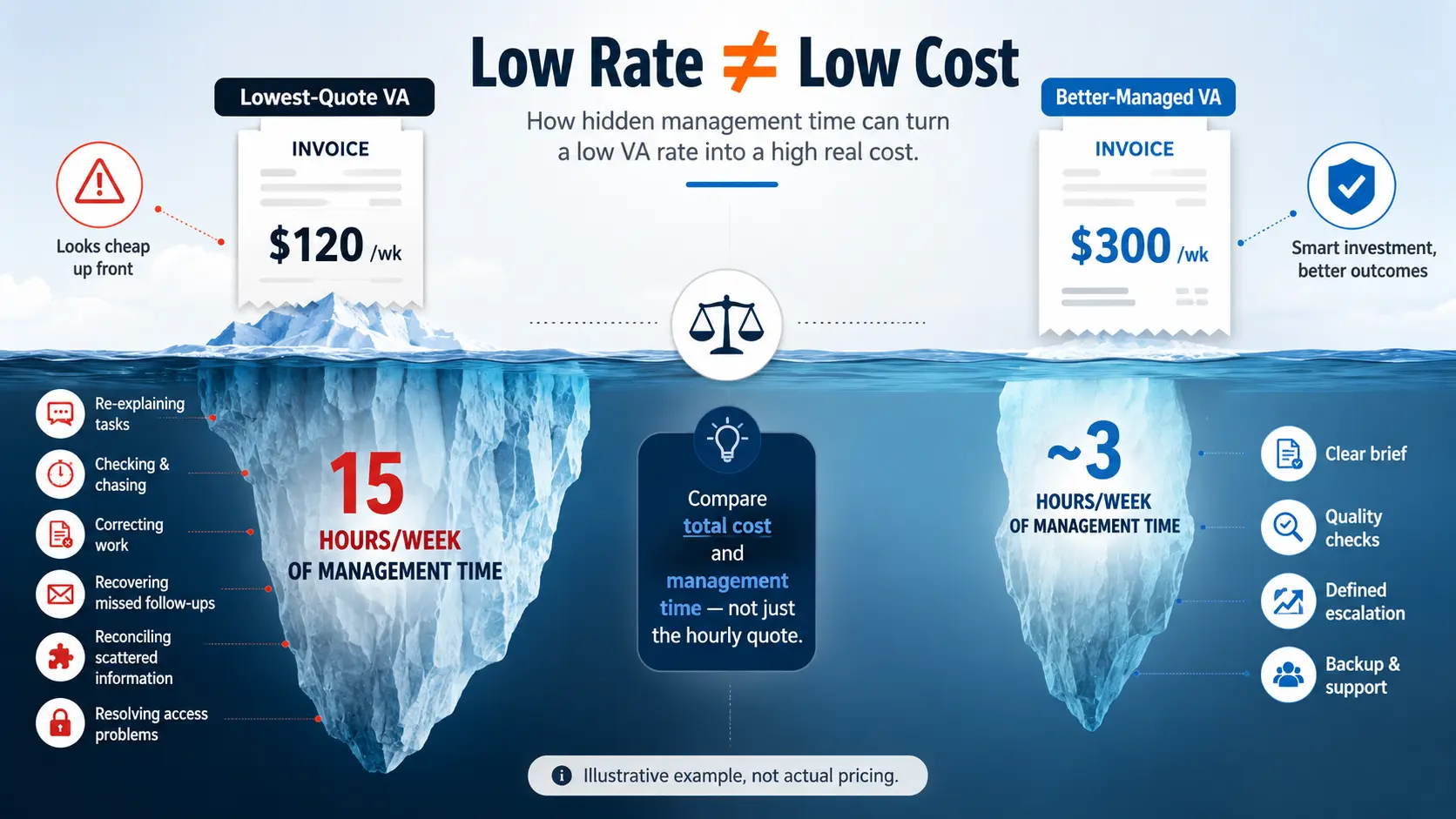
A low hourly rate does not automatically mean a low virtual assistant cost. For U.S. small-business owners, the cheapest VA can become the most expensive option when the work requires constant explanation, checking, correction and follow-up. The invoice may look small while the owner quietly spends another 15 hours each week managing the work.
The real question is not, “What is the lowest VA rate?” It is, “How much usable work do I receive without creating another management job for myself?” Affordable virtual assistant support can be an excellent investment. The problem begins when price is the only selection criterion and the hidden cost of supervision, rework, delays and missed opportunities is ignored.
This guide shows U.S. business owners how to calculate the true cost of hiring a virtual assistant, identify where management time disappears and compare VA pricing based on outcomes instead of the hourly quote alone. The 15-hour example is a transparent planning scenario—not a claim that every business loses exactly 15 hours.
What a cheap virtual assistant actually costs
Virtual assistant rates are only one line in the cost calculation. A more accurate formula is:
If a VA bills $120 for a week but the owner spends 15 hours reviewing and repairing the work, the service did not really cost $120. If the owner values an hour of their time at $75, management time alone adds $1,125. That makes the measurable weekly cost at least $1,245 before accounting for errors, missed leads or customer frustration.
This is why comparing virtual assistant pricing by hourly rate alone can be misleading. A more experienced VA or managed service may have a higher visible fee but a much lower effective cost because the work arrives complete, exceptions are escalated correctly and the owner is not dragged back into the task.
Affordable is not the same as cheap
Ellite Assistant offers affordable support, so the distinction matters. “Affordable” means the service is efficiently priced for the work delivered. “Cheap” means the buying decision ignores capability, communication, quality control, security, management requirements or task complexity.
A well-matched VA with a modest hourly rate can deliver excellent value on a clear, repeatable workflow. A poorly matched VA at the same rate may require so much intervention that delegation stops saving time. Business owners comparing options can use this broader framework alongside a guide to virtual assistant costs in the United States.

Low VA rates versus the true cost of support
Consider two hypothetical weekly options. These figures are examples for calculation purposes and do not represent Ellite Assistant’s pricing or a market average.
| Cost component | Lowest-quote option | Better-managed option |
|---|---|---|
| Weekly invoice | $120 | $300 |
| Owner management time | 15 hours | 3 hours |
| Owner time valued at $75/hour | $1,125 | $225 |
| Estimated weekly rework | $100 | $25 |
| Illustrative true weekly cost | $1,345 | $550 |
The lower invoice saves $180 but creates $975 in additional management time and rework. In this scenario, the lowest quote costs $795 more overall. The exact outcome will vary, but the method exposes the tradeoff that hourly-rate comparisons miss.
Calculate your effective VA rate
Use this calculation after the first two to four weeks:
Count accepted work—not simply logged hours. If 20 hours were billed but five hours of output had to be rebuilt, treating all 20 as productive understates the effective cost. This same approach helps owners compare a VA with a freelancer or agency using one consistent standard. For a broader comparison, review which outsourcing model fits your business.
Why inexpensive VA support becomes expensive
1. The role was purchased before the workflow was defined
A vague request such as “handle my admin” forces the VA to guess what matters, what “done” means and when to escalate. The owner then becomes the missing operating system. Clear responsibilities, deadlines, examples and approval boundaries reduce the need for daily interpretation.
2. Selection focused on the hourly rate instead of task fit
A VA who is strong at data entry may not be ready to manage client communication, bookkeeping support or sales follow-up. The lower virtual assistant rate is irrelevant when the assigned work requires judgment the person has not demonstrated.
3. No quality-control layer exists
Without checklists, sample outputs and review rules, every deliverable becomes a custom decision. Owners often respond by checking everything personally. That creates the exact management burden delegation was supposed to remove.
4. Communication expectations are unclear
Different time zones are manageable when response windows, handoff times and urgent channels are documented. They become expensive when the owner waits a full day for an answer that should have been escalated immediately.
5. The provider has no backup or management support
A single independent VA may be an excellent choice, but the business needs a continuity plan. If illness, turnover or workload pressure stops delivery, the owner may have to rebuild the entire process. Ask who protects the workflow when the assigned person is unavailable.
6. The owner delegated access before defining controls
Overly broad permissions, shared passwords and undocumented system access can turn a low-cost arrangement into a security and recovery problem. Use least-privilege access, named accounts where available and a documented offboarding process. U.S. businesses should also obtain appropriate professional guidance about contracts, worker classification, privacy and regulated information.
When a lower virtual assistant rate is still good value
A lower VA rate can be a sensible business decision when the work is well matched and properly controlled. Price alone does not determine quality.
Lower-cost support is often effective when:
- The task is repeatable and has a stable process.
- The input and expected output can be shown with examples.
- Errors are easy to identify before they affect a customer or payment.
- The VA has demonstrated the required tool and communication skills.
- Access can be limited to the information needed for the task.
- A review schedule is defined without requiring constant monitoring.
- The service includes a practical escalation and backup process.
Good VA pricing creates leverage: the owner invests a small amount of direction and receives reliable output repeatedly. Bad pricing creates dependency: the invoice is low, but the owner still owns every decision, reminder and correction.
What U.S. small-business owners should compare before hiring
Instead of sorting candidates only by virtual assistant rates, compare the complete service model.
| What to compare | What to ask | Why it affects cost |
|---|---|---|
| Relevant experience | Has the VA completed this type of workflow before? | Reduces training, clarification and avoidable rework. |
| Definition of done | Can the provider describe an acceptable finished output? | Prevents partial completion from being reported as finished. |
| Communication cadence | When will updates, blockers and exceptions be reported? | Reduces checking and missed deadlines. |
| Quality assurance | Who reviews work before it reaches the owner or customer? | Moves correction away from the business owner. |
| Backup coverage | What happens if the assigned VA is unavailable? | Protects continuity and retained process knowledge. |
| Security controls | How are access, passwords, data and offboarding managed? | Reduces the cost and risk of access recovery. |
| Reporting | Will reports show completed outputs, exceptions and next actions? | Lets the owner manage by exception instead of surveillance. |
| Scope and change rules | What is included, excluded and considered additional work? | Prevents pricing surprises and task drift. |
Before choosing a provider, view Ellite Assistant’s VA pricing plans and compare the support structure, included management and intended workload—not just the monthly total.
How to reduce hidden management time
Start with one measurable workflow
Do not begin by transferring a mixed list of unrelated tasks. Choose one workflow with a clear trigger and result, such as updating qualified leads in the CRM, preparing weekly invoices, scheduling approved social content or organizing customer-support requests.
Create a one-page operating brief
The brief should include:
- The task’s purpose and business outcome.
- Where the work begins and what counts as complete.
- Required tools, access and source files.
- One strong example and one unacceptable example.
- Deadlines and normal communication windows.
- Which decisions the VA can make independently.
- Which exceptions require approval.
Manage by exception
Routine work should not require daily approval once the process is stable. Ask the VA to report completed work, blocked items, exceptions and recommended next actions. The owner reviews the exceptions rather than reopening every task.
Track management hours for 30 days
Record the minutes spent explaining, checking, correcting and chasing. Review the total weekly. If management time is not declining, determine whether the cause is skill, scope, documentation, access, workload or approval design.

Questions to ask before choosing a VA
- What similar work has this VA completed?
- How will you confirm the scope and definition of done?
- What does onboarding require from me during the first two weeks?
- How are quality problems identified before delivery?
- Who reviews or supports the VA when a task is unclear?
- How will progress, blockers and exceptions be reported?
- What backup coverage is available?
- How do you control system access and offboarding?
- How will we measure owner time saved?
- What happens if the workflow requires skills outside the original scope?
The answers reveal whether the service is selling hours or taking responsibility for a defined operating outcome. Businesses that need help matching tasks, capacity and oversight can also explore Ellite Assistant’s Virtual Assistant support.
Frequently asked questions
What is a reasonable virtual assistant cost for a U.S. small business?
There is no single reasonable rate for every business. VA pricing varies by task complexity, experience, location, hours, management support, security requirements and whether the service is independent or managed. Compare the total cost of accepted work rather than the hourly quote alone.
Does a low VA rate always mean poor quality?
No. A lower rate can deliver strong value when the task is repeatable, the VA is appropriately skilled and the workflow includes clear instructions and quality checks. The risk comes from choosing exclusively by price without evaluating fit and management requirements.
How do I calculate the true cost of hiring a virtual assistant?
Add billed fees, the value of internal management time, rework, correction and recovery costs. Divide that total by accepted productive hours or completed outputs. Track the calculation for at least two to four weeks.
How much time should I spend managing a VA?
Management time is usually higher during onboarding and should decline as a repeatable workflow stabilizes. The appropriate amount depends on task risk and complexity. Constant checking after the ramp-up period is a warning sign that the role, process or skill match needs correction.
What tasks are suitable for an affordable VA?
Examples include structured data entry, research, inbox organization, calendar coordination, CRM maintenance, invoice preparation support, approved social scheduling and documented customer-service workflows. Higher-risk decisions should retain appropriate human approval.
Should I hire an independent VA or use a managed service?
An independent VA may suit a business that can recruit, train, supervise and provide backup internally. A managed service may be a better fit when the owner needs vetting, oversight, continuity and a clearer escalation path. The right choice depends on available management capacity.
How can I test a VA before committing to a monthly plan?
Use one defined workflow with a measurable output. Record onboarding time, accepted work, errors, communication quality and owner hours saved. Ellite Assistant also provides a five-hour, seven-day trial for $49 so businesses can test a real workflow before selecting ongoing support.
Compare the support—not only the hourly rate
Choose a Virtual Assistant plan based on the work you need completed, the management support included and the time the service can return to your business.
View Pricing PlansPricing pages and public links were checked on August 31, 2026. Rates can change and individual quotes vary. The 15-hour and cost-comparison examples are illustrative planning scenarios, not market averages or guaranteed results. This article provides general business information, not legal, tax, employment, cybersecurity or financial advice.
What is the true cost of hiring a virtual assistant?
- Does a low VA rate always mean poor quality?
- How do I calculate the true cost of a virtual assistant?
- How much time should I spend managing a VA?
- What tasks are suitable for an affordable VA?