
Insurance Verification Nightmares: How a VA Cuts Claim Denials and Delays
A healthcare virtual assistant can reduce avoidable claim denials by verifying insurance coverage, benefits, network status, referrals and prior-authorization indicators before the date of service—documenting results, following up on discrepancies and routing exceptions to qualified staff. Verification is a point-in-time administrative check, not a payment guarantee; final adjudication depends on coding, medical necessity, authorization and payer rules. Best practices include starting verification 3–5 business days before service, using the V·E·R·I·F·Y framework (Validate data, Establish eligibility, Review benefits, Investigate discrepancies, File evidence, Yield decisions to owners), implementing HIPAA safeguards (BAA when required, named accounts, MFA, least-privilege access, no PHI in personal tools) and measuring pre-service verification rate, exception resolution rate and eligibility-related denials. A 30-day pilot should start with one narrow workflow, double-review Week 2, shift routine cases to VA ownership in Week 3 and compare metrics in Week 4. Ellite Assistant's healthcare VA support is designed for defined, non-clinical workflows with documented boundaries and escalation.

Insurance verification becomes a revenue problem when nobody owns it early enough. A trained healthcare virtual assistant can reduce avoidable claim denials and payment delays by checking active coverage, benefits, network status, referrals and prior-authorization indicators before the date of service; documenting the result; following up on discrepancies; and routing exceptions to the right person.
The important qualification is that a VA cannot guarantee coverage or payment. Verification is a point-in-time administrative check, and a payer can still adjudicate a claim differently based on the final service, coding, medical necessity, authorization, contract terms, coordination of benefits or filing rules. The real value of a healthcare VA is earlier visibility: your team discovers a problem while there is still time to correct it, explain it to the patient or escalate it—not after the claim is already delayed or denied.
For U.S. independent practices, specialty clinics, therapy groups, dental offices and other outpatient teams, that shift can protect cash flow and patient trust at the same time. Ellite Assistant’s healthcare virtual assistant support is designed around this kind of defined, non-clinical workflow with documented boundaries and escalation.
Why insurance verification failures become revenue problems
Most verification breakdowns are ordinary, not dramatic. A patient changed employers. A dependent uses the subscriber’s ID. The plan is active, but the provider is out of network. A referral expired. The portal shows broad coverage but not the service-level limitation your team needs. A second payer should be primary. A prior authorization is required, but nobody moved the status from “requested” to “approved.”
Each issue is manageable when it appears several days before the appointment. The same issue becomes expensive when it appears at check-in, during claim submission or after a remittance. Staff then repeat work, contact the patient under pressure, hold the claim, rebill, investigate a denial or write off a balance that may have been collectible with earlier notice.
CMS describes the standard electronic eligibility inquiry and response as the ASC X12N 270/271 transaction. Its purpose is to obtain information about an enrollee’s eligibility and coverage. CMS also notes that eligibility operating rules require real-time responses that may include deductibles, copays, coinsurance and service-type coverage. That is a strong starting point, but it is not the whole operational answer. A practice still needs someone to match the response to the scheduled service, investigate incomplete results and preserve the evidence. See the CMS eligibility and benefit transaction guidance.
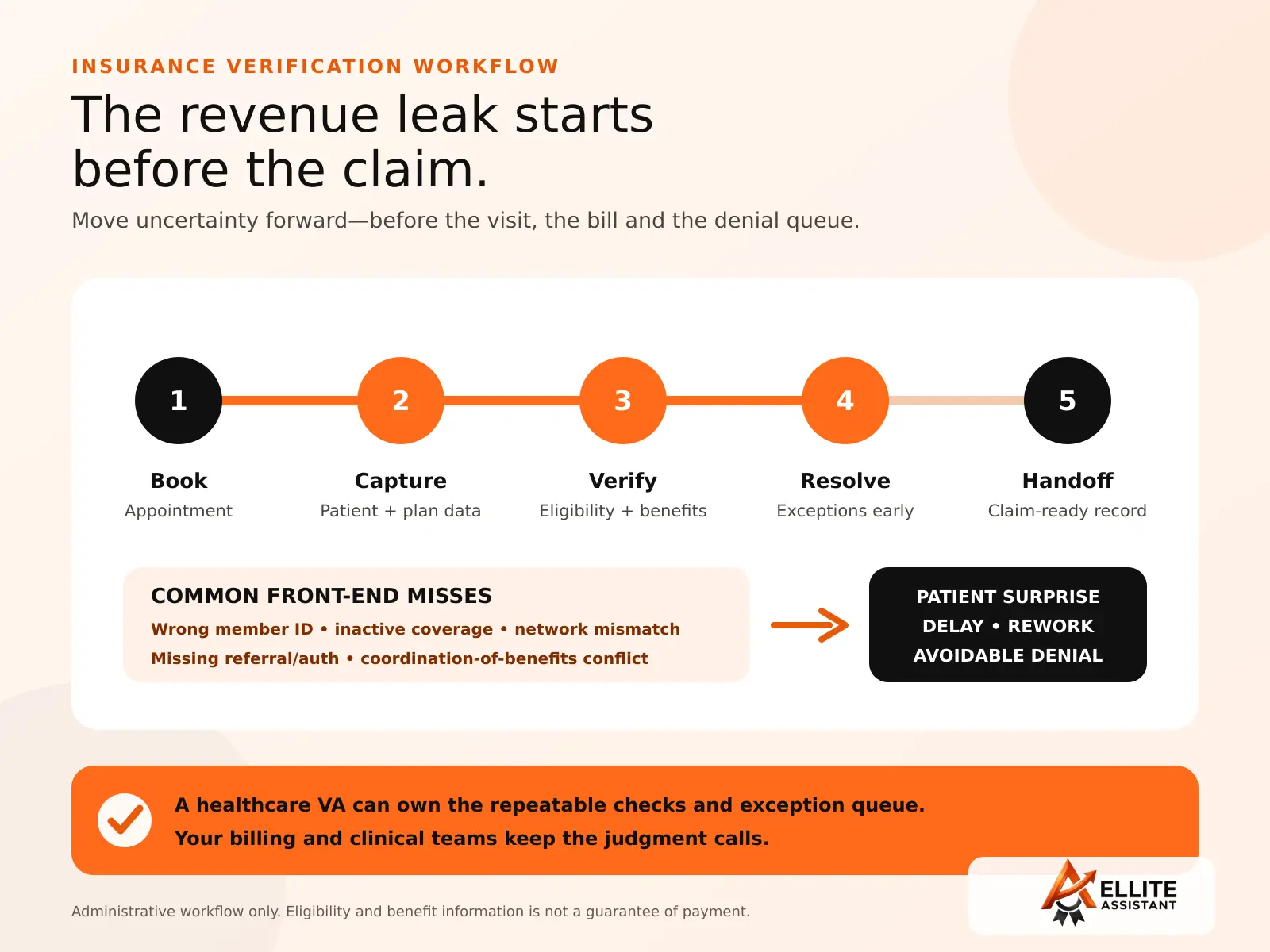
The recurring pattern: late discovery
The problem is rarely that a practice never checks insurance. It is that the check happens too late, is too shallow or produces an exception that has no owner. A green “active” result is treated as full confirmation. A phone reference number stays in somebody’s notebook. A pending authorization sits in a portal. A patient message receives no second attempt. The claim is delayed because the workflow stopped between checking and resolving.
Insurance verification, prior authorization and billing are different workflows
One of the fastest ways to create an unreliable process is to call every payer-related task “verification.” Each stage answers a different question, uses different evidence and requires different judgment. A VA can support several stages, but the scope should be explicit.
| Workflow | Main question | Appropriate VA role | Who retains judgment |
|---|---|---|---|
| Eligibility and benefits verification | Is the plan active for the service date, and what benefit information is available? | Run approved checks, compare data, document results and escalate gaps | Practice or billing lead interprets unusual coverage and contract issues |
| Referral verification | Does the patient need a valid referral for this provider or service? | Check status, request missing documentation and track receipt | Qualified owner determines whether the referral satisfies requirements |
| Prior authorization | Must the payer approve a planned item or service in advance? | Check requirements, assemble approved administrative fields, track status and follow up | Clinician supplies medical rationale; authorized staff approve and submit clinical content |
| Coding and claim submission | How should the completed encounter be coded and billed? | Maintain work queues and identify missing administrative fields | Qualified coder or billing owner selects codes and approves the claim |
| Denial management and appeals | Why was the claim denied, and what response is appropriate? | Log deadlines, retrieve records, track status and prepare a packet under instruction | Billing, clinical, legal or compliance owner decides the response |
Prior authorization deserves special attention because it is often mixed into benefit verification even though it is a separate process. In the American Medical Association’s 2024 physician survey, 93% of respondents reported care delays associated with prior authorization. That figure describes physician-reported prior-authorization burden; it is not a claim-denial rate and should not be used as one. The AMA’s summary of the survey and a centralized support model shows why status ownership and closed-loop follow-up matter.
CMS rules also now require certain impacted payers to provide a specific reason for denied prior-authorization decisions beginning in 2026, with defined timeframes for expedited and standard requests. Those requirements do not cover every plan, every service or every claim denial. They do, however, make a disciplined status-and-reason log even more useful. See the CMS prior-authorization final-rule fact sheet.
What an insurance verification virtual assistant can handle
A VA is most effective when the work is recurring, rule-based, auditable and supported by clear escalation paths. The role should not be “handle insurance.” It should be a defined queue with a standard operating procedure, approved scripts, payer-specific notes and a named decision owner.
Tasks a trained healthcare VA can own
- Review upcoming appointments against a verification schedule.
- Confirm that patient name, date of birth, subscriber relationship, member ID, group number and card images match the record.
- Run eligibility and benefit inquiries through approved payer portals, clearinghouses or practice systems.
- Check plan activity for the intended date of service.
- Capture available copay, coinsurance, deductible and service-level benefit information without promising the patient a final amount.
- Check available network, referral and prior-authorization indicators using the practice’s payer rules.
- Contact patients for missing or inconsistent insurance information using an approved script.
- Contact payers for clarification when the practice’s SOP requires a call.
- Record portal source, date, time, reference number, representative name when available, result and open questions.
- Maintain pending, resolved and escalated work queues.
- Send routine status updates and flag appointments that remain unresolved.
- Recheck coverage when the practice’s policy calls for it, such as after a plan-year change or before a high-cost service.
Patient outreach is often part of this job, but it should remain administrative. A VA may request a clearer card image, confirm a subscriber detail or explain that the practice is still checking benefits. Clinical questions and disputes about coverage should go to the designated team member. Practices that need reliable phone and inbox coverage can also review Ellite Assistant’s customer support virtual assistant service and adapt the communication scope to healthcare rules.
Tasks a VA can prepare but should not decide alone
- Whether the planned service is medically necessary.
- Which diagnosis or procedure code applies.
- Whether the practice should proceed when authorization is missing.
- How a payer contract should be interpreted.
- Whether a benefit response creates a legal payment obligation.
- What clinical documentation should be submitted.
- Whether to appeal, rebill, adjust or write off a denied claim.
- How state-specific patient billing or notice rules apply.
This division follows a simple delegation test: repeatable execution may be delegated; regulated judgment and risk acceptance stay with the appropriate owner. The same principle is explained in Ellite Assistant’s guide to deciding what to automate, delegate or keep.
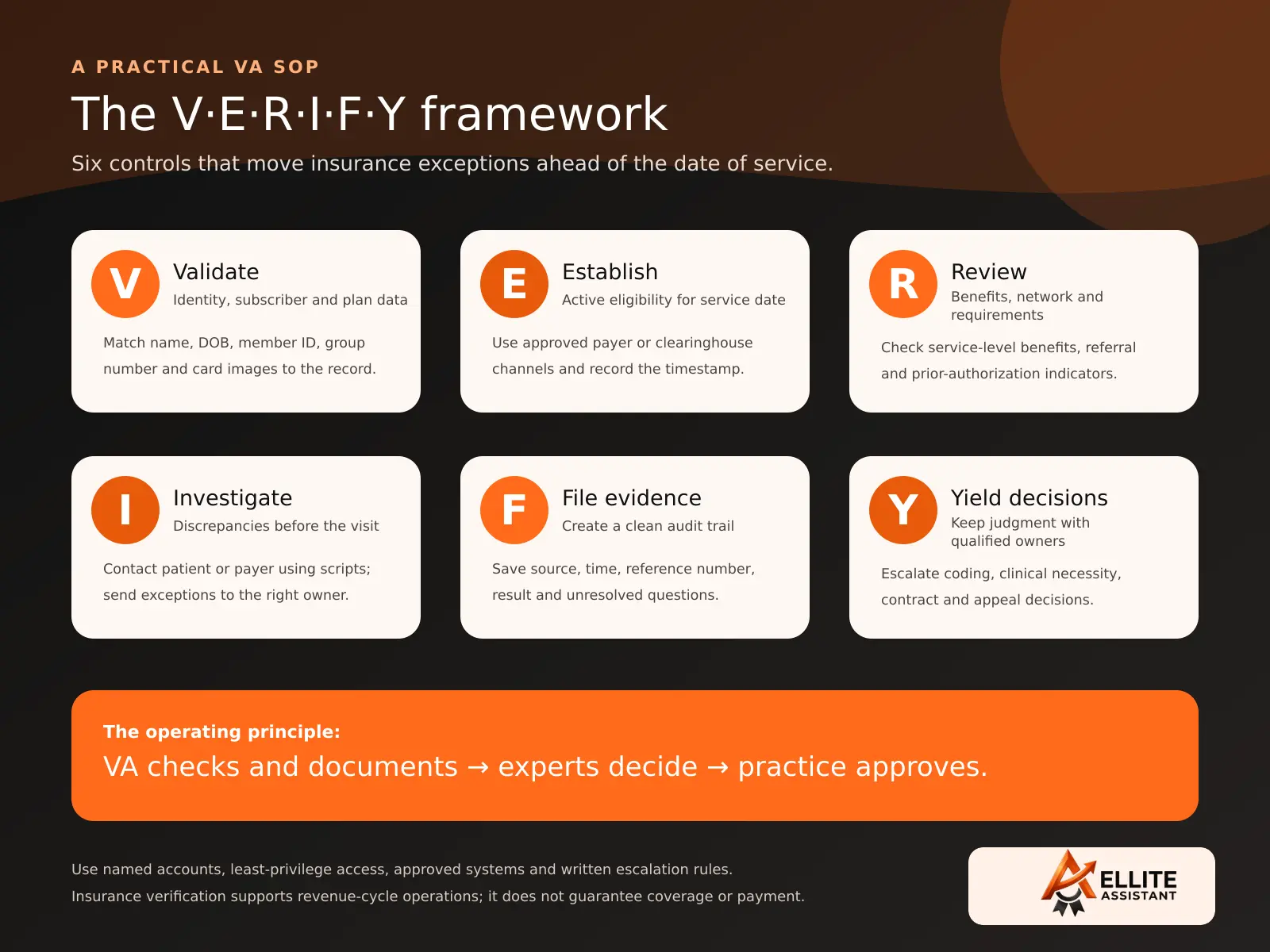
The V·E·R·I·F·Y framework for a reliable VA workflow
A checklist is useful, but a workflow needs more than boxes. It needs a sequence, evidence and a stop rule. The V·E·R·I·F·Y framework gives a practice six operating controls.
V — Validate patient and plan data
Start with identity and enrollment details. The VA compares the record with the insurance card and intake information. A small mismatch—an old surname, transposed member ID or wrong subscriber relationship—can cause the payer query to fail or send the team down the wrong path.
E — Establish active eligibility for the date of service
The VA runs the approved inquiry for the intended service date, not merely the day the appointment was booked. If the system cannot verify the future date, the SOP should define when to recheck. Coverage can change, so every result needs a timestamp.
R — Review benefits, network and requirements
“Active” is not enough. The assistant captures the information the practice has defined as necessary for the scheduled service: plan type, relevant benefit category, available patient-responsibility indicators, network clues, referral status and prior-authorization requirement. Ambiguous items move to an exception queue.
I — Investigate discrepancies early
The VA follows a written sequence: check the portal again, compare the card, contact the patient, call the payer or request a missing referral. Each path has a time limit and an escalation destination. The goal is not endless research; it is a clear next action.
F — File evidence in the approved system
Every verification should leave an audit trail. Record the channel used, timestamp, payer response, reference number when available, person contacted, unresolved item and next review date. The note should be stored in the practice-approved system—not in a personal spreadsheet, personal email account or consumer messaging app.
Y — Yield decisions to qualified owners
A strong VA knows where authority ends. Coding, clinical necessity, payer-contract interpretation, authorization strategy, patient financial policy and appeal decisions belong to the practice’s designated professionals. “Yield” means the assistant escalates with a concise packet: what was checked, what was found, what remains uncertain and what decision is needed.
A practical insurance verification timeline
The exact timing depends on specialty, payer mix and appointment lead time. A high-cost procedure, new patient or referral-dependent visit needs a different path from a routine follow-up. The following model is a practical starting point for U.S. outpatient practices.
| When | VA action | Expected output | Escalation trigger |
|---|---|---|---|
| At booking | Confirm required fields and request front/back card images | Complete intake record | Missing identity, subscriber or plan information |
| Three to five business days before | Run the primary eligibility and benefit check | Verified, pending or exception status | Inactive coverage, mismatch, network concern or unclear requirements |
| Two to three business days before | Work patient, payer, referral and authorization follow-ups | Resolved evidence or decision-ready exception | No response, conflicting information or clinical documentation needed |
| One business day before | Recheck designated cases and send final unresolved report | Clear front-desk status and open-risk list | Practice decision needed before service |
| Day of service | Confirm recent changes under the practice’s policy | Current administrative record | New card, coverage change or patient dispute |
| Before claim release | Confirm required administrative evidence is present | Complete handoff to billing | Missing authorization number, referral or payer note |
Use payer- and service-specific rules
A generic checklist will not cover every plan. Build a compact payer matrix with the channels your practice uses, common portal gaps, phone numbers, service categories, referral rules, expected turnaround, recheck timing and escalation owner. Review it whenever contracts, payer instructions or practice services change.
Plan for the difficult scenarios
- Portal says active, but benefit detail is incomplete: the VA records what the portal confirms and follows the approved secondary check; no one invents the missing answer.
- Primary coverage is unclear: the VA collects coordination-of-benefits information and escalates according to the billing team’s rules.
- Authorization is still pending: the assistant tracks the request and deadline, but the practice decides whether the service proceeds.
- Patient cannot be reached: the VA follows the documented number of attempts and channel rules, then flags the appointment for front-desk action.
- Payer representatives give conflicting answers: preserve both references and escalate. Do not overwrite the first result or promise payment.
HIPAA, access and security: the setup matters as much as the task
Insurance verification commonly involves protected health information. HHS explains that a vendor performing functions such as claims processing, billing or practice management on behalf of a covered entity may be a business associate when the work involves creating, receiving, maintaining or transmitting PHI. Covered entities generally need appropriate written assurances, commonly a business associate agreement, before disclosing PHI to a business associate. Whether a particular arrangement requires a BAA depends on the facts and should be reviewed by qualified counsel or a compliance professional. See the HHS business associate guidance.
HHS also describes the HIPAA minimum-necessary standard as requiring reasonable steps to limit uses, disclosures and requests for PHI to what is needed for the intended purpose. In operational terms, “the VA needs insurance access” is too broad. Define which system, which records, which fields, which actions and which working hours the role requires. Review Ellite Assistant’s detailed guide to data security and compliance when outsourcing when you map access.
Minimum security controls for the workflow
- A reviewed contract and BAA when legally required.
- Named user accounts—never shared logins.
- Multi-factor authentication on the EHR, practice-management system, payer portals and email.
- Least-privilege permissions based on job duties.
- Approved device, network, storage and communication rules.
- No PHI in personal email, personal cloud storage, consumer chat apps or unapproved AI tools.
- A password manager rather than passwords in documents or messages.
- Audit logs and periodic access review.
- A written incident-reporting path and short reporting deadline.
- Immediate offboarding and credential removal when the role ends.
How to measure whether the VA is reducing denials and delays
Do not judge the role by hours worked or calls made alone. Use a small baseline and track whether uncertainty is moving earlier, documentation is becoming more complete and the billing team is receiving cleaner handoffs.
| Metric | What it reveals | Simple definition |
|---|---|---|
| Pre-service verification rate | Coverage of the workflow | Appointments with documented status before service ÷ eligible appointments |
| Exception resolution rate | Whether checks turn into action | Exceptions resolved before service ÷ total exceptions found |
| Median verification turnaround | Queue speed | Time from assignment to documented initial result |
| Clean insurance-data rate | Registration accuracy | Records without a post-visit insurance-data correction ÷ reviewed records |
| Eligibility/referral/auth denial count | Relevant downstream outcome | Denials mapped by the billing team to agreed front-end categories |
| Claims held for missing front-end evidence | Payment delay risk | Claims not released because verification, referral or authorization evidence is missing |
| Escalation aging | Whether internal decisions are the new bottleneck | Open exceptions grouped by age and decision owner |
Compare at least four weeks before and after the pilot, using the same payer and service categories where possible. Do not credit every change to the VA: payer behavior, staffing, volume, seasonality, coding changes and service mix can all affect results. The goal is a credible operational trend, not a manufactured ROI claim.
A 30-day pilot for a healthcare insurance verification VA
Week 1: map one narrow workflow
Choose a defined appointment type, location or payer group. Document the current steps, systems, data fields, timing, scripts, escalation owners and baseline metrics. Confirm contracts, access and security controls before PHI is available. If you need a role-matched candidate, review how to hire a dedicated virtual assistant for a defined recurring workflow.
Week 2: run with double review
The VA performs the checklist, and a designated staff member reviews every case. Log mistakes, ambiguous instructions and payer-specific exceptions. Improve the SOP daily. This is a calibration period, not a speed contest.
Week 3: shift routine cases to VA ownership
Once accuracy is stable, allow the VA to close routine verified cases and send only exceptions for review. Audit a sample of completed work. Watch whether internal owners respond to escalations quickly enough; otherwise, you have moved the backlog rather than removed it.
Week 4: compare results and decide
Review verification coverage, exception resolution, turnaround, documentation quality, held claims and agreed denial categories. Ask the front desk and billing team whether rework changed. Then decide whether to extend the workflow, revise the scope or stop. A successful pilot should leave a better process even if you choose not to scale it.
Questions to ask before hiring
- Which eligibility, payer-portal and practice-management workflows have you used?
- How do you document the source, timestamp, result and reference number?
- How do you distinguish active eligibility from service-level benefits and prior authorization?
- What would you escalate rather than decide?
- How do you handle conflicting portal and phone information?
- What is your process for patient outreach using approved scripts?
- Which security controls, training and access restrictions support PHI handling?
- Will the provider sign a BAA when the arrangement requires one?
- How will quality be audited during onboarding?
- Which metrics will appear in the weekly report?
Frequently asked questions
Can a virtual assistant verify patient insurance?
Yes. A trained healthcare VA can perform defined administrative checks through practice-approved payer portals, clearinghouses and systems; document the result; follow up on missing information; and escalate exceptions. The practice must provide appropriate access, instructions, supervision and privacy safeguards.
Does insurance verification guarantee that a claim will be paid?
No. Verification reflects the information available at a point in time and is not a guarantee of coverage or payment. Final adjudication may depend on the service delivered, coding, medical necessity, authorization, contract terms, coordination of benefits, eligibility on the service date and payer rules.
Can a healthcare VA handle prior authorization?
A VA can support the administrative side: check requirements, collect approved non-clinical information, track status, follow up and maintain the queue. Clinical rationale, coding, medical-necessity decisions and final approval of submitted clinical content should remain with qualified practice staff.
Is a remote healthcare VA automatically HIPAA compliant?
No. HIPAA compliance is not an automatic trait or simple certificate. It depends on the arrangement, including whether a BAA is required, the systems used, training, permissions, safeguards, supervision, incident response and the practice's own policies. Obtain legal or compliance advice for your situation.
What should be included in an insurance verification checklist?
Typical fields include patient and subscriber identity, member and group numbers, plan activity for the date of service, plan type, relevant benefit information, available patient-responsibility indicators, network status, referral and authorization requirements, coordination-of-benefits issues, source, timestamp, reference number and open exceptions. Tailor the list to your services and payer contracts.
How far in advance should insurance be verified?
Many outpatient practices begin three to five business days before service so there is time to resolve problems, then recheck selected cases closer to the appointment. The right timing depends on appointment lead time, payer rules, service risk and whether the system can verify a future date.
How do I know whether a VA is improving revenue-cycle performance?
Track pre-service verification coverage, exception resolution before the visit, turnaround time, registration corrections, claims held for missing evidence, escalation aging and denials that the billing team maps to eligibility, referral or authorization categories. Compare a consistent baseline and avoid attributing unrelated claim changes to the VA.
Start with one verification queue—not your entire revenue cycle
Use Ellite Assistant’s $49 trial for five hours over seven days to test a narrow administrative workflow, document the handoffs and see whether a dedicated healthcare VA fits your practice. Confirm privacy, BAA and system-access requirements before sharing PHI.
View VA Pricing PlansSources and methodology
- Centers for Medicare & Medicaid Services: Health Plan Eligibility Benefit Inquiry and Response
- CMS: Interoperability and Prior Authorization Final Rule fact sheet
- HHS Office for Civil Rights: Business Associates
- HHS Office for Civil Rights: Minimum Necessary Requirement
- DataSpring/CAQH: 2025 Index Report
- American Medical Association: 2024 prior-authorization survey summary and Geisinger case example
Public guidance, cited sources and Ellite Assistant pricing were checked on September 9, 2026. Payer rules, benefit information, regulations, service terms and rates can change, and individual results vary. Eligibility and benefit verification is not a guarantee of coverage or payment. This article provides general business information, not medical, legal, coding, billing, employment, tax, compliance or financial advice. Obtain advice from qualified professionals for your practice and jurisdiction.
Can a virtual assistant verify patient insurance?
- How much does a healthcare virtual assistant cost?
- What is the V·E·R·I·F·Y framework for insurance verification?
- Can a VA handle prior authorization requests?
- What security controls are needed for a healthcare VA?
- How do I measure if a verification VA is working?
- What is a 30-day pilot for insurance verification?
- Should verification happen at booking or before service?
- What happens when portal and phone information conflict?
- Can a VA contact payers directly?
- What metrics matter for verification workflows?
- Do I need a BAA for a healthcare VA?
- How do I train a VA for insurance verification?