Executive Virtual Assistant: Support for Founders and CEOs
An Executive Virtual Assistant remotely supports a founder or CEO by managing calendar strategy, preparing briefings, coordinating travel, tracking commitments and organizing executive information. The role protects attention and improves decision readiness while strategic authority remains with the executive.

An Executive Virtual Assistant provides remote administrative and operational support to a founder, CEO or senior leader. The role goes beyond booking meetings. Effective executive support protects priorities, prepares decisions and makes sure commitments become tracked actions.
The assistant does not replace executive judgment. They create the organized environment in which that judgment can be used well.
This guide explains the responsibilities, skills, working model and controls to consider before hiring executive-level remote support. If you are still deciding which support model fits your business, you can hire a dedicated Virtual Assistant through Ellite Assistant.

What Does an Executive Virtual Assistant Do?
An Executive VA may manage complex calendars, prepare meetings and briefings, coordinate travel, maintain follow-up, organize confidential information, support projects and produce executive dashboards.
Core Executive Virtual Assistant Responsibilities
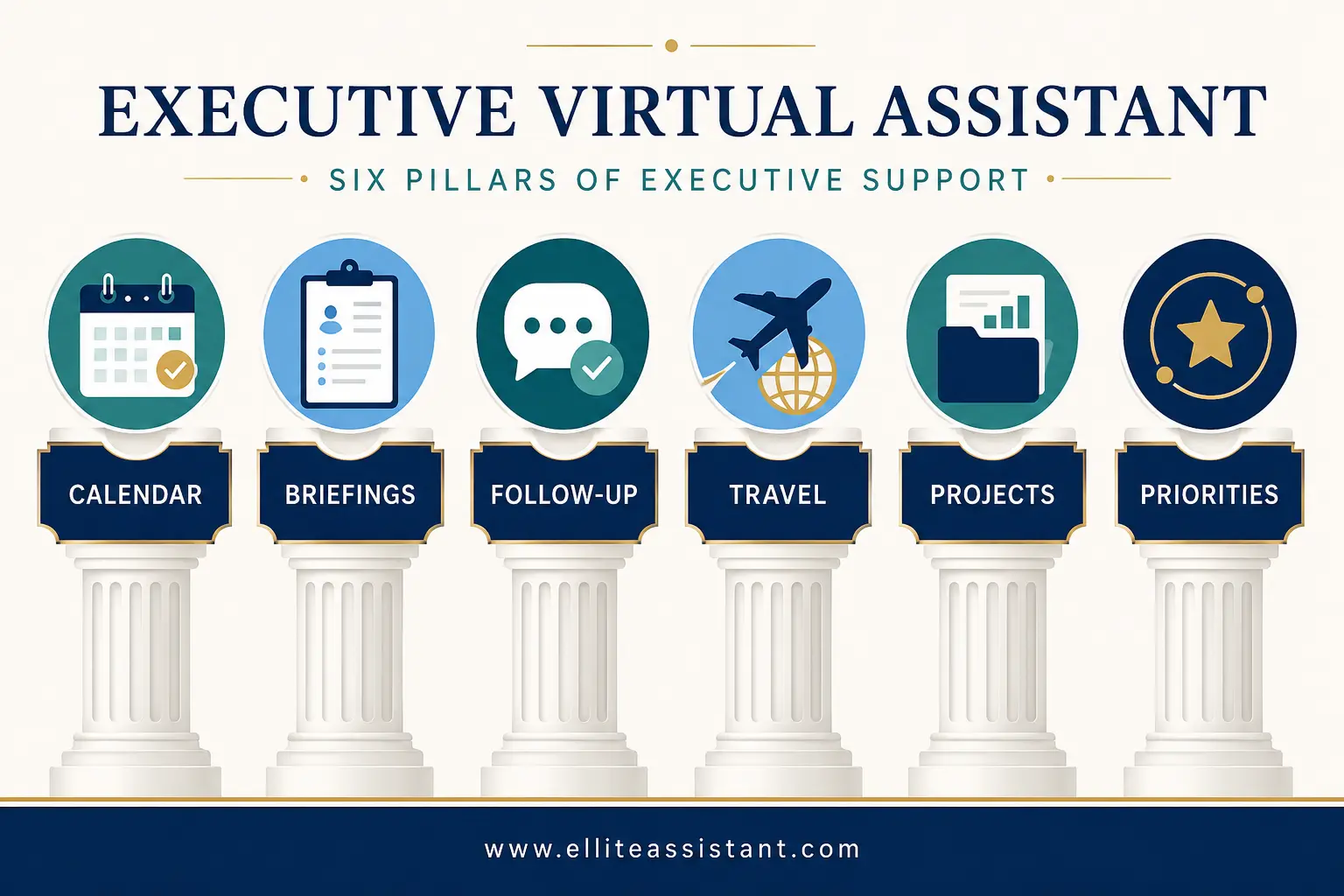
- Calendar design and meeting protection
- Agenda, document and decision preparation
- Inbox triage and communication drafts
- Action-item tracking
- Travel research and itinerary coordination
- Leadership meeting administration
- Project and stakeholder follow-up
- Expense and document organization
If you want a broader task list, see our guide to 50 tasks to delegate to a Virtual Assistant.
Calendar Management as Priority Management
The assistant should understand meeting purpose, preparation time, working preferences, time zones and protected focus blocks. Rules should define which meetings may be accepted, declined, shortened or redirected.
A well-managed calendar reflects business priorities rather than simply filling available space.
Briefings and Decision Readiness
Before an important meeting, the assistant can assemble the objective, participants, prior decisions, open questions, documents and required outcome. Afterward, they record actions, owners and deadlines.
This reduces executive time spent reconstructing context and makes accountability visible.
Confidentiality, Access and Controls
Use individual accounts, multifactor authentication, least-privilege access and an approved password manager. Define which messages the assistant may read, draft or send and how sensitive HR, legal, health or financial information is handled.
The FTC advises businesses to limit access to sensitive information on a need-to-know basis and use secure remote-access practices. Controls should apply to employees and vendors alike. For more detail, see our guide to data security and compliance when outsourcing to a Virtual Assistant.
Executive VA Versus General Administrative VA
| Factor | Administrative VA | Executive VA |
|---|---|---|
| Primary focus | Defined recurring tasks | Executive priorities and coordination |
| Context | Task-level | Cross-functional and stakeholder-level |
| Communication | Routine | Sensitive and high-stakes |
| Judgment | Rules-based | Greater discretion within defined limits |
| Experience | Varies by workflow | Senior support experience usually required |
What to Look for When Hiring
Evaluate written judgment, prioritization, discretion, follow-through, time-zone reliability and comfort challenging an unclear request. Ask candidates to organize a conflicted calendar, draft a briefing and explain how they would escalate a sensitive issue.
For more structure, use our step-by-step VA hiring guide alongside these executive-specific criteria.
Clarify working hours, backup coverage, response expectations and which tools are already familiar.
How to Measure Executive Support
Useful measures include meeting preparation completed on time, scheduling errors, overdue executive actions, turnaround on decision briefs, travel accuracy and executive hours reclaimed.
Combine metrics with qualitative feedback about trust, anticipation and communication. Avoid measuring the role by messages sent or calendar events processed.
The First 30 Days With an Executive Virtual Assistant
Week 1: context and preferences
Introduce key stakeholders, recurring meetings, strategic priorities, communication preferences and sensitive categories. Begin with calendar observation, meeting preparation and a daily decision queue.
Week 2: supervised ownership
Transfer defined calendar rules, standard follow-up and briefing preparation. Review drafts before external communication and record exceptions that do not fit the rules.
Week 3: operating rhythm
Move to a weekly priority review, daily exception summary and consistent meeting-close process. The assistant should know which commitments must enter the project system and which conversations remain confidential.
Week 4: controlled independence
Reduce routine review where accuracy is proven. Assess calendar quality, missed actions, briefing usefulness and executive hours reclaimed. Expand responsibility only where access and authority are appropriate.
Common Executive Support Mistakes
- Giving calendar access without defining scheduling priorities.
- Expecting anticipation before sharing business context.
- Allowing sensitive decisions to remain only in chat.
- Using one shared login instead of individual access.
- Measuring performance by the number of processed messages.
- Failing to define backup coverage.
- Delegating public or contractual commitments without approval limits.
Trust is built through repeated accuracy, appropriate judgment and transparent escalation. It should not depend on unrestricted access or unspoken expectations.
When full-time support may be appropriate
Leaders with heavy travel, multiple businesses, large meeting volumes, frequent stakeholder communication or daily project coordination may need reserved part-time or full-time capacity. Leaders with stable, low-volume needs may begin with a smaller plan and a tightly defined scope.
For more on the staffing choice, see our Virtual Assistant vs Employee comparison. For more on capacity options, read how to scale a business without hiring full-time staff.
Frequently Asked Questions
What is an Executive Virtual Assistant?
An Executive Virtual Assistant is a remote professional who supports founders and senior leaders with calendars, briefings, communication, follow-up, travel and project coordination.
What is the difference between an Executive VA and a regular VA?
An Executive VA usually works with broader context, sensitive information, complex stakeholders and greater discretion within defined limits.
Can an Executive Virtual Assistant manage email?
Yes, using agreed rules for access, categorization, drafting, sending and escalation.
How many hours of executive support are needed?
The requirement depends on meeting volume, travel, communication, projects and expected overlap. Audit a normal week before selecting a plan. You can compare Virtual Assistant plans to see typical hour allowances and support features.
Can an Executive VA make decisions for a CEO?
They may make routine decisions within explicit authority, but strategic, legal, financial and high-impact decisions remain with the appropriate leader or specialist.
What does an Executive Virtual Assistant do?
- What is an Executive Virtual Assistant?
- What is the difference between an Executive VA and a regular VA?
- Can an Executive Virtual Assistant manage email?
- How many hours of executive support are needed?
- Can an Executive VA make decisions for a CEO?