Ellite Assistant vs. a Telehealth VA Agency: Which Is Better for Your Practice?
Ellite Assistant and specialist telehealth VA agencies serve different medical-practice needs. Ellite Assistant is positioned for flexible, managed, non-clinical support covering scheduling, routine patient communication, referrals, insurance administration, data entry and back-office coordination. Specialist agencies may offer greater depth in advanced medical coding, formal scribing or specialty-specific security environments. The best choice depends on the exact workflow rather than the provider’s label. Medical practices should verify the assigned assistant’s experience, permitted duties, supervision, access controls, Business Associate Agreement requirements, incident-response process and offboarding procedures. A controlled pilot involving one measurable administrative queue is the safest way to evaluate performance before expanding access.
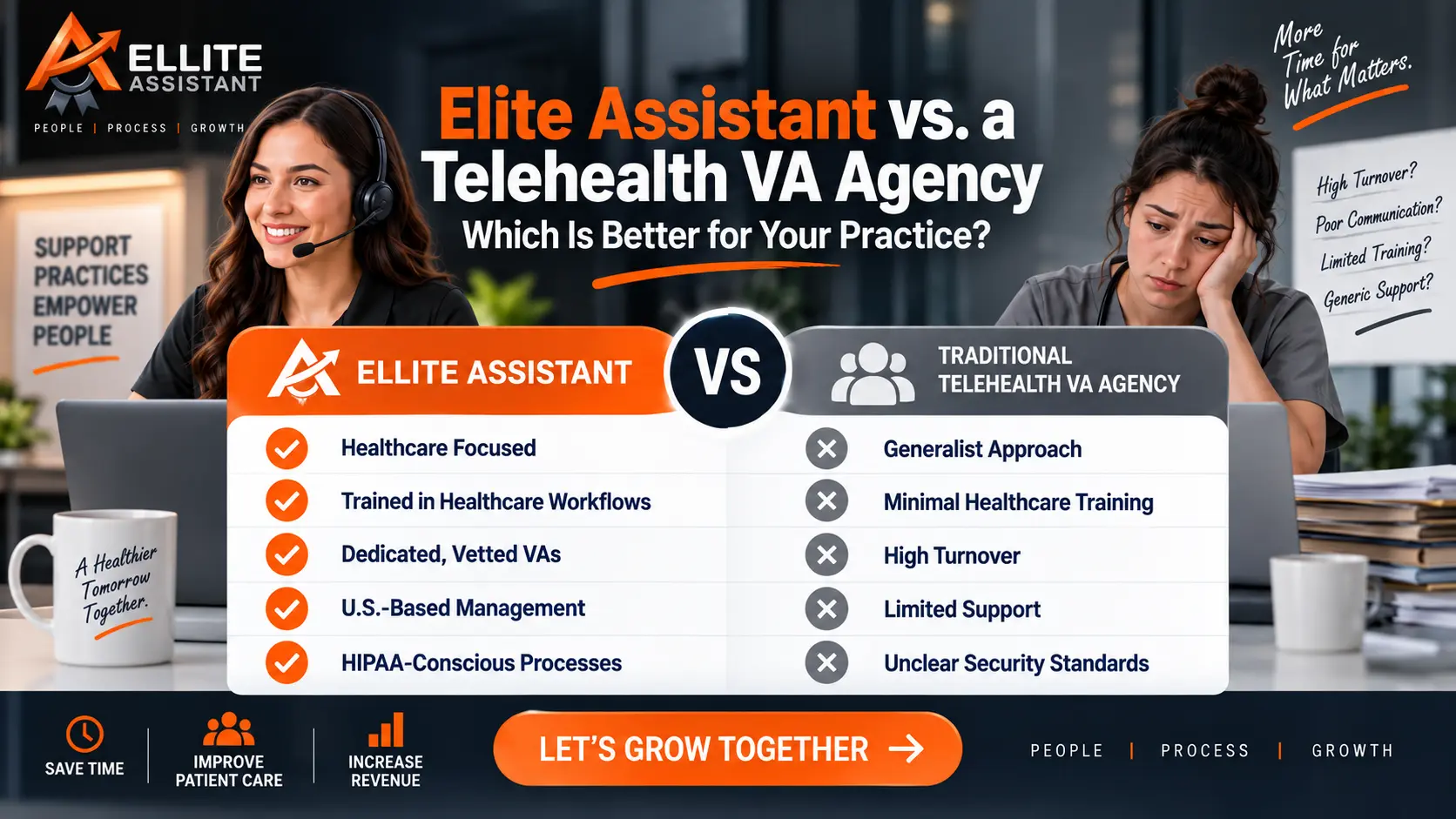
For many independent U.S. medical practices, Ellite Assistant is the better fit when the real need is flexible, non-clinical workflow support across scheduling, patient calls, referrals, insurance administration, data entry, inboxes and back-office coordination. A specialist telehealth virtual assistant agency may be the better choice when the role requires deeper healthcare specialization—such as formal medical scribing, advanced revenue-cycle work or a vendor security environment your compliance team has already audited.
The right choice is not the provider with the most healthcare language on its homepage. It is the one that can show, in writing, who will perform the work, what that person may access, how they are supervised, what happens when something goes wrong and which tasks remain with licensed clinical staff. This guide weighs both models using public information checked on September 17, 2026, current U.S. government guidance and a practical buyer scorecard.
The quick verdict: which option is better?
Ellite Assistant and a specialist healthcare VA agency solve overlapping problems, but they are not identical buying decisions. Ellite’s published healthcare service is designed around non-clinical administrative work and role matching. A specialist agency may package narrower medical roles, healthcare-specific technology or formal compliance controls as its main product.
| Your practice needs | Likely better fit | Why | What to verify |
|---|---|---|---|
| Scheduling, calls, referrals, insurance follow-up and routine operations | Ellite Assistant | Broad non-clinical scope can be organized under one managed support relationship. | Candidate experience, approved scripts, system access and escalation rules. |
| A role that crosses healthcare administration, customer support and general business operations | Ellite Assistant | A flexible generalist model can reduce the need to coordinate several narrow vendors. | Which tasks the assigned assistant can perform confidently from day one. |
| Advanced medical coding, complex scribing or specialty-specific clinical documentation | Specialist agency | A focused provider may maintain a deeper bench for a narrow healthcare discipline. | Credentials, documented competency testing and who reviews the work. |
| Access to protected health information under a required BAA | The provider that passes your review | The contract, safeguards and actual workflow matter more than the provider category. | BAA, subcontractors, devices, location, incident response, access logs and termination procedures. |
| An unclear backlog and uncertainty about how many hours are needed | Start with a controlled pilot | A small live test reveals task volume, training time and management load. | Baseline metrics, permitted data and a written stop/go decision. |
This is why the best comparison is not “general VA versus medical VA.” It is your workflow versus the provider’s documented operating model. Ellite’s healthcare virtual assistant service explicitly limits the role to approved non-clinical support. That can be a strength for a practice that wants clean boundaries rather than vague promises.
What is being compared?
Ellite Assistant
Ellite Assistant is a managed virtual-assistant and remote-support provider serving U.S. businesses. Its healthcare offering publicly lists patient scheduling, routine calls and messages, referral administration, insurance workflow support, healthcare data entry and back-office coordination. Candidate options are typically presented after consultation, and the client reviews the proposed assistant, role, hours, tools and boundaries before onboarding.
A telehealth VA agency
In this article, “telehealth VA agency” means a provider whose primary positioning is remote staffing for medical, dental, behavioral-health or virtual-care organizations. It does not refer to one named competitor. Agencies differ substantially: some provide administrative talent, some focus on medical billing or scribing, and some combine staffing with a secure technology environment.
That distinction matters because “specialized” is not a standardized credential. A healthcare-focused website does not prove that every assistant has the same training, that a BAA applies to every arrangement or that the vendor’s systems match your practice. Ask for evidence tied to the exact worker and workflow you are buying.
What can a telehealth virtual assistant actually handle?
A telehealth virtual assistant supports the administrative work surrounding a virtual visit. The role should make care easier to access without drifting into diagnosis, prescribing, emergency triage or other work reserved for qualified professionals.
Federal telehealth guidance emphasizes helping patients understand virtual care, schedule appointments, prepare their technology, know what to expect and follow an emergency plan. Those are operational moments where a trained assistant can reduce friction while a clinician retains medical responsibility.
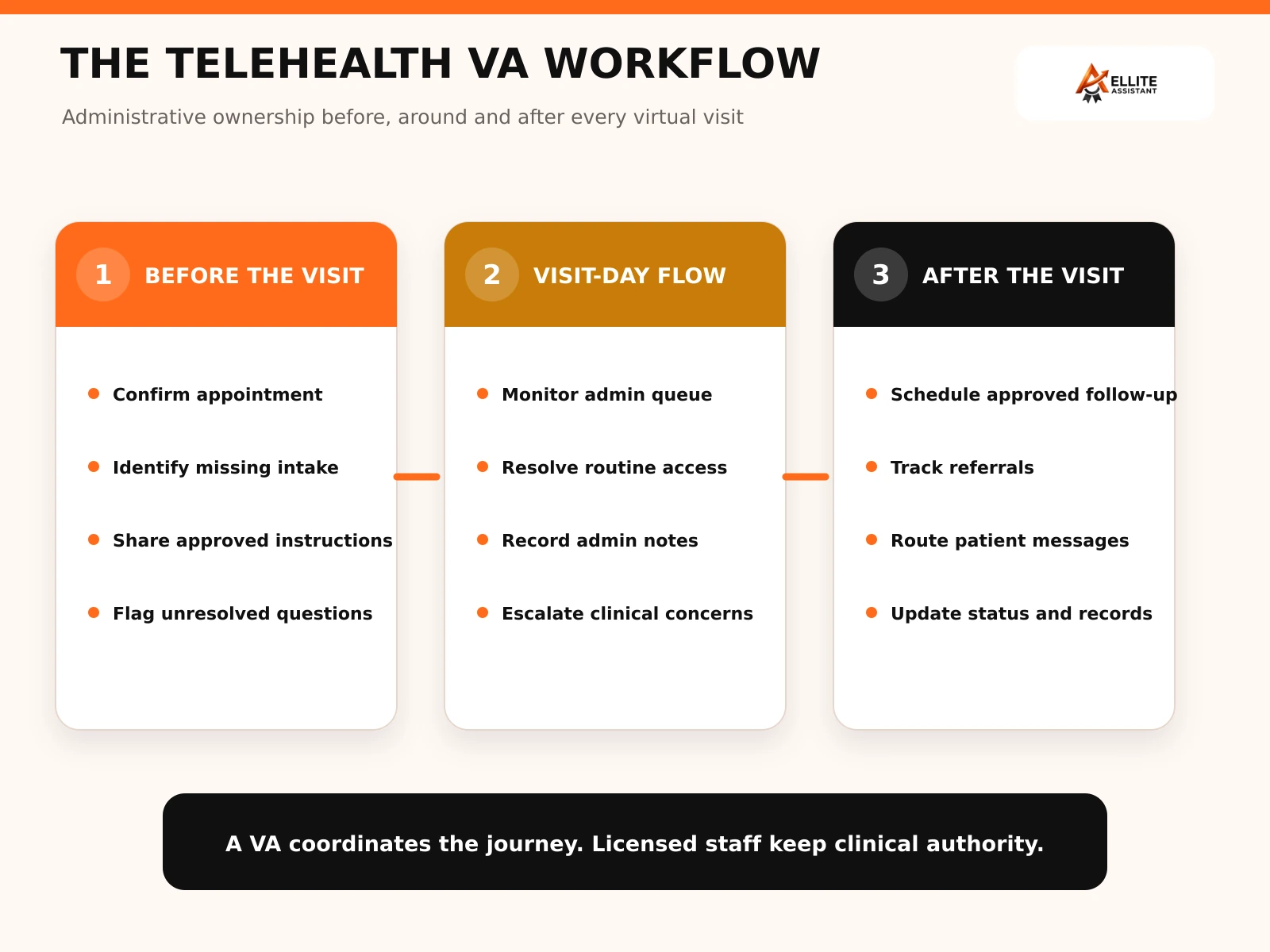
| Workflow stage | Appropriate administrative support | Keep with qualified staff | Useful measure |
|---|---|---|---|
| Before the visit | Scheduling, confirmations, approved intake reminders, demographic updates, platform instructions and missing-document follow-up. | Clinical suitability, medical urgency, informed-consent decisions and advice about symptoms. | Confirmed appointments, unresolved intake items and cancellation-backfill rate. |
| Visit-day support | Approved check-in steps, basic connection guidance, queue monitoring and routing administrative issues. | Clinical triage, diagnosis, treatment, examination and emergency decisions. | On-time starts, connection issues and escalations resolved. |
| After the visit | Scheduling approved follow-ups, sending approved instructions, referral tracking, record requests and administrative message routing. | Interpreting results, changing care plans, medication advice and responding to clinical questions. | Follow-ups booked, referral age and messages awaiting clinical review. |
| Revenue-cycle support | Eligibility workflow support, document checks, prior-authorization status follow-up, claim-status tracking and missing-information queues. | Coding or billing judgments beyond the assistant’s verified competency and authorized scope. | Queue age, preventable omissions, turnaround time and rework. |
Practices with a recurring eligibility or denial backlog may also use the workflow in Ellite’s guide to reducing insurance-verification delays with a healthcare VA.
Ellite Assistant vs. a telehealth VA agency: detailed comparison
The table below compares Ellite’s publicly documented model with characteristics commonly associated with specialist agencies. Because the second column represents a provider category rather than one company, every agency claim must be confirmed during procurement.
| Decision factor | Ellite Assistant | Specialist telehealth VA agency | Buying implication |
|---|---|---|---|
| Core scope | Broad non-clinical healthcare administration plus access to wider customer-support and business-operations capabilities. | Usually narrower healthcare roles, though depth varies by vendor. | Choose breadth for mixed workflows; choose depth for a highly specialized role. |
| Patient communication | Routine calls and messages using approved scripts, with clinical and urgent matters escalated. | Often offered; scripts, languages and escalation models vary. | Listen to a role-play before granting live call access. |
| Candidate selection | Role matching followed by client interview and approval. | May offer interviews, roster selection or pooled staffing. | Know whether you are choosing a named person or buying an anonymous queue. |
| Working model | Published hour-based plans, time tracking and scalable support. | May use hourly, full-time, seat-based or custom pricing. | Match the billing model to predictable workload, not to the lowest headline rate. |
| Oversight | Published plans include team-lead supervision and quality controls, with additional management features on larger plans. | Ranges from self-managed placement to fully managed service. | Ask who reviews accuracy and who responds when the VA needs help. |
| Continuity | Free rematching is publicly offered when fit is not right; backup support is listed on selected plans. | Replacement and leave coverage vary by contract. | A replacement promise is useful only if handover documentation exists. |
| Clinical boundary | Explicitly non-clinical: no diagnosis, prescribing, emergency triage or clinical advice. | Some agencies offer clinically adjacent roles; authorization and qualifications vary. | Do not let marketing language expand a worker’s lawful or competent scope. |
| Systems | Access depends on the agreed workflow, platform, training and permissions. | Some providers advertise experience with specific EHR, practice-management or telehealth systems. | Request a live competency demonstration using test data. |
| Privacy and security | Public guidance calls for NDAs, named accounts, MFA, password managers and least-privilege access; HIPAA-related arrangements must be reviewed before access. | Some agencies package BAAs, secure desktops or compliance personnel; others do not. | Require written, workflow-specific evidence from either provider. |
| Best overall fit | Practices that need accountable, flexible ownership of recurring non-clinical work. | Practices buying a narrow healthcare specialty or predetermined compliance stack. | The more specialized the task, the more task-level evidence should influence the decision. |
What this decision feels like inside a real practice
Consider a composite example based on common small-practice workflows. A two-provider behavioral-health practice has a capable front-desk coordinator, but Monday mornings are unmanageable. Weekend messages wait in one inbox, new patients submit incomplete forms, cancellations create unused appointment slots, and referral status lives in a spreadsheet only one person understands.
The owner initially asks for a “telehealth expert.” After mapping the work, however, only a small part of the backlog is platform-specific. Most of it is repeatable administration: confirm appointments, identify missing forms, return approved non-clinical messages, update referral status, offer open times to the waitlist and escalate anything clinical.
In that scenario, the practice may gain more from a flexible healthcare VA with clear scripts and daily ownership than from paying for a narrowly specialized role. The decision changes if the same practice needs complex behavioral-health coding, clinical documentation or a vendor with a security configuration already approved by its compliance counsel.
The lesson is simple: hire for the queue that is failing, not for the label that sounds most impressive. A good discovery call should leave the practice with a clearer workflow even if it does not buy immediately.
Which option costs less?
There is no responsible universal answer because a telehealth VA agency is a category, not a single price list. Agencies may charge by hour, seat, role, month or custom scope. Ellite publishes flexible plans and a $49 one-time trial providing five hours over seven days. Its public pricing also includes part-time and larger monthly options; practices should confirm the current terms on the Ellite Assistant pricing page before buying.
The more useful calculation is total operating cost:
Total monthly cost = provider fee + onboarding time + software and security costs + manager review time + rework + uncovered-work cost.
| Cost component | Question to ask | Why it changes the answer |
|---|---|---|
| Base fee | What hours, schedules and tasks are included? | A lower rate may exclude patient-facing work, supervision or peak-hour coverage. |
| Setup | Are recruitment, background checks, onboarding and replacement included? | Separate setup charges can change the first-quarter cost. |
| Management | Who trains, reviews and answers the assistant’s questions? | An inexpensive worker who consumes five owner-hours each week may be the costly option. |
| Security | Who supplies the device, secure connection, access controls and monitoring? | Safeguards should be budgeted, not assumed. |
| Continuity | What happens during leave, turnover or an urgent absence? | Unanswered calls and aging queues create operational cost even when the seat is inexpensive. |
| Rework | How are errors found, documented and corrected? | Accuracy and recovery time often matter more than nominal hourly price. |
Do not promise yourself that a VA will “pay for itself” through hypothetical revenue. Measure the concrete outcomes: owner or staff hours returned, response time, appointment utilization, queue age, correction volume and work completed within the agreed service level.
HIPAA, PHI and security: the questions that matter
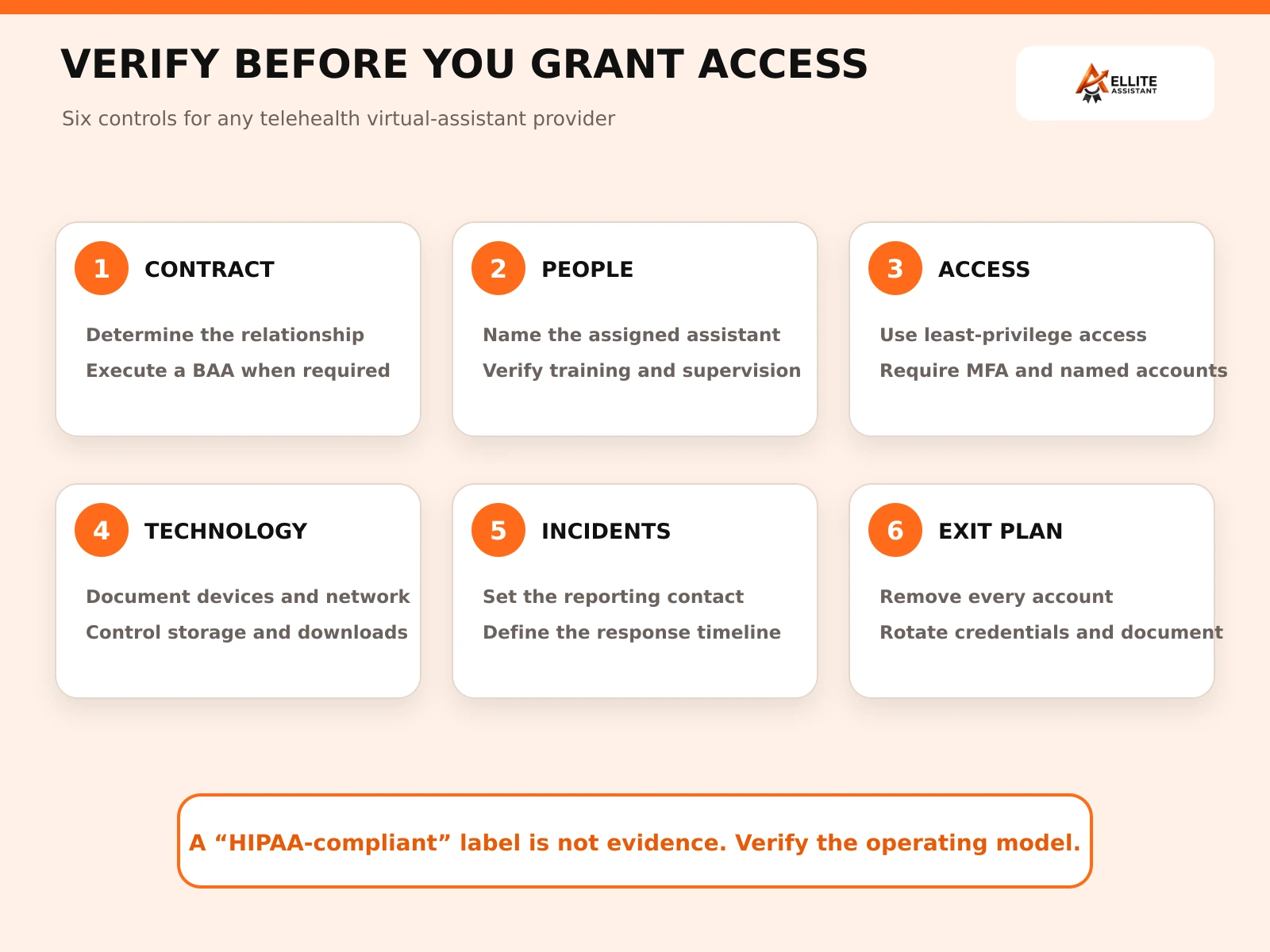
The phrase “HIPAA-compliant virtual assistant” is popular in search results, but it should start a due-diligence conversation—not end one. The U.S. Department of Health and Human Services explains that an outside person or organization performing services involving protected health information may be a business associate. HHS lists billing, claims administration, practice management, patient messaging and EHR access among relevant examples.
When a business-associate relationship exists, a written business associate agreement generally must describe permitted uses and disclosures and require appropriate safeguards. Your exact obligation depends on the parties and workflow, so obtain qualified legal or compliance advice rather than relying on an article or a salesperson.
| Ask for | Acceptable evidence | Red flag |
|---|---|---|
| Relationship and BAA review | A workflow-specific determination and, where required, an executable agreement identifying the responsible entities. | “Every VA is automatically HIPAA certified.” |
| Named-user access | Individual accounts, role-based permissions, MFA and documented approval. | Shared credentials sent through ordinary chat or email. |
| Minimum necessary access | A role-to-system matrix showing exactly what the assistant can view or change. | Full administrator access “to make onboarding easier.” |
| Device and workplace controls | Written device, storage, screen, network, printing and physical-privacy rules. | No answer about where work occurs or whether data can be downloaded. |
| Incident response | A reporting route, contact person, response timeline and cooperation obligations. | Only a promise that a breach “will never happen.” |
| Subcontractors | Disclosure of relevant downstream providers and corresponding contractual safeguards. | The vendor cannot say who may handle or host the information. |
| Offboarding | Immediate access removal, credential rotation, return/deletion steps and retained audit evidence. | No written termination checklist. |
HHS also emphasizes risk analysis and appropriate administrative, physical and technical safeguards for electronic PHI, including remote access. A buyer should therefore review both the agency and the practice’s own configuration. Secure staffing cannot repair an unsafe shared login, excessive permissions or an undocumented internal process.
Which model fits your type of practice?
| Practice situation | Recommended starting model | First workflow to test |
|---|---|---|
| Solo practitioner with a growing telehealth schedule | Ellite Assistant or another flexible managed VA | Confirmations, intake completion and approved message routing. |
| Small multi-provider practice with mixed front- and back-office queues | Ellite Assistant | One daily operations queue covering scheduling, referrals and follow-ups. |
| High-volume patient call environment | Human VA or hybrid reception model with clear escalation | Call answering, message classification and service-level reporting. Compare models in the AI receptionist versus human virtual receptionist guide. |
| Specialty group needing experienced medical scribes or coders | Specialist agency | Controlled competency test reviewed by a qualified internal specialist. |
| Practice with no documented SOPs or access rules | Pause broad access; run a narrow pilot | A low-risk administrative queue using test or minimum-necessary data. |
| Organization needing help beyond healthcare administration | Ellite Assistant | Combine the healthcare workflow with approved general operations or customer-support VA services. |
If the role is still unclear, use Ellite’s broader virtual assistant matching process to define tasks, hours, tools and success measures before selecting a candidate.
15 questions to ask before hiring any telehealth VA provider
- Which exact tasks will the assistant own, prepare or only route?
- Which tasks are explicitly prohibited?
- Will I interview and approve the named assistant?
- What healthcare and telehealth workflows has this candidate handled personally?
- Can the candidate complete a role-play using fictional data?
- Who supervises the assistant and reviews quality?
- What response-time and queue-aging targets will we use?
- Where will the assistant work, and on what device and network?
- Will the role create, receive, maintain or transmit PHI?
- Does our arrangement require a BAA, and which legal entity signs it?
- Which subcontractors or systems could touch our data?
- How are user access, MFA, logs, downloads and permissions controlled?
- What is the incident-reporting process?
- What coverage and handover exist during absence or replacement?
- How will every account and data copy be removed at offboarding?
Use a 30-day pilot instead of making a blind commitment
A pilot should test a real workflow without exposing the entire practice on day one. Choose one recurring queue, establish a baseline and expand access only after accuracy and communication are stable.
| Period | Actions | Evidence to review |
|---|---|---|
| Before day 1 | Define scope, prohibited actions, scripts, test cases, access, escalation contacts and baseline metrics. | Signed scope, access matrix and ten representative work samples. |
| Days 1–5 | Shadow, practice with fictional or minimum-necessary data and review every completed item. | Accuracy, questions asked, adherence to scripts and escalation judgment. |
| Days 6–14 | Give controlled ownership of one live queue with daily review. | Queue age, turnaround time, rework and unresolved items. |
| Days 15–30 | Reduce routine checking only where performance is stable; test absence and escalation coverage. | Service-level consistency, manager time, handover quality and patient-facing exceptions. |
| Day 30 | Continue, change scope, retrain, rematch or stop. | A written decision tied to the baseline—not to general impressions. |
Seven practical pilot metrics
- Percentage of assigned items completed within the agreed service level
- Patient messages older than one business day
- Appointment confirmations and usable cancellation backfills
- Referral and prior-authorization queue age
- Accuracy and number of corrections required
- Escalations made correctly and on time
- Practice-owner or staff review hours required each week
Ellite’s public trial currently offers five hours over seven days for $49. Use those first hours to test one measurable workflow rather than assigning a miscellaneous task list that proves little about long-term fit.
Red flags when comparing healthcare VA providers
- A guarantee of HIPAA compliance without reviewing the workflow. Compliance depends on actual roles, contracts, systems and behavior.
- A promise that one assistant can perform every medical-office task. Scheduling, billing, coding and scribing require different levels of knowledge.
- No clear answer about clinical escalation. Administrative staff should never improvise care advice.
- Shared accounts or passwords. Accountability requires named access and traceable activity.
- No candidate interview or competency test. Agency reputation does not prove individual fit.
- No backup or handover process. A replacement without documentation simply restarts the risk.
- ROI claims based only on optimistic revenue. Demand operational evidence before assuming financial outcomes.
- Pressure to grant broad access immediately. Begin with the minimum permissions needed for the pilot.
Quick-answer comparison table
| Common buyer question | Short answer |
|---|---|
| Is Ellite Assistant a healthcare-only VA agency? | No. It is a broader managed VA provider with a dedicated non-clinical healthcare service. |
| Is a specialist telehealth agency always safer? | No. Safety depends on written controls, contracts, access and execution—not positioning alone. |
| Can a telehealth VA speak with patients? | Yes, for approved administrative communication with scripts and escalation rules. |
| Can a VA provide medical advice? | No. Clinical judgment and emergency decisions remain with qualified professionals. |
| Does every medical VA require a BAA? | Not automatically. The relationship and whether the role handles PHI determine the analysis. |
| Which model is more affordable? | Compare total operating cost, not only hourly or monthly price. |
| What should a practice delegate first? | One repetitive, measurable, non-clinical queue with clear escalation. |
| How should a practice test a provider? | Run a controlled pilot with baseline metrics and minimum necessary access. |
Frequently asked questions
Is Ellite Assistant a telehealth virtual assistant agency?
Ellite Assistant is a managed virtual-assistant provider with a dedicated healthcare service rather than a healthcare-only staffing company. Its published scope includes non-clinical telehealth and medical-practice workflows such as scheduling, routine patient communication, referral follow-up, insurance administration, data entry and back-office coordination.
Is Ellite Assistant or a specialist telehealth VA agency better?
Ellite Assistant is often the better fit for flexible, recurring non-clinical administration or a role that crosses several operational functions. A specialist agency may be better for narrow roles requiring verified medical-domain depth, such as advanced coding, scribing or a predetermined healthcare security environment. The final choice should follow candidate, contract, workflow and security review.
What does a telehealth virtual assistant do?
A telehealth virtual assistant handles approved administrative work around virtual care. Tasks can include appointment scheduling, confirmations, intake reminders, basic technology instructions, routine calls, referral tracking, insurance follow-up, record requests, queue updates and post-visit scheduling. The assistant should not diagnose, prescribe, interpret results or make emergency decisions.
Can a telehealth VA access patient information?
Potentially, but access should be based on the role, legal and compliance review, required agreements and documented safeguards. Use named accounts, multi-factor authentication, least-privilege permissions, secure credential handling, logs and an offboarding process. Do not grant broad access merely because a provider markets healthcare experience.
Does hiring a healthcare virtual assistant require a BAA?
It depends on the relationship and work. HHS explains that an outside provider performing services that involve creating, receiving, maintaining or transmitting PHI may be a business associate, in which case a compliant written arrangement is generally required. Ask qualified counsel or your compliance adviser to review the exact workflow and parties.
How much does a telehealth virtual assistant cost?
Pricing varies by hours, schedule, experience, patient-facing responsibilities, specialty, management and security requirements. Ellite publicly lists a $49 trial for five hours over seven days and several monthly plans. Specialist agencies may use hourly, seat-based or custom quotes. Confirm current terms and compare total operating cost.
What is the best first task to delegate to a medical VA?
Start with one repetitive, measurable and non-clinical queue—such as appointment confirmations, missing-intake follow-up, referral-status tracking or approved message routing. A narrow starting scope makes training, accuracy and value easier to judge before you expand permissions.
How do I evaluate a telehealth VA during a trial?
Record a baseline, define permitted and prohibited actions, provide scripts and test cases, and measure completion time, accuracy, queue age, escalation quality and internal review time. Begin with fictional or minimum-necessary data, then expand only after the assistant demonstrates consistent performance.
Sources and verification
- HHS guidance on business associates and BAAs
- HHS Security Rule guidance and remote-access resources
- Telehealth.HHS.gov guidance for preparing patients
- CMS list of Medicare telehealth services
- NIST SP 800-66 Rev. 2: Implementing the HIPAA Security Rule
Verification note: Ellite Assistant’s healthcare service description, public pricing and linked pages were manually checked on September 17, 2026. The comparison describes a provider category, not one unnamed company. No private contract, candidate file, security audit or compliance certification was reviewed.
Test one telehealth workflow before expanding the role
Bring Ellite Assistant the queue that is slowing your practice down. We will help define the non-clinical scope, match the role and give you a controlled way to evaluate the workflow before a larger commitment.
View Healthcare VA Pricing and TrialPublic pages, pricing and government guidance were checked on September 17, 2026. Rates, plan terms, laws, payer rules and telehealth requirements can change. Individual quotes and compliance obligations vary. This article provides general business information and is not legal, medical, tax, employment, cybersecurity or financial advice. Practices should obtain qualified advice for their jurisdiction, contracts and workflow.
Is Ellite Assistant or a Specialist Telehealth Virtual Assistant Agency Better for Medical Practices?
- What does a telehealth virtual assistant do?
- Is Ellite Assistant a healthcare-only virtual assistant agency?
- Is Ellite Assistant better than a specialist telehealth VA agency?
- Can a telehealth virtual assistant communicate with patients?
- Can a healthcare virtual assistant access patient information?
- Does hiring a medical virtual assistant require a BAA?
- How much does a telehealth virtual assistant cost?
- What is the best first task to delegate to a medical VA?
- How should a medical practice evaluate a virtual assistant?
- Is a specialist healthcare VA agency automatically more secure?