The Founder's GEO Checklist: 10 Things to Fix Before Hiring an Agency
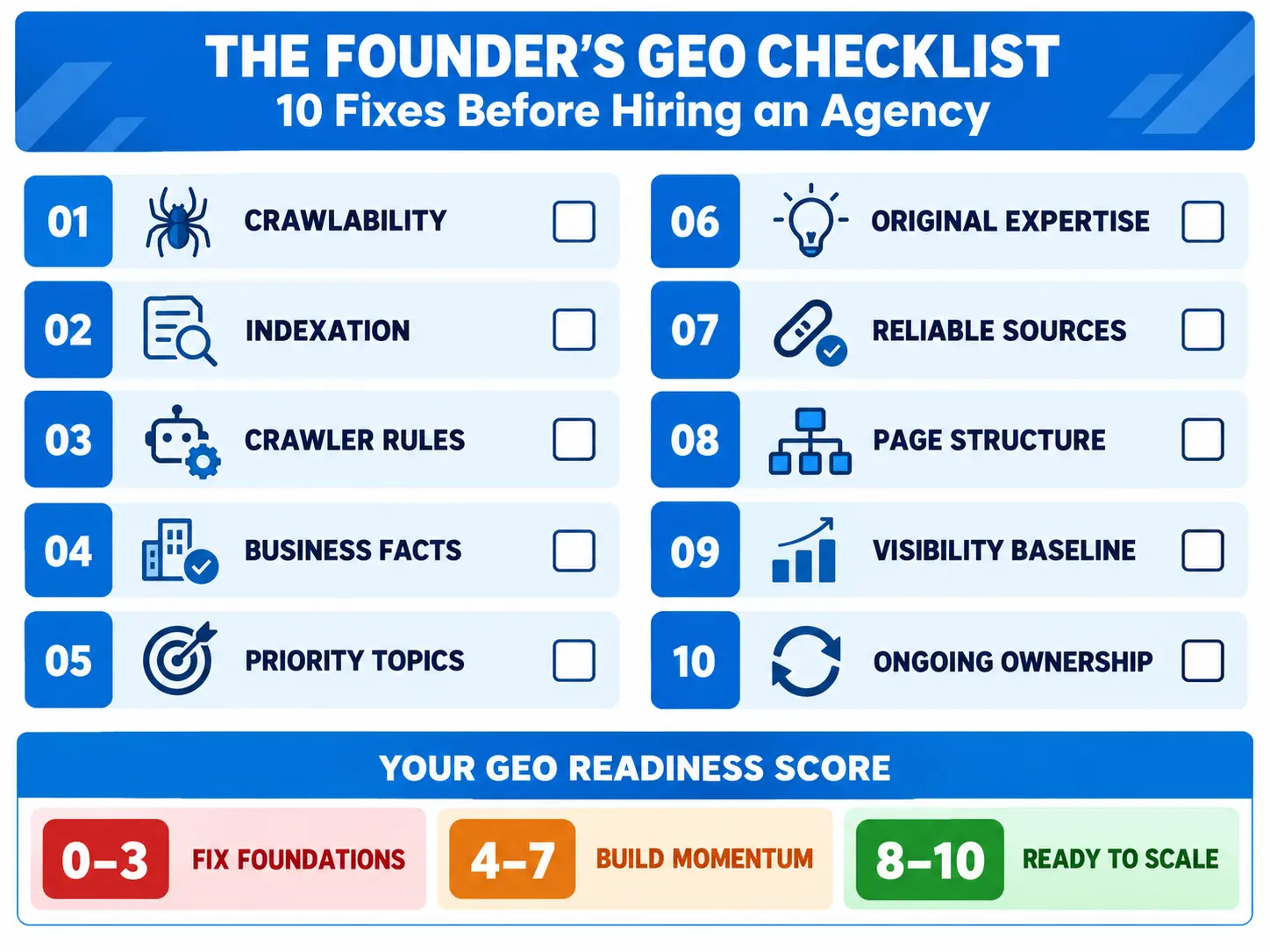
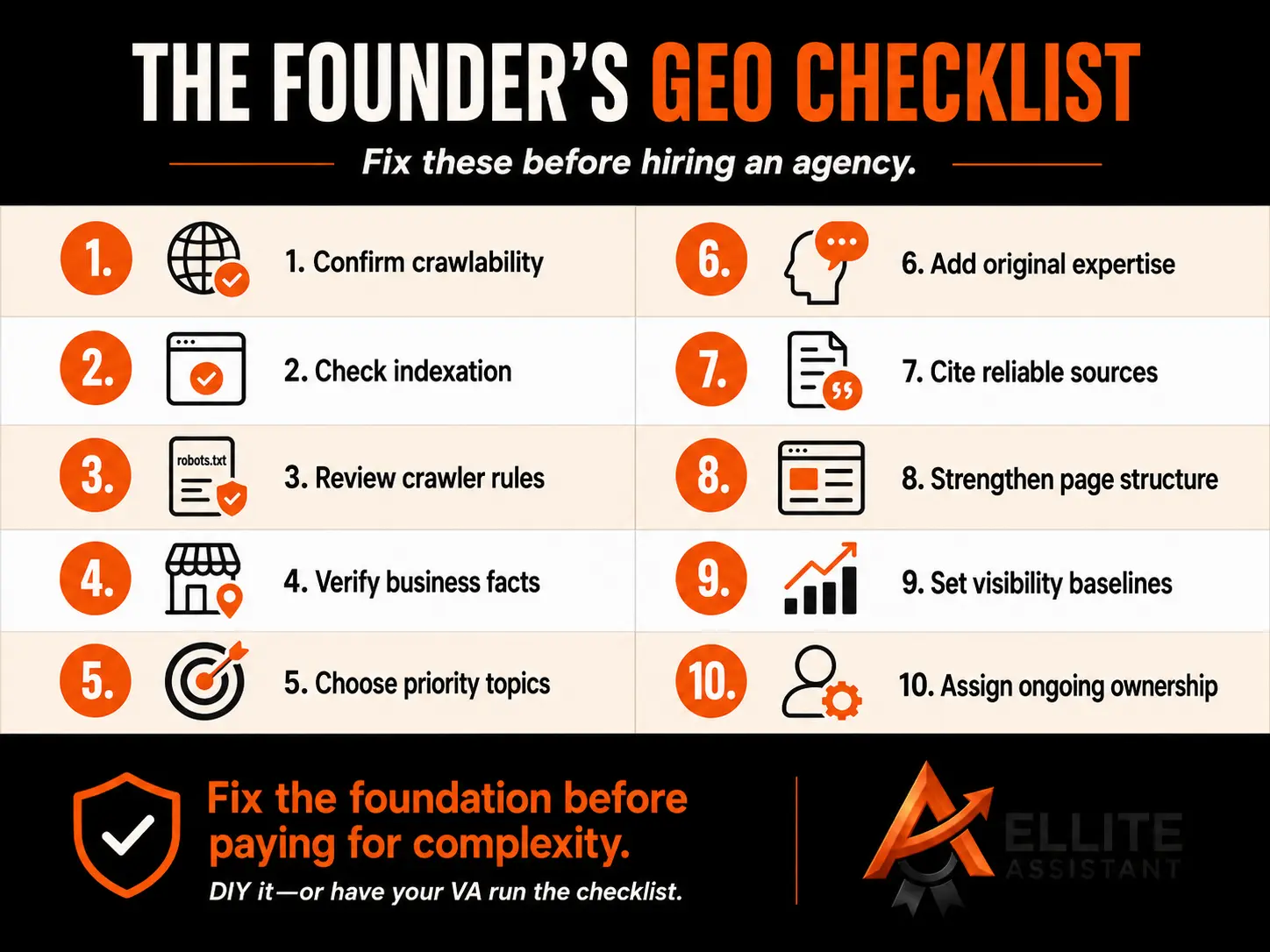
Before hiring a GEO agency, complete 10 foundational fixes: confirm important pages are crawlable, check indexation via Google Search Console, review crawler rules (Googlebot, Bingbot, OAI-SearchBot, GPTBot), verify business facts across all profiles, choose priority topics instead of targeting everything, add original expertise only your business possesses, cite reliable sources and control claims, strengthen page structure for people-first readability, set a 90-day visibility baseline, and assign ongoing ownership to specific individuals. GEO (Generative Engine Optimization) improves visibility in AI-assisted search but relies on core SEO fundamentals—Google states there is no special schema or shortcut that replaces crawlability, indexation and helpful content. Score 0–3: delay agency hiring and fix foundations; 4–7: run a 30-day internal sprint; 8–10: ready to evaluate strategic help. A trained Virtual Assistant can maintain URL inventory, business-fact checks, source logs, question research, CMS publishing, QA and reporting while founders retain strategy and approval. Avoid agencies that guarantee rankings, AI citations or fixed revenue results.
Before you pay a GEO agency, make sure your website is ready to benefit from one.
That does not mean mastering every technical detail yourself. It means fixing—or at least documenting—the basic issues that no strategy, content calendar or "AI visibility" package can compensate for.
Generative Engine Optimization (GEO) is the work of improving how clearly and credibly your business can be discovered, understood and referenced across AI-assisted search experiences. It overlaps heavily with SEO, content operations, digital PR and business-information management. Google's current guidance is especially direct: established SEO foundations still matter for generative search, and there is no special GEO shortcut that replaces crawlability, indexation and useful content.
So the founder's first job is not to buy complexity. It is to remove avoidable uncertainty.
This ten-point checklist will help you decide:
- What you can check yourself
- What a capable Virtual Assistant can document or maintain
- What genuinely needs a developer, SEO specialist or agency
- Whether an agency proposal is solving a real problem or selling a fashionable label
Why do this before speaking to an agency?
An agency can investigate your site, define strategy and implement specialist work. But if you enter the relationship without basic facts, you make three expensive problems more likely.
First, you pay agency rates for inventory work your team could have prepared: collecting URLs, recording business details, listing customer questions, finding old claims and gathering access.
Second, you cannot judge the proposal. If you do not know whether priority pages are indexed, which services matter, where facts conflict or what you currently measure, every recommendation sounds equally technical.
Third, you risk confusing activity with progress. A new schema file, long keyword list or AI-visibility dashboard may look impressive while the site still lacks a clear offer, original expertise or a reliable way to convert interest into an enquiry.
The checklist does not replace an agency. It helps you hire one for the right reasons.
What GEO is—and what it is not
GEO is useful shorthand for improving visibility in generative search and answer experiences. AEO, or Answer Engine Optimization, emphasizes direct answers. SEO emphasizes discovery, understanding and ranking across search results.
For a small business, these are not three separate websites or content strategies. Google says its generative search features are rooted in core search ranking and quality systems. Pages still need to be crawlable, indexed and eligible to appear with a snippet. Helpful, reliable, people-first content remains the foundation.
That means GEO is not:
- A guaranteed route into ChatGPT or AI Overviews
- A special schema type that forces citations
- A requirement to rewrite every page into tiny "AI chunks"
- A reason to publish hundreds of generic AI-generated pages
- A substitute for a useful service page, accurate business information or strong proof
Keep that standard in mind as you work through the ten fixes.
1. Confirm that important pages are crawlable
DIY check: Can a normal visitor and a search crawler reach every page you expect to generate business?
Start with the pages closest to revenue: the homepage, primary service pages, pricing or plan pages, important industry pages, contact page and strongest articles.
Check that they load without a password, login, broken redirect or obvious server error. Make sure important content is present on the mobile page and not hidden behind an interaction that fails. Follow the navigation and internal links as a first-time visitor would.
Then review crawler controls. A robots.txt file tells crawlers which URLs they may access, but Google notes that it is not the correct tool for reliably keeping a page out of its index. A page can also be affected by a noindex directive, canonical setting or other technical condition.
A VA can: build the priority-page list, test links, record response issues, take mobile screenshots and document the current crawler rules.
Escalate when: pages depend heavily on JavaScript, crawler access is unintentionally blocked, redirects loop, server errors appear or important content differs between desktop and mobile.
2. Check indexation instead of assuming it
A live page is not automatically an indexed page.
Use Google Search Console's URL Inspection tool for priority URLs. Record whether each page is indexed, which canonical Google selected, when it was last crawled and whether enhancements or rendering issues appear. Do the equivalent checks in Bing Webmaster Tools where relevant.
Also find your XML sitemap. Many content-management systems generate one automatically. Confirm that it loads, contains the canonical URLs you want indexed and excludes staging pages, duplicate parameters or obsolete redirects. Google describes a sitemap as a helpful discovery signal, not a guarantee of crawling or indexing.
Create a simple indexation sheet:
| URL | Page purpose | Index status | Canonical | Sitemap | Owner | Next action |
|---|---|---|---|---|---|---|
/services/example |
Primary service | Indexed / not indexed | Correct / review | Yes / no | Name | Fix or monitor |
A VA can: maintain this inventory, run approved inspections, compare the sitemap with priority pages and track fixes.
Escalate when: Google selects unexpected canonicals, pages repeatedly drop from the index, large sections are missing or duplicate URL patterns are growing.
3. Review crawler rules—including AI-search choices
"Allow AI" is not one universal switch. Different crawlers serve different purposes, and a business should make informed choices rather than copy a random robots.txt template.
OpenAI documents OAI-SearchBot for surfacing websites in ChatGPT search results. It documents GPTBot separately for potential model-training use. Those controls are independent. A business may make one decision about search visibility and another about training access.
Googlebot and Bingbot still matter because conventional crawling and indexing remain part of AI-assisted search discovery. Blocking an important crawler, CDN range or asset can create visibility problems that no content brief will solve.
Record the decision in plain language:
- Which search crawlers should access the public site?
- Which areas must remain private or excluded?
- Who approved the policy?
- When was the file last reviewed?
- Who may change production crawler rules?
A VA can: capture the current rules, compare them with official documentation and maintain the decision log.
Escalate when: changes affect production infrastructure, security, sensitive data, legal policy or multiple crawler types.
4. Verify every important business fact
Generative visibility is not only a content problem. It is also a source-of-truth problem.
Search your site for your company name, phone numbers, email addresses, service locations, operating hours, prices, plan names, trial terms, guarantees, years in business and key team roles. Compare the information across:
- Homepage and footer
- Contact and About pages
- Service and pricing pages
- Structured data
- Google Business Profile
- Relevant directories and social profiles
- Press or partner pages you control
Conflicting information weakens trust for visitors and creates avoidable ambiguity for systems trying to understand the business.
Build one approved business-information sheet. Mark each field as public, internal or restricted, and assign an owner. Update the source of truth first, then the website and external profiles.
A VA can: audit public facts, flag conflicts, update approved profiles and keep a dated change log.
Escalate when: a change affects contracts, regulated disclosures, legal business identity, taxes, pricing commitments or customer obligations.
5. Choose priority topics instead of "being visible for everything"
An agency cannot create focus on your behalf unless you give it commercial context.
Choose one audience, one service and one business outcome for the first GEO workstream. For example:
- Audience: small US professional-services firms
- Service: customer-support Virtual Assistants
- Problem: owner spending too much time on customer enquiries
- Desired action: request a callback or start a trial
Then collect the real questions people ask before buying:
- What does the service include?
- How much does it cost?
- What access will the assistant need?
- How quickly can support begin?
- How is quality managed?
- What should not be outsourced?
Group those questions into a small set of page opportunities. Do not create a new page for every wording variation. Google's current GEO guidance says there is no need to capture every long-tail phrase or rewrite content solely for AI systems.
A VA can: collect questions from sales calls, emails, support logs and approved research tools; cluster them by intent; prepare a content opportunity list.
The founder retains: audience selection, service priority, positioning and commercial goals.
6. Add original expertise that an agency cannot invent
The strongest reason to delay an agency engagement is simple: you have not yet extracted the knowledge only your business possesses.
Generic content is easy to produce and easy to ignore. Useful original material can include:
- A process you have refined through real projects
- Common mistakes customers make before hiring you
- Trade-offs your sales team explains repeatedly
- Anonymous patterns from support or operations
- A first-hand comparison with clear criteria
- Original data your business is allowed to publish
- A checklist based on actual delivery experience
- A qualified opinion that explains when your service is not the right fit
Schedule a 30-minute founder or subject-matter interview. Record the questions, transcribe the answers and separate publishable material from confidential information. Turn the approved insights into a source pack before drafting.
Google's people-first guidance emphasizes first-hand expertise and content that provides substantial value. A large volume of AI-assisted text without added value may create policy and quality risks.

A VA can: prepare interview questions, take notes, organize approved examples and turn them into a brief.
The founder retains: the truth, nuance and permission to publish.
7. Cite reliable sources and control your claims
If a page contains a statistic, platform requirement or significant factual claim, a reader should be able to understand where it came from.
Prefer primary sources: official platform documentation, government data, standards bodies, original research or your own clearly explained data. Record the publication date, the exact claim supported and the date you reviewed it.
Create a claim log with four categories:
- Fact: externally verifiable statement with a source
- Internal evidence: approved company data or documented experience
- Opinion: clearly attributed professional judgment
- Example: illustrative scenario that is not presented as a measured result
This prevents a common failure: a citation near a paragraph that does not actually support the sentence being claimed.
A VA can: maintain the source and claim logs, check links, flag expired data and prepare citations.
The business retains: approval for performance, financial, legal, health, safety, privacy and comparative claims.
8. Strengthen page structure for people first
Good structure helps visitors scan, compare and act. It also helps search systems understand the relationship between sections without requiring a special "AI format."
For each priority page, check:
- One clear title and H1
- A direct opening that answers the page's main question
- Logical H2 and H3 sections
- Descriptive internal links to relevant supporting pages
- Source links where facts require them
- Useful tables, checklists or examples when appropriate
- Relevant images with descriptive filenames and alt text
- Accurate title tag and meta description
- Clear author, reviewer or business ownership
- A next step that matches the reader's intent
- Mobile readability and working forms
Google says you do not need to "chunk" content into tiny pieces for generative search. Page length and section size should serve the reader. Structured data can support established search features when it accurately describes visible content, but there is no special schema that guarantees inclusion in generative answers.

A VA can: apply approved formatting, upload content, add links and images, run the publishing checklist and record changes.
Escalate when: templates, rendering, site-wide schema, canonicals, redirects or production code need modification.
9. Set a visibility baseline before anyone claims improvement
You cannot evaluate an agency—or your own work—without a starting point.
Record the last 90 days where possible:
- Search impressions and clicks for priority pages
- Search queries and countries relevant to the offer
- Indexed priority URLs
- Organic enquiries, booked meetings and trial starts
- Referral visits from AI and search platforms
- Pages cited in Bing's AI Performance report, when available
- Grounding-query samples reported by supported tools
- Branded versus non-branded discovery
Bing's 2026 AI Performance reporting can show citations, cited pages and sampled grounding queries across supported Microsoft AI experiences. Bing also explains that citation counts do not reveal placement, authority or the importance of a page in an individual answer.
Google's current guide points site owners to Search Console's Generative AI performance reporting for supported visibility data. Use first-party data where available, and treat third-party prompt trackers as directional—not as a private view into an AI system's ranking logic.
Connect visibility to business outcomes. A citation that produces no relevant visit or enquiry may be less valuable than a conventional result that generates qualified conversations.
A VA can: update the baseline dashboard, annotate content changes and prepare monthly reports.
The founder or strategist retains: interpretation, budget decisions and success criteria.
10. Assign ongoing ownership
GEO fails quietly when everyone assumes someone else is maintaining it.
Assign a name—not merely a department—to each recurring responsibility:
| Responsibility | Suggested owner | Frequency |
|---|---|---|
| Business-fact audit | VA + business approver | Monthly |
| Priority-page index check | VA | Monthly |
| Crawler-policy review | Technical owner | Quarterly or after policy change |
| Customer-question collection | VA + sales/support | Ongoing |
| Expert interview | Founder or subject expert | Monthly |
| Source and claim review | VA + approver | Before publication and on refresh |
| Publishing QA | VA | Every publication |
| Visibility and conversion report | VA + strategist | Monthly |
| Strategy and budget decision | Founder or marketing lead | Quarterly |
The owner does not need to perform every task. Ownership means ensuring that the task happens, standards are followed and problems are escalated.
This is where a VA can create disproportionate value: running the repeatable checklist while the founder retains the decisions only the founder can make.
Score your agency readiness
Give yourself one point for each completed checklist item.
0–3: Do not hire for a large GEO program yet
Your first need is foundation work. Fix access, business facts, priority pages and basic measurement. A VA, webmaster or targeted technical specialist may be more appropriate than a broad agency retainer.
4–7: Run a focused internal sprint
You have enough structure to improve, but an agency discovery phase may still spend heavily on missing inputs. Use a 30-day sprint to complete the remaining checklist and document what requires specialist support.
8–10: You are ready to evaluate strategic help
You can explain the audience, priority pages, current state, evidence and measurement. Agency proposals can now be compared against specific problems and outcomes.
When hiring an agency actually makes sense
An agency or specialist can be the right next step when you face:
- Complex crawling, rendering or indexation problems
- A large multilingual, marketplace or ecommerce site
- A migration or major information-architecture change
- Site-wide structured-data or template implementation
- Competitive digital PR and authority-building work
- Significant reputation or misinformation problems
- A need for advanced research, experimentation and strategy
- An internal team that has execution capacity but lacks senior direction
Hire for a defined gap. "We need GEO" is not a defined gap. "Our priority service pages are indexed, but they lack original evidence and we need a six-month expert-content and distribution strategy" is.
Questions to ask a GEO agency
Use these questions to separate process from promises:
- Which parts of your approach are standard SEO foundations, and which are specific to AI-assisted search?
- What will you change in the first 30 days?
- Which recommendations are based on official platform guidance?
- How will you use our first-hand expertise?
- Who approves factual and commercial claims?
- How do you measure citations without confusing them with revenue?
- What access do you require, and how is it controlled?
- Which tasks can our VA or internal team operate after setup?
- What outcomes do you refuse to guarantee?
- How will we retain our data, content and process if the engagement ends?
A credible provider should be comfortable explaining limits. No agency controls whether a generative system selects or cites a specific page.
A 30-day DIY-first GEO sprint
Week 1: technical eligibility
- List priority pages
- Check crawlability and mobile access
- Inspect indexation and canonicals
- Review sitemaps and crawler policies
- Document technical escalation items
Week 2: business clarity
- Create the approved business-fact sheet
- Choose one audience and service
- Collect real customer questions
- Identify the three most important page gaps
Week 3: expertise and publishing
- Interview the founder or subject expert
- Create the source and claim log
- Refresh one priority service page
- Publish one evidence-led supporting article
- Run mobile and link QA
Week 4: measurement and ownership
- Record the visibility baseline
- Assign recurring owners and review dates
- Separate tasks for the VA, developer, founder and specialist
- Write the agency brief only for unresolved strategic or technical work
At the end of the month, you should know whether you need a broad agency, a narrow specialist engagement or simply consistent internal execution.
Or have your VA run the checklist
DIY-first does not mean founder-does-everything.
A trained Virtual Assistant can maintain the page inventory, check approved dashboards, organize customer questions, prepare expert interviews, manage source logs, format content, run publishing QA and update the monthly report.
The founder still approves positioning, expertise, offers and significant claims. Developers and specialists handle high-risk technical changes. The VA keeps the operating system moving.
That is a helpful middle path between two extremes: buying an agency retainer too early and letting essential work remain permanently "on the list."
Frequently asked questions
What should I fix first for GEO?
Start with crawlability, indexation and accurate business information. There is little value in optimizing a page for generative discovery if crawlers cannot access it, it is not indexed or its core facts conflict with other pages.
Do I need an agency to appear in AI search results?
No. Many fundamentals can be handled internally: technical eligibility checks, expert-led content, clear page structure, source hygiene and measurement. An agency becomes useful when the site or competitive problem requires specialist strategy and implementation.
Does Google require special GEO schema?
No. Google says there is no special schema requirement for its generative search features. Use structured data when it accurately describes visible content and supports established search features.
Should I create llms.txt before hiring an agency?
Do not treat it as a universal GEO requirement. Google says it does not use llms.txt for visibility in its generative search features. Other platforms may publish their own guidance, so decisions should be platform-specific.
Can a Virtual Assistant complete this GEO checklist?
A VA can own much of the documentation and recurring execution: URL inventory, business-fact checks, source logs, question research, CMS publishing, QA and reporting. Technical changes, strategy and sensitive claims still need the appropriate approver.
How long should I test DIY GEO improvements?
Use 30 days to complete the foundation and test the workflow. Search visibility, citations and conversions may require longer observation. Do not judge the work on a handful of prompts immediately after publication.
What should a GEO agency never guarantee?
An agency should not guarantee rankings, AI citations, inclusion in a specific answer or a fixed revenue result. It can commit to research, implementation quality, reporting and a documented strategy.
Fix the foundation, then buy the expertise you actually need
The goal of this checklist is not to discourage you from hiring an agency. It is to stop you from paying for uncertainty you can remove first.
Fix the basics. Record the evidence. Create a baseline. Decide who owns the recurring work. Then, if you need specialist help, you will be able to brief it properly and measure whether it helped.
If you want the checklist completed without keeping every task on your own desk, Ellite Assistant can support the research, documentation, source management, CMS publishing, QA and reporting—while you retain strategy and approval.
Sources
- Google Search Central: Optimizing your website for generative AI features
- Google Search Central: AI features and your website
- Google Search Central: Creating helpful, reliable, people-first content
- Google Search Central: Introduction to robots.txt
- Google Search Central: Build and submit a sitemap
- Google Search Central: SEO link best practices
- Bing Webmaster Blog: AI Performance in Bing Webmaster Tools
- OpenAI: Overview of OpenAI crawlers
Public guidance, cited sources and Ellite Assistant pricing were checked on September 15, 2026. Platform features, crawler policies, search algorithms and service terms can change. This article provides general business information, not SEO, legal, technical or financial advice. Obtain advice from qualified professionals for your situation.
What should I fix before hiring a GEO agency?
- How much does a GEO agency cost?
- What is the difference between SEO and GEO?
- Can I do GEO without an agency?
- How long does GEO take to show results?
- What tools are needed for Generative Engine Optimization?
- Is GEO worth it for small businesses?
- Should I create llms.txt for AI search?
- What is Answer Engine Optimization (AEO)?
- How do I measure GEO success?
- Can a virtual assistant help with GEO tasks?
- What are AI crawlers and how do they work?
- Do I need special schema for AI search?
- How does Bing AI Performance reporting work?
- What content works best for AI-generated answers?
- Should I block AI crawlers from my site?